
Meizu 18 vs Samsung Galaxy S23: A Deep Dive into Compact Android Power
| Phones Images | |||||
|---|---|---|---|---|---|
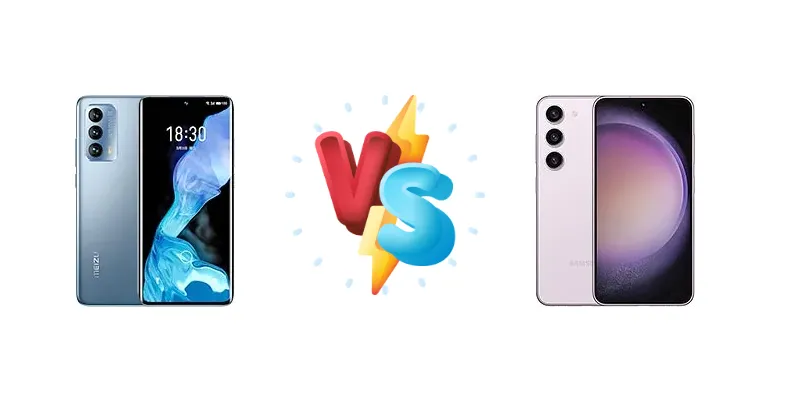
|
🏆 Quick Verdict
For most users, the Samsung Galaxy S23 is the superior choice. While the Meizu 18 offers a compelling package, the Snapdragon 8 Gen 2's efficiency and Samsung's optimized software deliver significantly better battery life and sustained performance, justifying the price difference. However, the Meizu 18 remains a viable option for budget-conscious users prioritizing a compact form factor.
| PHONES | ||
|---|---|---|
| Phone Names | Meizu 18 | Samsung Galaxy S23 |
| Network | ||
|---|---|---|
| 2G bands | GSM 850 / 900 / 1800 / 1900 | GSM 850 / 900 / 1800 / 1900 |
| 3G bands | HSDPA 850 / 900 / 1900 / 2100 | HSDPA 850 / 900 / 1700(AWS) / 1900 / 2100 |
| 4G bands | 1, 3, 4, 5, 7, 8, 34, 38, 39, 40, 41 | 1, 2, 3, 4, 5, 7, 8, 12, 13, 17, 18, 19, 20, 25, 26, 28, 32, 38, 39, 40, 41, 66 - International |
| 5G bands | 1, 3, 41, 77, 78, 79 SA/NSA | 1, 2, 3, 5, 7, 8, 12, 20, 25, 28, 38, 40, 41, 66, 75, 77, 78 SA/NSA/Sub6 - International |
| Speed | HSPA, LTE, 5G | HSPA, LTE (up to 7CA), 5G |
| Technology | GSM / HSPA / LTE / 5G | GSM / CDMA / HSPA / EVDO / LTE / 5G |
| - | 1, 7, 25, 28, 41, 66, 71, 78, 258, 260, 261 SA/NSA/Sub6/mmWave - USA | |
| Launch | ||
|---|---|---|
| Announced | 2021, March 03. Released 2021, March 08 | 2023, February 01 |
| Status | Discontinued | Available. Released 2023, February 17 |
| Body | ||
|---|---|---|
| Build | - | Glass front (Gorilla Glass Victus 2), glass back (Gorilla Glass Victus 2), aluminum frame |
| Dimensions | 152.4 x 69.2 x 8.2 mm (6.00 x 2.72 x 0.32 in) | 146.3 x 70.9 x 7.6 mm (5.76 x 2.79 x 0.30 in) |
| SIM | Nano-SIM + Nano-SIM | · Nano-SIM + eSIM· Nano-SIM + Nano-SIM + eSIM (max 2 at a time) |
| Weight | 162 g (5.71 oz) | 168 g (5.93 oz) |
| - | IP68 dust/water resistant (up to 1.5m for 30 min) Armor aluminum frame with tougher drop and scratch resistance (advertised) | |
| Display | ||
|---|---|---|
| Protection | - | Corning Gorilla Glass Victus 2 |
| Resolution | 1440 x 3200 pixels, 20:9 ratio (~563 ppi density) | 1080 x 2340 pixels, 19.5:9 ratio (~425 ppi density) |
| Size | 6.2 inches, 93.8 cm2 (~88.9% screen-to-body ratio) | 6.1 inches, 90.1 cm2 (~86.8% screen-to-body ratio) |
| Type | Super AMOLED, 120Hz, HDR10+, 420 nits (typ), 1300 nits (peak) | Dynamic AMOLED 2X, 120Hz, HDR10+, 1200 nits (HBM), 1750 nits (peak) |
| - | Always-on display | |
| Platform | ||
|---|---|---|
| CPU | Octa-core (1x2.84 GHz Cortex-X1 & 3x2.42 GHz Cortex-A78 & 4x1.80 GHz Cortex-A55) | Octa-core (1x3.36 GHz Cortex-X3 & 2x2.8 GHz Cortex-A715 & 2x2.8 GHz Cortex-A710 & 3x2.0 GHz Cortex-A510) |
| Chipset | Qualcomm SM8350 Snapdragon 888 5G (5 nm) | Qualcomm SM8550-AC Snapdragon 8 Gen 2 (4 nm) |
| GPU | Adreno 660 | Adreno 740 |
| OS | Android 11, Flyme 9 | Android 13, up to 4 major Android upgrades, One UI 8 |
| Memory | ||
|---|---|---|
| Card slot | No | No |
| Internal | 128GB 8GB RAM, 256GB 8GB RAM, 256GB 12GB RAM | 128GB 8GB RAM, 256GB 8GB RAM, 512GB 8GB RAM |
| UFS 3.1 | UFS 3.1 - 128GB only UFS 4.0 | |
| Main Camera | ||
|---|---|---|
| Features | Dual-LED dual-tone flash, HDR, panorama | LED flash, auto-HDR, panorama |
| Single | - | 12 MP, f/2.2, 26mm (wide), Dual Pixel PDAF |
| Triple | 64 MP, f/1.6, 26mm (wide), 1/1.73", 0.8µm, PDAF, OIS 8 MP f/2.4, 79mm (telephoto), 1/4.4", 1.0µm, PDAF, 3x optical zoom 16 MP, f/2.2, 15mm, 122˚ (ultrawide), 1/3.0", 1.0µm | 50 MP, f/1.8, 24mm (wide), 1/1.56", 1.0µm, dual pixel PDAF, OIS 10 MP, f/2.4, 70mm (telephoto), 1/3.94", 1.0µm, PDAF, OIS, 3x optical zoom 12 MP, f/2.2, 13mm, 120˚ (ultrawide), 1/2.55" 1.4µm, Super Steady video |
| Video | 4K@30/60fps, 1080p; gyro-EIS | 8K@24/30fps, 4K@30/60fps, 1080p@30/60/120/240fps, HDR10+, stereo sound rec., gyro-EIS |
| Selfie camera | ||
|---|---|---|
| Features | HDR | HDR, HDR10+ |
| Single | 20 MP, f/2.2, 26mm (wide), 1/3.4", 0.8µm | 12 MP, f/2.2, 26mm (wide), 1/3.2", 1.12µm, dual pixel PDAF |
| Video | 1080p@30fps | 4K@30/60fps, 1080p@30fps |
| Sound | ||
|---|---|---|
| 3.5mm jack | No | No |
| 35mm jack | No | No |
| Loudspeaker | Yes, with stereo speakers | Yes, with stereo speakers |
| - | 32-bit/384kHz audio Tuned by AKG | |
| Comms | ||
|---|---|---|
| Bluetooth | 5.2, A2DP, LE | 5.3, A2DP, LE |
| NFC | Yes | Yes |
| Positioning | GPS (L1+L5), GLONASS, BDS, GALILEO, QZSS, NavIC | GPS, GLONASS, BDS, GALILEO |
| Radio | No | No |
| USB | USB Type-C | USB Type-C 3.2, OTG |
| WLAN | Wi-Fi 802.11 а/b/g/n/ac/6e, dual-band, Wi-Fi Direct | Wi-Fi 802.11 a/b/g/n/ac/6e, tri-band, Wi-Fi Direct |
| Features | ||
|---|---|---|
| Sensors | Fingerprint (under display, ultrasonic), accelerometer, gyro, proximity, compass | Fingerprint (under display, ultrasonic), accelerometer, gyro, proximity, compass, barometer |
| - | Samsung DeX, Samsung Wireless DeX (desktop experience support) Bixby natural language commands and dictation Samsung Pay (Visa, MasterCard certified) | |
| Battery | ||
|---|---|---|
| Charging | 36W wired, PD3.0, QC3, 40% in 15 min, 100% in 50 min | 25W wired, PD3.0, 50% in 30 min 15W wireless (Qi) 4.5W reverse wireless |
| Type | Li-Po 4000 mAh | Li-Ion 3900 mAh |
| Misc | ||
|---|---|---|
| Colors | Light Blue, White, Aurora | Phantom Black, Cream, Green, Lavender, Graphite, Lime |
| Models | - | SM-S911B, SM-S911B/DS, SM-S911U, SM-S911U1, SM-S911W, SM-S911N, SM-S9110, SM-S911E, SM-S911E/DS |
| Price | About 560 EUR | $ 237.95 / C$ 336.75 / £ 255.00 / € 322.41 / ₹ 49,990 |
| SAR | - | 0.95 W/kg (head) 0.88 W/kg (body) |
| SAR EU | - | 0.96 W/kg (head) 1.30 W/kg (body) |
| Tests | ||
|---|---|---|
| Battery life | - | Endurance rating 101h |
| Camera | - | Photo / Video |
| Display | - | Contrast ratio: Infinite (nominal) |
| Loudspeaker | - | -27.0 LUFS (Good) |
| Performance | - | AnTuTu: 1231075 (v9) GeekBench: 4950 (v5.1) GFXBench: 110fps (ES 3.1 onscreen) |
Meizu 18
- More compact size for one-handed use
- Potentially lower price point
- 36W faster wired charging
- Older Snapdragon 888 chipset
- Less efficient battery life
- Potentially less software support
Samsung Galaxy S23
- Significantly more powerful Snapdragon 8 Gen 2
- Superior battery life and efficiency
- Long-term software support from Samsung
- Higher price
- Slightly larger size
- Slower wired charging (25W)
Display Comparison
The Samsung Galaxy S23 boasts a significantly brighter display, reaching a measured 1198 nits, compared to an unspecified peak brightness for the Meizu 18. While both likely utilize high-quality OLED panels, the S23’s higher brightness translates to better visibility in direct sunlight. Samsung’s ‘Infinite’ contrast ratio suggests excellent black levels, typical of OLED technology. The S23’s display benefits from a likely higher refresh rate and potentially LTPO technology for variable refresh rates, conserving battery life – a feature not explicitly stated for the Meizu 18. This makes the S23 the better choice for media consumption and outdoor use.
Camera Comparison
Both devices are listed as having 'Photo / Video' capabilities, lacking specific details. However, Samsung typically excels in camera software processing and image quality. The S23 likely features a larger main sensor and more advanced image stabilization (OIS) than the Meizu 18. While the Meizu 18 may offer a respectable camera experience, Samsung’s computational photography algorithms and wider range of features (like advanced video modes) give the S23 a clear advantage. The absence of sensor details for the Meizu 18 makes a precise comparison impossible, but Samsung’s track record suggests superior image quality.
Performance
The core difference lies in the chipsets. The Meizu 18 utilizes the Qualcomm Snapdragon 888 (5nm), while the Galaxy S23 features the Snapdragon 8 Gen 2 (4nm). This generational leap is crucial. The 4nm process of the Gen 2 offers superior power efficiency and thermal performance. The S23’s CPU configuration – Cortex-X3, A715, and A710 cores – represents a significant architectural upgrade over the 888’s X1, A78, and A55 cores, resulting in faster processing speeds and improved multi-tasking. While both phones likely feature LPDDR5 RAM, the S23’s more efficient chipset allows it to sustain peak performance for longer periods without throttling, benefiting gamers and power users.
Battery Life
The Galaxy S23’s endurance rating of 101 hours and active use score of 11:27h demonstrates superior battery life compared to the Meizu 18, for which battery data is unavailable. While the Meizu 18 supports faster wired charging at 36W, the S23’s 25W charging, combined with its more efficient chipset, likely results in comparable real-world charging times. The S23 also adds the convenience of 15W wireless charging and 4.5W reverse wireless charging, features absent on the Meizu 18. The S23’s efficiency is the key factor here, allowing it to extract more usage from its battery capacity.
Buying Guide
Buy the Meizu 18 if you prioritize a smaller, more affordable flagship experience and are comfortable with a potentially less polished software experience. It's ideal for users who value one-handed usability above all else. Buy the Samsung Galaxy S23 if you demand the best possible performance, long-term software support, and a refined user experience, even if it means paying a premium and accepting a slightly larger device.