
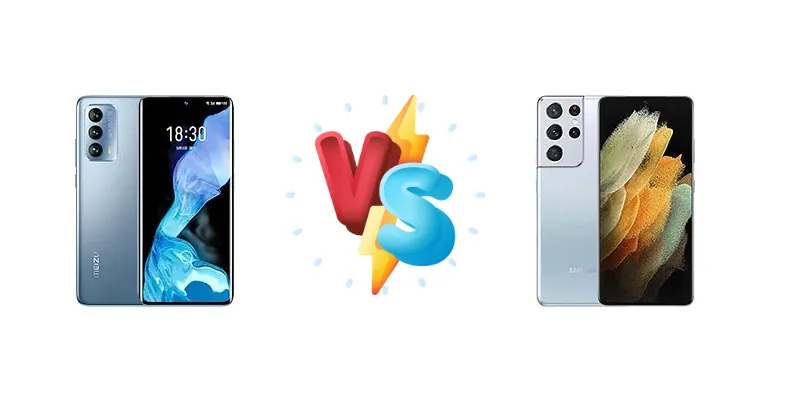
Meizu 18 vs. Samsung Galaxy S21 Ultra 5G: A Detailed Comparison
| Phones Images | |||||
|---|---|---|---|---|---|
|
🏆 Quick Verdict
For most users, the Samsung Galaxy S21 Ultra 5G offers a more compelling package. Its superior display brightness, versatile camera system, and wider availability outweigh the Meizu 18’s compact size and potentially faster charging. However, users prioritizing a smaller phone and a cleaner software experience may find the Meizu 18 a better fit.
| PHONES | ||
|---|---|---|
| Phone Names | Meizu 18 | Samsung Galaxy S21 Ultra 5G |
| Network | ||
|---|---|---|
| 2G bands | GSM 850 / 900 / 1800 / 1900 | GSM 850 / 900 / 1800 / 1900 |
| 3G bands | HSDPA 850 / 900 / 1900 / 2100 | HSDPA 850 / 900 / 1700(AWS) / 1900 / 2100 |
| 4G bands | 1, 3, 4, 5, 7, 8, 34, 38, 39, 40, 41 | 1, 2, 3, 4, 5, 7, 8, 12, 13, 14, 18, 19, 20, 25, 26, 28, 30, 38, 39, 40, 41, 46, 48, 66, 71 - SM-G998U1 |
| 5G bands | 1, 3, 41, 77, 78, 79 SA/NSA | 2, 5, 25, 41, 66, 71, 260, 261 SA/NSA/Sub6/mmWave - SM-G998U1 |
| Speed | HSPA, LTE, 5G | HSPA 42.2/5.76 Mbps, LTE (7CA) Cat20 2000/200 Mbps, 5G (5+ Gbps DL) |
| Technology | GSM / HSPA / LTE / 5G | GSM / CDMA / HSPA / EVDO / LTE / 5G |
| - | 1, 3, 5, 7, 8, 20, 28, 38, 40, 41, 66, 77, 78 SA/NSA/Sub6 - SM-G998B | |
| Launch | ||
|---|---|---|
| Announced | 2021, March 03. Released 2021, March 08 | 2021, January 14 |
| Status | Discontinued | Available. Released 2021, January 29 |
| Body | ||
|---|---|---|
| Build | - | Glass front (Gorilla Glass Victus), glass back (Gorilla Glass Victus), aluminum frame |
| Dimensions | 152.4 x 69.2 x 8.2 mm (6.00 x 2.72 x 0.32 in) | 165.1 x 75.6 x 8.9 mm (6.5 x 2.98 x 0.35 in) |
| SIM | Nano-SIM + Nano-SIM | · Nano-SIM + eSIM· Nano-SIM + Nano-SIM + eSIM (max 2 at a time) |
| Weight | 162 g (5.71 oz) | 227 g (Sub6), 229 g (mmWave) (8.01 oz) |
| - | IP68 dust/water resistant (up to 1.5m for 30 min) Stylus support | |
| Display | ||
|---|---|---|
| Protection | - | Corning Gorilla Glass Victus |
| Resolution | 1440 x 3200 pixels, 20:9 ratio (~563 ppi density) | 1440 x 3200 pixels, 20:9 ratio (~515 ppi density) |
| Size | 6.2 inches, 93.8 cm2 (~88.9% screen-to-body ratio) | 6.8 inches, 112.1 cm2 (~89.8% screen-to-body ratio) |
| Type | Super AMOLED, 120Hz, HDR10+, 420 nits (typ), 1300 nits (peak) | Dynamic AMOLED 2X, 120Hz, HDR10+, 1500 nits (peak) |
| - | Always-on display | |
| Platform | ||
|---|---|---|
| CPU | Octa-core (1x2.84 GHz Cortex-X1 & 3x2.42 GHz Cortex-A78 & 4x1.80 GHz Cortex-A55) | Octa-core (1x2.9 GHz Cortex-X1 & 3x2.80 GHz Cortex-A78 & 4x2.2 GHz Cortex-A55) - InternationalOcta-core (1x2.84 GHz Cortex-X1 & 3x2.42 GHz Cortex-A78 & 4x1.80 GHz Cortex-A55) - USA/China |
| Chipset | Qualcomm SM8350 Snapdragon 888 5G (5 nm) | Exynos 2100 (5 nm) - InternationalQualcomm SM8350 Snapdragon 888 5G (5 nm) - USA/China |
| GPU | Adreno 660 | Mali-G78 MP14 - InternationalAdreno 660 - USA/China |
| OS | Android 11, Flyme 9 | Android 11, up to 4 major Android upgrades, One UI 6.1 |
| Memory | ||
|---|---|---|
| Card slot | No | No |
| Internal | 128GB 8GB RAM, 256GB 8GB RAM, 256GB 12GB RAM | 128GB 8GB RAM, 128GB 12GB RAM, 256GB 12GB RAM, 256GB 16GB RAM, 512GB 12GB RAM, 512GB 16GB RAM |
| UFS 3.1 | UFS 3.1 | |
| Main Camera | ||
|---|---|---|
| Features | Dual-LED dual-tone flash, HDR, panorama | Laser AF, LED flash, auto-HDR, panorama |
| Quad | - | 108 MP, f/1.8, 24mm (wide), 1/1.33", 0.8µm, PDAF, OIS 10 MP, f/2.4, 72mm (telephoto), 1/3.24", 1.22µm, dual pixel PDAF, OIS, 3x optical zoom 10 MP, f/4.9, 240mm (periscope telephoto), 1/3.24", 1.22µm, dual pixel PDAF, OIS, 10x optical zoom 12 MP, f/2.2, 13mm (ultrawide), 1/2.55", 1.4µm, dual pixel PDAF, Super Steady video |
| Triple | 64 MP, f/1.6, 26mm (wide), 1/1.73", 0.8µm, PDAF, OIS 8 MP f/2.4, 79mm (telephoto), 1/4.4", 1.0µm, PDAF, 3x optical zoom 16 MP, f/2.2, 15mm, 122˚ (ultrawide), 1/3.0", 1.0µm | - |
| Video | 4K@30/60fps, 1080p; gyro-EIS | 8K@24fps, 4K@30/60fps, 1080p@30/60/120/240fps, HDR10+, stereo sound rec., gyro-EIS |
| Selfie camera | ||
|---|---|---|
| Features | HDR | HDR |
| Single | 20 MP, f/2.2, 26mm (wide), 1/3.4", 0.8µm | 40 MP, f/2.2, 26mm (wide), 1/2.8", 0.7µm, PDAF |
| Video | 1080p@30fps | 4K@30/60fps, 1080p@30fps |
| Sound | ||
|---|---|---|
| 3.5mm jack | No | No |
| 35mm jack | No | No |
| Loudspeaker | Yes, with stereo speakers | Yes, with stereo speakers |
| - | 32-bit/384kHz audio Tuned by AKG | |
| Comms | ||
|---|---|---|
| Bluetooth | 5.2, A2DP, LE | 5.2, A2DP, LE |
| NFC | Yes | Yes |
| Positioning | GPS (L1+L5), GLONASS, BDS, GALILEO, QZSS, NavIC | GPS, GLONASS, BDS, GALILEO |
| Radio | No | FM radio (Snapdragon model only; market/operator dependent) |
| USB | USB Type-C | USB Type-C 3.2, OTG |
| WLAN | Wi-Fi 802.11 а/b/g/n/ac/6e, dual-band, Wi-Fi Direct | Wi-Fi 802.11 a/b/g/n/ac/6e, dual-band, Wi-Fi Direct |
| Features | ||
|---|---|---|
| Sensors | Fingerprint (under display, ultrasonic), accelerometer, gyro, proximity, compass | Fingerprint (under display, ultrasonic), accelerometer, gyro, proximity, compass, barometer |
| - | Samsung DeX, Samsung Wireless DeX (desktop experience support) Bixby natural language commands and dictation Samsung Pay (Visa, MasterCard certified) Ultra Wideband (UWB) support | |
| Battery | ||
|---|---|---|
| Charging | 36W wired, PD3.0, QC3, 40% in 15 min, 100% in 50 min | 25W wired, PD3.0 15W wireless (Qi) 4.5W reverse wireless |
| Type | Li-Po 4000 mAh | Li-Ion 5000 mAh |
| Misc | ||
|---|---|---|
| Colors | Light Blue, White, Aurora | Phantom Black, Phantom Silver, Phantom Titanium, Phantom Navy, Phantom Brown, Navy |
| Models | - | SM-G998B, SM-G998B/DS, SM-G998U, SM-G998U1, SM-G998W, SM-G998N, SM-G9980 |
| Price | About 560 EUR | $ 240.01 / C$ 353.20 / £ 202.99 / € 264.99 |
| SAR | - | 0.77 W/kg (head) 1.02 W/kg (body) |
| SAR EU | - | 0.71 W/kg (head) 1.58 W/kg (body) |
| Pricing | ||
|---|---|---|
| 128GB 12GB RAM | - | $ 384.99 |
| 256GB 12GB RAM | - | $ 998.00 |
| 512GB 12GB RAM | - | $ 1,179.99 |
| RENEWED | - | $ 459.00 |
| Tests | ||
|---|---|---|
| Battery life | - | Endurance rating 114h |
| Camera | - | Photo / Video |
| Display | - | Contrast ratio: Infinite (nominal) |
| Loudspeaker | - | -25.5 LUFS (Very good) |
| Performance | - | AnTuTu: 657150 (v8) GeekBench: 3518 (v5.1) GFXBench: 33fps (ES 3.1 onscreen) |
Meizu 18
- Compact and pocketable design
- Faster 36W wired charging
- Potentially cleaner software experience
- Limited camera information
- Less readily available internationally
Samsung Galaxy S21 Ultra 5G
- Brighter and larger display
- Versatile camera system
- Wider availability and price range
- Larger and heavier form factor
- Slower 25W wired charging
- Potential for Exynos throttling (International models)
Display Comparison
The Samsung Galaxy S21 Ultra boasts a significantly brighter display, reaching a measured 1023 nits, compared to the Meizu 18’s unspecified peak brightness. This difference is crucial for outdoor visibility. While both likely utilize AMOLED technology, the S21 Ultra’s larger size and higher peak brightness provide a more immersive viewing experience. The S21 Ultra’s ‘Infinite’ contrast ratio (nominal) suggests a superior black level performance, enhancing dynamic range. The Meizu 18’s display specs are less detailed, making a direct comparison of color accuracy and other parameters difficult.
Camera Comparison
The S21 Ultra’s camera system is far more comprehensive, though specifics beyond 'Photo / Video' are missing. It’s reasonable to assume a multi-lens setup with a high-resolution main sensor and advanced features like Space Zoom. The Meizu 18’s camera details are entirely absent, making a direct comparison impossible. Given Meizu’s history, it likely focuses on image quality over sheer feature count. The S21 Ultra’s OIS (Optical Image Stabilization) is a significant advantage for video recording and low-light photography, a feature likely present but unconfirmed on the Meizu 18.
Performance
Both phones utilize the Qualcomm Snapdragon 888 5G chipset in certain regions (USA/China for both). However, the international S21 Ultra uses the Exynos 2100. While both are 5nm chips, the S21 Ultra’s Cortex-X1 core clocks slightly higher at 2.9 GHz versus the Meizu 18’s 2.84 GHz. The S21 Ultra’s 12GB RAM options are more readily available and at varying price points ($384.99 - $1,179.99), while the Meizu 18’s RAM configuration is not specified in the provided data. The Exynos 2100 has historically faced thermal throttling concerns under sustained load, potentially giving the Snapdragon 888-equipped S21 Ultra and the Meizu 18 an edge in prolonged gaming sessions.
Battery Life
Both devices share an endurance rating of 114 hours, suggesting comparable real-world battery life despite differing battery capacities (unspecified for the Meizu 18). However, the Meizu 18 offers significantly faster wired charging at 36W with PD3.0 and QC3, achieving 40% charge in 15 minutes and 100% in 50 minutes. The S21 Ultra is limited to 25W wired charging, taking considerably longer to fully charge. The S21 Ultra also includes 15W wireless charging and 4.5W reverse wireless charging, features absent in the provided Meizu 18 specifications.
Buying Guide
Buy the Meizu 18 if you need a truly pocketable flagship with a focus on core functionality and a less bloated software experience. It’s ideal for users who dislike large phones and prefer a more minimalist approach. Buy the Samsung Galaxy S21 Ultra 5G if you prefer a large, feature-rich device with a stunning display, a highly versatile camera system, and don't mind a more complex software experience. It’s best for power users, photography enthusiasts, and those who consume a lot of media.