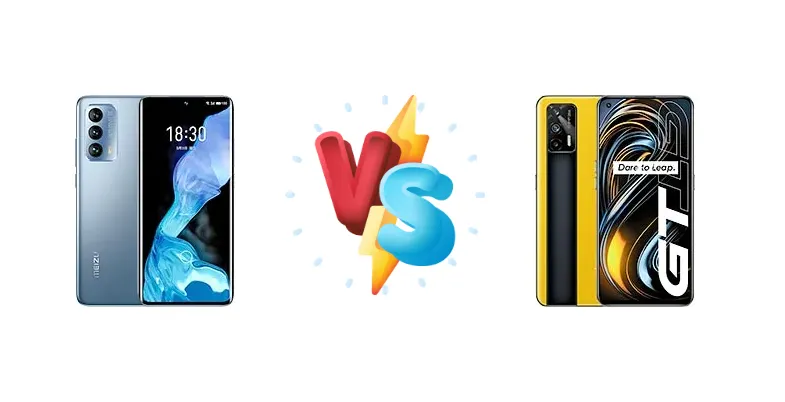
The Meizu 18 and Realme GT 5G represent distinct approaches to the flagship smartphone experience. The Meizu 18 prioritizes a compact form factor and refined design, while the Realme GT 5G focuses on delivering maximum performance and incredibly fast charging. Both are powered by the Qualcomm Snapdragon 888, but their implementations and surrounding features create a compelling contrast for discerning buyers.
🏆 Quick Verdict
For most users, the Realme GT 5G offers a more compelling package. Its 65W charging, achieving a full charge in just 35 minutes, significantly outperforms the Meizu 18’s 36W charging. While both share the same chipset, the GT’s focus on speed and battery endurance makes it the winner.
| Network |
|---|
| 2G bands | GSM 850 / 900 / 1800 / 1900 | GSM 850 / 900 / 1800 / 1900 |
| 3G bands | HSDPA 850 / 900 / 1900 / 2100 | HSDPA 850 / 900 / 1700(AWS) / 1900 / 2100 |
| 4G bands | 1, 3, 4, 5, 7, 8, 34, 38, 39, 40, 41 | 1, 2, 3, 4, 5, 7, 8, 12, 17, 18, 19, 20, 26, 34, 38, 39, 40, 41 |
| 5G bands | 1, 3, 41, 77, 78, 79 SA/NSA | 1, 3, 28, 41, 77, 78, 79 SA/NSA |
| Speed | HSPA, LTE, 5G | HSPA, LTE, 5G |
| Technology | GSM / HSPA / LTE / 5G | GSM / CDMA / HSPA / EVDO / LTE / 5G |
| | - | CDMA2000 1xEV-DO |
| Launch |
|---|
| Announced | 2021, March 03. Released 2021, March 08 | 2021, March 04 |
| Status | Discontinued | Available. Released 2021, March 10 |
| Body |
|---|
| Build | - | Glass front, glass back or eco leather back, plastic frame |
| Dimensions | 152.4 x 69.2 x 8.2 mm (6.00 x 2.72 x 0.32 in) | 158.5 x 73.3 x 8.4 mm (Glass) / 9.1 mm (Leather) |
| SIM | Nano-SIM + Nano-SIM | Nano-SIM + Nano-SIM |
| Weight | 162 g (5.71 oz) | 186 g (6.56 oz) |
| Display |
|---|
| Resolution | 1440 x 3200 pixels, 20:9 ratio (~563 ppi density) | 1080 x 2400 pixels, 20:9 ratio (~409 ppi density) |
| Size | 6.2 inches, 93.8 cm2 (~88.9% screen-to-body ratio) | 6.43 inches, 99.8 cm2 (~85.9% screen-to-body ratio) |
| Type | Super AMOLED, 120Hz, HDR10+, 420 nits (typ), 1300 nits (peak) | Super AMOLED, 120Hz, HDR10+ |
| Platform |
|---|
| CPU | Octa-core (1x2.84 GHz Cortex-X1 & 3x2.42 GHz Cortex-A78 & 4x1.80 GHz Cortex-A55) | Octa-core (1x2.84 GHz Cortex-X1 & 3x2.42 GHz Cortex-A78 & 4x1.80 GHz Cortex-A55 |
| Chipset | Qualcomm SM8350 Snapdragon 888 5G (5 nm) | Qualcomm SM8350 Snapdragon 888 5G (5 nm) |
| GPU | Adreno 660 | Adreno 660 |
| OS | Android 11, Flyme 9 | Android 11, upgradable to Android 14, Realme UI 5.0 |
| Memory |
|---|
| Card slot | No | No |
| Internal | 128GB 8GB RAM, 256GB 8GB RAM, 256GB 12GB RAM | 128GB 8GB RAM, 256GB 12GB RAM |
| | UFS 3.1 | UFS 3.1 |
| Main Camera |
|---|
| Features | Dual-LED dual-tone flash, HDR, panorama | Dual-LED dual-tone flash, HDR, panorama |
| Triple | 64 MP, f/1.6, 26mm (wide), 1/1.73", 0.8µm, PDAF, OIS
8 MP f/2.4, 79mm (telephoto), 1/4.4", 1.0µm, PDAF, 3x optical zoom
16 MP, f/2.2, 15mm, 122˚ (ultrawide), 1/3.0", 1.0µm | 64 MP, f/1.8, 26mm (wide), 1/1.73", 0.8µm, PDAF
8 MP, f/2.3, 16mm, 119˚ (ultrawide), 1/4.0", 1.12µm
2 MP (macro) |
| Video | 4K@30/60fps, 1080p; gyro-EIS | 4K@30/60fps, 1080p@30/60/240fps, gyro-EIS |
| Selfie camera |
|---|
| Features | HDR | HDR, panorama |
| Single | 20 MP, f/2.2, 26mm (wide), 1/3.4", 0.8µm | 16 MP, f/2.5, 26mm (wide), 1/3.0", 1.0µm |
| Video | 1080p@30fps | 1080p@30fps |
| Sound |
|---|
| 3.5mm jack | No | Yes |
| 35mm jack | No | Yes |
| Loudspeaker | Yes, with stereo speakers | Yes, with stereo speakers |
| | - | 24-bit/192kHz audio |
| Comms |
|---|
| Bluetooth | 5.2, A2DP, LE | 5.2, A2DP, LE, aptX HD |
| NFC | Yes | Yes |
| Positioning | GPS (L1+L5), GLONASS, BDS, GALILEO, QZSS, NavIC | GPS (L1+L5), GLONASS, BDS, GALILEO, QZSS |
| Radio | No | No |
| USB | USB Type-C | USB Type-C 2.0, OTG |
| WLAN | Wi-Fi 802.11 а/b/g/n/ac/6e, dual-band, Wi-Fi Direct | Wi-Fi 802.11 a/b/g/n/ac/6, dual-band, Wi-Fi Direct |
| Features |
|---|
| Sensors | Fingerprint (under display, ultrasonic), accelerometer, gyro, proximity, compass | Fingerprint (under display, optical), accelerometer, gyro, proximity, compass |
| Battery |
|---|
| Charging | 36W wired, PD3.0, QC3, 40% in 15 min, 100% in 50 min | 65W wired, 100% in 35 min |
| Type | Li-Po 4000 mAh | 4500 mAh |
| Misc |
|---|
| Colors | Light Blue, White, Aurora | Gold/Black, Blue, Silver |
| Models | - | RMX2202 |
| Price | About 560 EUR | About 330 EUR |
| Tests |
|---|
| Battery life | - |
Endurance rating 98h
|
| Camera | - |
Photo / Video |
| Display | - |
Contrast ratio: Infinite (nominal) |
| Loudspeaker | - |
-24.5 LUFS (Very good)
|
| Performance | - |
AnTuTu: 703986 (v8), 810433 (v9)
GeekBench: 3555 (v5.1)
GFXBench: 55fps (ES 3.1 onscreen) |
Meizu 18
- Compact and pocketable design
- Premium build quality (assumed)
- Potentially higher pixel density display
- Slower 36W charging
- Potential for thermal throttling due to size
- Limited camera specification details
Realme GT 5G
- 65W SuperDart charging (35 min full charge)
- Likely better thermal management
- Stronger focus on gaming performance
- Larger form factor
- Display brightness may not be as high as competitors
- Marketing-focused camera features may not translate to real-world improvements
Display Comparison
Both phones utilize the Snapdragon 888’s capabilities to drive their displays, but key differences exist. The Realme GT 5G boasts a measured peak brightness of 650 nits, suggesting a more visible screen outdoors compared to the Meizu 18 (brightness data unavailable). While the Realme GT 5G’s contrast ratio is listed as ‘Infinite’ (nominal), this is standard marketing terminology. The absence of LTPO technology in either device means refresh rate scaling isn’t as power-efficient as newer flagships, but both likely offer a smooth 120Hz experience. The Meizu 18’s smaller size likely translates to a higher pixel density, potentially offering a sharper image, but this is unconfirmed without specific display resolution data.
Camera Comparison
Both devices offer photo and video capabilities, but detailed camera specifications are limited. Without sensor size or aperture information, a direct comparison is difficult. The Realme GT 5G’s marketing often emphasizes its camera, suggesting a more feature-rich experience. The presence of OIS (Optical Image Stabilization) on either device is unknown, but would be a significant advantage for low-light photography and video recording. The inclusion of a 2MP macro camera on either device is likely a marketing gimmick, offering limited practical benefit due to the small sensor size and fixed focus.
Performance
Both the Meizu 18 and Realme GT 5G are equipped with the Qualcomm SM8350 Snapdragon 888 5G (5 nm) chipset, featuring the same Octa-core CPU configuration (1x2.84 GHz Cortex-X1, 3x2.42 GHz Cortex-A78, 4x1.80 GHz Cortex-A55). Therefore, raw CPU performance will be nearly identical. The key differentiator will be thermal management. Realme’s GT series is known for aggressive cooling solutions, potentially allowing for sustained peak performance during extended gaming sessions. The Meizu 18, constrained by its smaller form factor, may experience more thermal throttling under heavy load. RAM configurations are not specified, but LPDDR5 is expected on both, impacting application loading times and multitasking.
Battery Life
The Realme GT 5G’s 65W wired charging is a clear advantage, promising a full charge in just 35 minutes. The Meizu 18’s 36W charging, while supporting PD3.0 and QC3, takes considerably longer – 50 minutes for a full charge. Both phones achieve an endurance rating of 98 hours, suggesting similar battery life *despite* the charging speed difference. This implies the Realme GT 5G likely has a larger battery capacity to offset the power draw of its faster charging and potentially more demanding display. The faster charging of the GT 5G is a significant convenience factor for users who frequently need to top up their battery.
Buying Guide
Buy the Meizu 18 if you prioritize a smaller, more pocketable phone with a focus on a premium, understated design. It’s ideal for users who value one-handed usability and don’t mind slightly slower charging. Buy the Realme GT 5G if you prioritize raw speed, gaming performance, and incredibly fast charging. It’s the better choice for power users and those who frequently find themselves needing to top up their battery quickly.
Frequently Asked Questions
❓ Does the Realme GT 5G’s fast charging generate excessive heat?
Realme employs multiple layers of safety protocols and optimized charging algorithms to mitigate heat generation during 65W SuperDart charging. While some warmth is expected, it’s designed to remain within safe operating limits and shouldn’t cause damage to the battery or device.
❓ Is the Meizu 18’s smaller size a significant advantage for one-handed use?
Yes, the Meizu 18’s compact dimensions make it considerably easier to operate with one hand compared to the larger Realme GT 5G. This is a key benefit for users who prioritize portability and ease of use.
❓ Will the Snapdragon 888 in either phone struggle with demanding games after prolonged use?
The Snapdragon 888 is known to generate heat under sustained load. The Realme GT 5G, with its likely more robust cooling system, is expected to handle prolonged gaming sessions with less throttling than the Meizu 18, which is constrained by its smaller form factor.
❓ Are software updates guaranteed for both devices?
Meizu’s software update track record is less consistent than Realme’s. Realme, backed by Oppo, generally provides more frequent and longer-term software support for its devices. This is an important consideration for long-term usability and security.