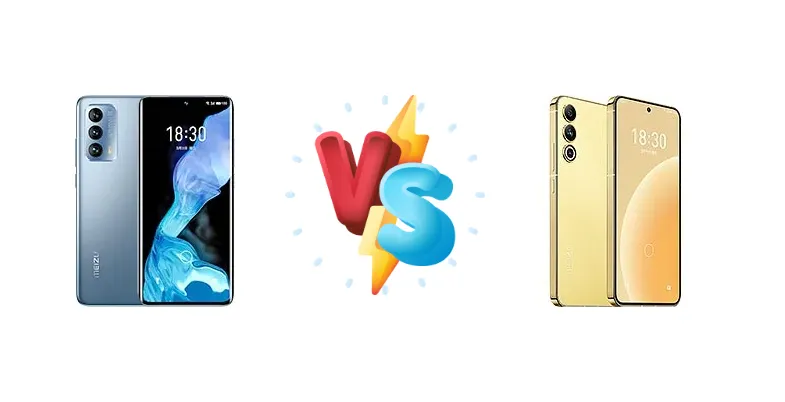
The Meizu 18 and Meizu 20 represent distinct points in the company’s flagship strategy. The 18, released in 2021, aimed for a premium, compact experience with the Snapdragon 888. The 20, arriving later, leverages the significantly upgraded Snapdragon 8 Gen 2, promising substantial performance and efficiency gains. This comparison dissects the key differences to help you determine which device best suits your needs.
🏆 Quick Verdict
For most users, the Meizu 20 is the clear winner. The Snapdragon 8 Gen 2 provides a substantial performance uplift and improved power efficiency compared to the 888 in the Meizu 18. While the 18 remains a capable device, the 20’s faster charging and newer architecture justify the price difference.
| Network |
|---|
| 2G bands | GSM 850 / 900 / 1800 / 1900 | GSM 850 / 900 / 1800 / 1900 |
| 3G bands | HSDPA 850 / 900 / 1900 / 2100 | HSDPA 850 / 900 / 1900 / 2100 |
| 4G bands | 1, 3, 4, 5, 7, 8, 34, 38, 39, 40, 41 | 1, 2, 3, 4, 5, 7, 8, 12, 28, 34, 38, 39, 40, 41 |
| 5G bands | 1, 3, 41, 77, 78, 79 SA/NSA | 1, 3, 5, 8, 28, 38, 41, 77, 78 SA/NSA |
| Speed | HSPA, LTE, 5G | HSPA, LTE, 5G |
| Technology | GSM / HSPA / LTE / 5G | GSM / HSPA / LTE / 5G |
| Launch |
|---|
| Announced | 2021, March 03. Released 2021, March 08 | 2023, March 30 |
| Status | Discontinued | Available. Released 2023, May 22 |
| Body |
|---|
| Dimensions | 152.4 x 69.2 x 8.2 mm (6.00 x 2.72 x 0.32 in) | 157.9 x 73.5 x 8 mm (6.22 x 2.89 x 0.31 in) |
| SIM | Nano-SIM + Nano-SIM | Nano-SIM + Nano-SIM |
| Weight | 162 g (5.71 oz) | 190 g (6.70 oz) |
| | - | IP54 |
| Display |
|---|
| Resolution | 1440 x 3200 pixels, 20:9 ratio (~563 ppi density) | 1080 x 2400 pixels, 20:9 ratio (~402 ppi density) |
| Size | 6.2 inches, 93.8 cm2 (~88.9% screen-to-body ratio) | 6.55 inches, 103.6 cm2 (~89.2% screen-to-body ratio) |
| Type | Super AMOLED, 120Hz, HDR10+, 420 nits (typ), 1300 nits (peak) | OLED, 1B colors, 144Hz, 500 nits (typ), 800 nits (HBM) |
| Platform |
|---|
| CPU | Octa-core (1x2.84 GHz Cortex-X1 & 3x2.42 GHz Cortex-A78 & 4x1.80 GHz Cortex-A55) | Octa-core (1x3.2 GHz Cortex-X3 & 2x2.8 GHz Cortex-A715 & 2x2.8 GHz Cortex-A710 & 3x2.0 GHz Cortex-A510) |
| Chipset | Qualcomm SM8350 Snapdragon 888 5G (5 nm) | Qualcomm SM8550-AB Snapdragon 8 Gen 2 (4 nm) |
| GPU | Adreno 660 | Adreno 740 |
| OS | Android 11, Flyme 9 | Android 13, Flyme 10 |
| Memory |
|---|
| Card slot | No | No |
| Internal | 128GB 8GB RAM, 256GB 8GB RAM, 256GB 12GB RAM | 128GB 12GB RAM, 256GB 12GB RAM, 512GB 12GB RAM |
| | UFS 3.1 | UFS 4.0
UFS 3.1 - 128GB only |
| Main Camera |
|---|
| Features | Dual-LED dual-tone flash, HDR, panorama | Ring-LED flash, panorama, HDR |
| Triple | 64 MP, f/1.6, 26mm (wide), 1/1.73", 0.8µm, PDAF, OIS
8 MP f/2.4, 79mm (telephoto), 1/4.4", 1.0µm, PDAF, 3x optical zoom
16 MP, f/2.2, 15mm, 122˚ (ultrawide), 1/3.0", 1.0µm | 50 MP, f/1.9, 24mm (wide), 1/1.56", PDAF, OIS
16 MP, f/2.4, 16mm, 122˚ (ultrawide)
5 MP, f/2.4 |
| Video | 4K@30/60fps, 1080p; gyro-EIS | 8K, 4K, 1080p; gyro-EIS |
| Selfie camera |
|---|
| Features | HDR | HDR |
| Single | 20 MP, f/2.2, 26mm (wide), 1/3.4", 0.8µm | 32 MP, f/2.5, (wide) |
| Video | 1080p@30fps | Yes |
| Sound |
|---|
| 3.5mm jack | No | No |
| 35mm jack | No | No |
| Loudspeaker | Yes, with stereo speakers | Yes, with stereo speakers |
| Comms |
|---|
| Bluetooth | 5.2, A2DP, LE | 5.3, A2DP, LE |
| NFC | Yes | Yes |
| Positioning | GPS (L1+L5), GLONASS, BDS, GALILEO, QZSS, NavIC | GPS (L1+L5), GLONASS, BDS (B1I+B1c+B2a), GALILEO, QZSS |
| Radio | No | No |
| USB | USB Type-C | USB Type-C, OTG |
| WLAN | Wi-Fi 802.11 а/b/g/n/ac/6e, dual-band, Wi-Fi Direct | Wi-Fi 802.11 а/b/g/n/ac/6e/7, dual-band |
| Features |
|---|
| Sensors | Fingerprint (under display, ultrasonic), accelerometer, gyro, proximity, compass | Fingerprint (under display, ultrasonic), accelerometer, gyro, proximity, compass |
| Battery |
|---|
| Charging | 36W wired, PD3.0, QC3, 40% in 15 min, 100% in 50 min | 67W wired, PD3 PPS, QC4+ |
| Type | Li-Po 4000 mAh | Li-Po 4700 mAh |
| Misc |
|---|
| Colors | Light Blue, White, Aurora | Gray, Yellow, Mint, Rose Gold |
| Price | About 560 EUR | About 400 EUR |
Meizu 18
- More compact form factor
- Potentially lower price point (due to age)
- Still a capable performer for everyday tasks
- Older Snapdragon 888 chipset
- Slower 36W charging
- Less efficient power consumption
Meizu 20
- Significantly faster Snapdragon 8 Gen 2 chipset
- Much faster 67W charging with advanced protocols
- Improved power efficiency and thermal management
- Potentially larger size
- Higher price point
- May lack the same level of software optimization as the 18 at launch
Display Comparison
While specific display specs aren't provided, both phones likely feature high-quality OLED panels. However, the Meizu 20 benefits from the advancements in panel technology available at its release. The Snapdragon 8 Gen 2’s ISP is also more capable of handling display processing, potentially leading to more accurate colors and improved HDR performance. The Meizu 18, while still excellent, will lack these refinements.
Camera Comparison
Without detailed camera specs, it’s difficult to make a definitive statement. However, the Snapdragon 8 Gen 2’s improved ISP in the Meizu 20 will contribute to better image processing, noise reduction, and dynamic range. The newer chip also supports more advanced camera features. The Meizu 20 likely benefits from improved computational photography algorithms, resulting in superior image quality, particularly in challenging lighting conditions. The 18’s camera is still capable, but will be limited by the older image signal processor.
Performance
The core difference lies in the chipsets. The Meizu 20’s Snapdragon 8 Gen 2 (4nm) is a generational leap over the Meizu 18’s Snapdragon 888 (5nm). The Gen 2 features a new CPU architecture – Cortex-X3, A715, and A710 – offering a significant performance increase in both single-core and multi-core tasks. The 4nm process node also translates to better thermal efficiency, meaning the Meizu 20 is less likely to throttle under sustained load. The 888 in the 18, while powerful, is known to run warmer, impacting sustained performance. The Gen 2’s Adreno 740 GPU also provides a substantial graphics boost.
Battery Life
The Meizu 18 offers 36W wired charging, achieving 40% charge in 15 minutes and 100% in 50 minutes. The Meizu 20 significantly upgrades this with 67W wired charging, utilizing PD3 PPS and QC4+. This faster charging translates to a much quicker top-up time, a significant convenience for power users. While battery capacity isn't specified, the Snapdragon 8 Gen 2’s improved efficiency in the Meizu 20 means it will likely deliver comparable or better real-world battery life despite potentially having a similar or even smaller battery capacity than the Meizu 18.
Buying Guide
Buy the Meizu 18 if you prioritize a more compact form factor and can find it at a significantly discounted price. It’s a solid performer for everyday tasks and light gaming. Buy the Meizu 20 if you demand the best possible performance, faster charging speeds, and a more future-proofed experience, especially if you’re a power user or mobile gamer.
Frequently Asked Questions
❓ Does the Snapdragon 888 in the Meizu 18 experience significant thermal throttling during extended gaming sessions?
Yes, the Snapdragon 888 is known to generate considerable heat under sustained load. While Meizu likely implemented cooling solutions, the Meizu 18 will likely experience more noticeable performance throttling during prolonged gaming compared to the more efficient Snapdragon 8 Gen 2 in the Meizu 20.
❓ What charging protocol does the Meizu 20 support that the 18 doesn't, and what's the practical benefit?
The Meizu 20 supports PD3 PPS and QC4+, while the 18 uses PD3.0 and QC3. PPS allows for more granular voltage control during charging, resulting in more efficient power delivery and potentially reducing heat buildup. QC4+ offers faster charging speeds with compatible chargers. This translates to a quicker and potentially safer charging experience for the Meizu 20.
❓ Is the performance difference between the Snapdragon 888 and 8 Gen 2 noticeable in everyday tasks like browsing and social media?
While both chips are capable of handling everyday tasks smoothly, the Snapdragon 8 Gen 2 in the Meizu 20 will feel noticeably snappier and more responsive. App launch times will be faster, and multitasking will be more fluid. The difference is most apparent when switching between demanding applications.