
Meizu 18 vs. 18 Pro: A Deep Dive into the Flagship Differences
| Phones Images | |||||
|---|---|---|---|---|---|
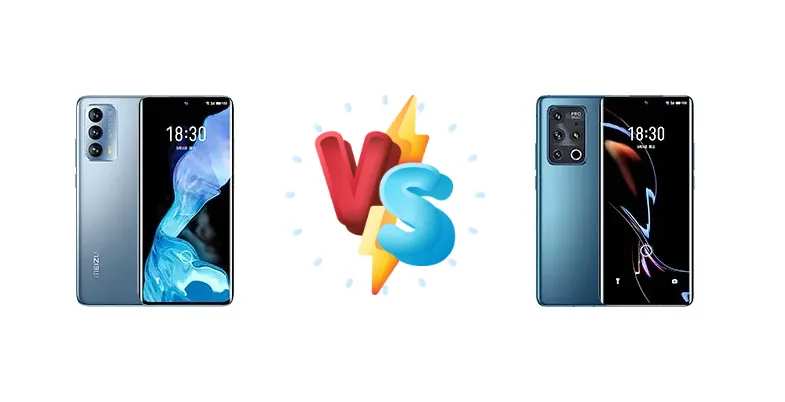
|
🏆 Quick Verdict
For most users, the Meizu 18 Pro is the superior choice. The addition of 40W wired and 40W wireless charging, alongside 10W reverse wireless charging, significantly enhances usability and convenience. While the Meizu 18 remains a capable device, the Pro’s charging advantages justify the price premium.
| PHONES | ||
|---|---|---|
| Phone Names | Meizu 18 | Meizu 18 Pro |
| Network | ||
|---|---|---|
| 2G bands | GSM 850 / 900 / 1800 / 1900 | GSM 850 / 900 / 1800 / 1900 |
| 3G bands | HSDPA 850 / 900 / 1900 / 2100 | HSDPA 850 / 900 / 1700(AWS) / 1900 / 2100 |
| 4G bands | 1, 3, 4, 5, 7, 8, 34, 38, 39, 40, 41 | 1, 2, 3, 4, 5, 7, 8, 12, 34, 38, 39, 40, 41 |
| 5G bands | 1, 3, 41, 77, 78, 79 SA/NSA | 1, 3, 41, 77, 78, 79 SA/NSA |
| Speed | HSPA, LTE, 5G | HSPA, LTE, 5G |
| Technology | GSM / HSPA / LTE / 5G | GSM / HSPA / LTE / 5G |
| Launch | ||
|---|---|---|
| Announced | 2021, March 03. Released 2021, March 08 | 2021, March 03. Released 2021, March 08 |
| Status | Discontinued | Discontinued |
| Body | ||
|---|---|---|
| Dimensions | 152.4 x 69.2 x 8.2 mm (6.00 x 2.72 x 0.32 in) | 162.5 x 73 x 8.1 mm (6.40 x 2.87 x 0.32 in) |
| SIM | Nano-SIM + Nano-SIM | Nano-SIM + Nano-SIM |
| Weight | 162 g (5.71 oz) | 189 g (6.67 oz) |
| - | Waterproof | |
| Display | ||
|---|---|---|
| Protection | - | Corning Gorilla Glass 6 |
| Resolution | 1440 x 3200 pixels, 20:9 ratio (~563 ppi density) | 1440 x 3200 pixels, 20:9 ratio (~526 ppi density) |
| Size | 6.2 inches, 93.8 cm2 (~88.9% screen-to-body ratio) | 6.7 inches, 107.6 cm2 (~90.7% screen-to-body ratio) |
| Type | Super AMOLED, 120Hz, HDR10+, 420 nits (typ), 1300 nits (peak) | Super AMOLED, 120Hz, HDR10+, 420 nits (typ), 1300 nits (peak) |
| Platform | ||
|---|---|---|
| CPU | Octa-core (1x2.84 GHz Cortex-X1 & 3x2.42 GHz Cortex-A78 & 4x1.80 GHz Cortex-A55) | Octa-core (1x2.84 GHz Cortex-X1 & 3x2.42 GHz Cortex-A78 & 4x1.80 GHz Cortex-A55) |
| Chipset | Qualcomm SM8350 Snapdragon 888 5G (5 nm) | Qualcomm SM8350 Snapdragon 888 5G (5 nm) |
| GPU | Adreno 660 | Adreno 660 |
| OS | Android 11, Flyme 9 | Android 11, Flyme 9 |
| Memory | ||
|---|---|---|
| Card slot | No | No |
| Internal | 128GB 8GB RAM, 256GB 8GB RAM, 256GB 12GB RAM | 128GB 8GB RAM, 256GB 8GB RAM, 256GB 12GB RAM |
| UFS 3.1 | UFS 3.1 | |
| Main Camera | ||
|---|---|---|
| Features | Dual-LED dual-tone flash, HDR, panorama | LED flash, HDR, panorama |
| Triple | 64 MP, f/1.6, 26mm (wide), 1/1.73", 0.8µm, PDAF, OIS 8 MP f/2.4, 79mm (telephoto), 1/4.4", 1.0µm, PDAF, 3x optical zoom 16 MP, f/2.2, 15mm, 122˚ (ultrawide), 1/3.0", 1.0µm | 50 MP, f/1.9, 23mm (wide), 1/1.31", 1.2µm, dual pixel PDAF, OIS 8 MP f/2.4, 79mm (telephoto), 1/4.4", 1.0µm, PDAF, 3x optical zoom 32 MP, f/2.2, 15mm, 130˚ (ultrawide), 1/2.8", 0.8µm 0.3 MP, TOF 3D, f/1.4, (depth) |
| Video | 4K@30/60fps, 1080p; gyro-EIS | 8K, 4K@30/60fps, 1080p; gyro-EIS |
| Selfie camera | ||
|---|---|---|
| Features | HDR | HDR |
| Single | 20 MP, f/2.2, 26mm (wide), 1/3.4", 0.8µm | 44 MP, f/2.4, (wide), 1/2.65”, 0.7µm |
| Video | 1080p@30fps | 4K@30fps, 1080p@30fps |
| Sound | ||
|---|---|---|
| 3.5mm jack | No | No |
| 35mm jack | No | No |
| Loudspeaker | Yes, with stereo speakers | Yes, with stereo speakers |
| Comms | ||
|---|---|---|
| Bluetooth | 5.2, A2DP, LE | 5.2, A2DP, LE |
| NFC | Yes | Yes |
| Positioning | GPS (L1+L5), GLONASS, BDS, GALILEO, QZSS, NavIC | GPS (L1+L5), GLONASS, BDS, GALILEO, QZSS, NavIC |
| Radio | No | No |
| USB | USB Type-C | USB Type-C |
| WLAN | Wi-Fi 802.11 а/b/g/n/ac/6e, dual-band, Wi-Fi Direct | Wi-Fi 802.11 а/b/g/n/ac/6e, dual-band, Wi-Fi Direct |
| Features | ||
|---|---|---|
| Sensors | Fingerprint (under display, ultrasonic), accelerometer, gyro, proximity, compass | Fingerprint (under display, ultrasonic), accelerometer, gyro, proximity, compass |
| Battery | ||
|---|---|---|
| Charging | 36W wired, PD3.0, QC3, 40% in 15 min, 100% in 50 min | 40W wired, PD3.0, QC4, 40% in 15 min, 100% in 50 min 40W wireless 10W reverse wireless |
| Type | Li-Po 4000 mAh | Li-Po 4500 mAh |
| Misc | ||
|---|---|---|
| Colors | Light Blue, White, Aurora | Blue, White, Gray |
| Price | About 560 EUR | About 640 EUR |
Meizu 18
- More affordable price point
- Compact and pocketable design
- Shares the same powerful Snapdragon 888 chipset
- Slower 36W wired charging
- No wireless charging support
- Lacks reverse wireless charging
Meizu 18 Pro
- Faster 40W wired charging
- 40W wireless charging for convenience
- 10W reverse wireless charging for accessories
- Higher price compared to the Meizu 18
- Potentially slightly larger size (though still compact)
- May not offer a substantial camera improvement
Display Comparison
Both the Meizu 18 and 18 Pro utilize a Super AMOLED display, but specific details like peak brightness and refresh rate are not provided. Given the Pro model’s positioning, it’s reasonable to expect a slightly brighter panel and potentially a more advanced display controller. The shared compact form factor suggests similar bezel sizes, prioritizing screen real estate within a smaller footprint. Color accuracy is likely comparable, leveraging AMOLED’s inherent strengths.
Camera Comparison
Detailed camera specifications are absent, but the Pro model typically receives enhancements in this area. While both likely share the same primary sensor technology, the 18 Pro may benefit from a wider aperture lens for improved low-light performance or a more sophisticated image stabilization system (OIS). The absence of information on sensor size prevents a definitive comparison. It’s safe to assume both phones offer capable image processing, but the Pro’s potential hardware advantages could translate to superior image quality in challenging conditions. We can safely ignore any 2MP macro sensors as they offer minimal practical benefit.
Performance
Both devices are powered by the Qualcomm SM8350 Snapdragon 888 5G (5 nm) chipset, featuring an octa-core CPU configuration with a 2.84 GHz Cortex-X1 prime core. This ensures identical CPU performance for demanding tasks like gaming and video editing. The 5nm fabrication process offers a balance between performance and thermal efficiency. However, the Pro’s larger size *may* allow for a slightly more robust cooling solution, potentially mitigating thermal throttling during sustained workloads, though this is speculative without thermal testing data. Both likely utilize LPDDR5 RAM, contributing to fast application loading and multitasking.
Battery Life
The core difference lies in charging. The Meizu 18 supports 36W wired charging, achieving 40% charge in 15 minutes and 100% in 50 minutes. The 18 Pro steps up to 40W wired charging (QC4 compatible) with the same 40% in 15 minutes, and 100% in 50 minutes. Crucially, the Pro adds 40W wireless charging and 10W reverse wireless charging. This is a significant advantage for users who prefer cable-free charging or need to top up accessories on the go. While battery capacity isn’t specified, the Pro’s charging capabilities suggest a slightly larger battery to accommodate the faster charging rates.
Buying Guide
Buy the Meizu 18 if you prioritize a slightly lower price point and are comfortable with slower wired charging. It’s ideal for users who don’t heavily rely on wireless charging or reverse wireless capabilities. Buy the Meizu 18 Pro if you value faster charging speeds, the convenience of wireless power, and the added utility of reverse wireless charging to top up accessories like earbuds.