
Meizu 18 vs Huawei P50 Pro: A Detailed Comparison of Flagship Performance and Features
| Phones Images | |||||
|---|---|---|---|---|---|
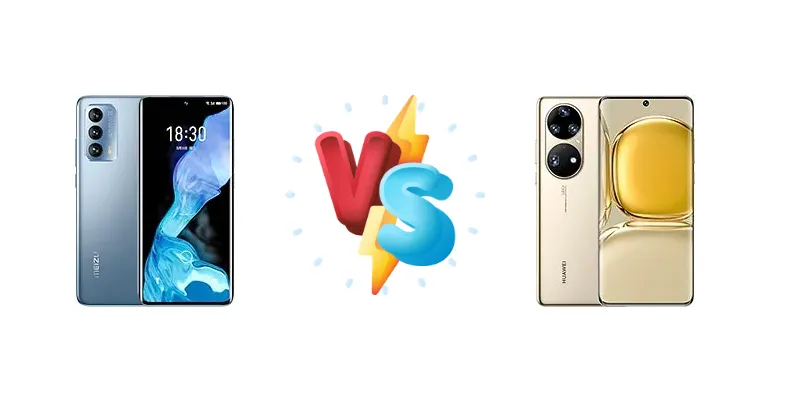
|
🏆 Quick Verdict
For most users, the Huawei P50 Pro emerges as the stronger contender. Its 66W charging and potentially superior camera system, coupled with a comparable processor (Snapdragon 888 variant), outweigh the Meizu 18’s more compact size. However, the P50 Pro's 4G limitation is a significant drawback for some.
| PHONES | ||
|---|---|---|
| Phone Names | Meizu 18 | Huawei P50 Pro |
| Network | ||
|---|---|---|
| 2G bands | GSM 850 / 900 / 1800 / 1900 | GSM 850 / 900 / 1800 / 1900 |
| 3G bands | HSDPA 850 / 900 / 1900 / 2100 | HSDPA 800 / 850 / 900 / 1700(AWS) / 1900 / 2100 |
| 4G bands | 1, 3, 4, 5, 7, 8, 34, 38, 39, 40, 41 | 1, 2, 3, 4, 5, 6, 7, 8, 9, 12, 17, 18, 19, 20, 26, 28, 34, 38, 39, 40, 41 - China |
| 5G bands | 1, 3, 41, 77, 78, 79 SA/NSA | - |
| Speed | HSPA, LTE, 5G | HSPA, LTE |
| Technology | GSM / HSPA / LTE / 5G | GSM / CDMA / HSPA / CDMA2000 / LTE |
| - | 1, 2, 3, 4, 5, 7, 8, 12, 17, 18, 19, 20, 26, 28, 32, 34, 38, 39, 40, 41, 66 - International | |
| Launch | ||
|---|---|---|
| Announced | 2021, March 03. Released 2021, March 08 | 2021, July 29 |
| Status | Discontinued | Available. Released 2021, August 12 |
| Body | ||
|---|---|---|
| Build | - | Glass front, glass back, aluminum frame |
| Dimensions | 152.4 x 69.2 x 8.2 mm (6.00 x 2.72 x 0.32 in) | 158.8 x 72.8 x 8.5 mm (6.25 x 2.87 x 0.33 in) |
| SIM | Nano-SIM + Nano-SIM | · Nano-SIM· Nano-SIM + Nano-SIM |
| Weight | 162 g (5.71 oz) | 195 g (6.88 oz) |
| - | IP68 dust/water resistant (up to 1.5m for 30 min) | |
| Display | ||
|---|---|---|
| Resolution | 1440 x 3200 pixels, 20:9 ratio (~563 ppi density) | 1228 x 2700 pixels (~450 ppi density) |
| Size | 6.2 inches, 93.8 cm2 (~88.9% screen-to-body ratio) | 6.6 inches, 105.4 cm2 (~91.2% screen-to-body ratio) |
| Type | Super AMOLED, 120Hz, HDR10+, 420 nits (typ), 1300 nits (peak) | OLED, 1B colors, 120Hz |
| Platform | ||
|---|---|---|
| CPU | Octa-core (1x2.84 GHz Cortex-X1 & 3x2.42 GHz Cortex-A78 & 4x1.80 GHz Cortex-A55) | Octa-core (1x3.13 GHz Cortex-A77 & 3x2.54 GHz Cortex-A77 & 4x2.05 GHz Cortex-A55)Octa-core (1x2.84 GHz Cortex-X1 & 3x2.42 GHz Cortex-A78 & 4x1.80 GHz Cortex-A55) |
| Chipset | Qualcomm SM8350 Snapdragon 888 5G (5 nm) | Kirin 9000 (5 nm)Qualcomm SM8350 Snapdragon 888 4G (5 nm) |
| GPU | Adreno 660 | Mali-G78 MP24Adreno 660 |
| OS | Android 11, Flyme 9 | HarmonyOS 2.0 (China), EMUI 14.2 (Europe), no Google Play Services |
| Memory | ||
|---|---|---|
| Card slot | No | Nano Memory (uses shared SIM slot) |
| Internal | 128GB 8GB RAM, 256GB 8GB RAM, 256GB 12GB RAM | 128GB 8GB RAM, 256GB 8GB RAM, 512GB 8GB RAM, 512GB 12GB RAM |
| UFS 3.1 | - | |
| Main Camera | ||
|---|---|---|
| Features | Dual-LED dual-tone flash, HDR, panorama | Laser AF, color spectrum sensor, Leica optics, dual-LED flash, panorama, HDR |
| Quad | - | 50 MP, f/1.8, 23mm (wide), PDAF, OIS 64 MP, f/3.5, 90mm (periscope telephoto), PDAF, OIS, 3.5x optical zoom, 7x lossless zoom 13 MP, f/2.2, 13mm (ultrawide), AF 40 MP, f/1.6, 23mm (B/W), AF |
| Single | - | 13 MP, f/2.4, (wide), AF |
| Triple | 64 MP, f/1.6, 26mm (wide), 1/1.73", 0.8µm, PDAF, OIS 8 MP f/2.4, 79mm (telephoto), 1/4.4", 1.0µm, PDAF, 3x optical zoom 16 MP, f/2.2, 15mm, 122˚ (ultrawide), 1/3.0", 1.0µm | - |
| Video | 4K@30/60fps, 1080p; gyro-EIS | 4K@30/60fps, 1080p@30/60fps, 1080p@960fps; gyro-EIS |
| Selfie camera | ||
|---|---|---|
| Features | HDR | Panorama, HDR |
| Single | 20 MP, f/2.2, 26mm (wide), 1/3.4", 0.8µm | 13 MP, f/2.4, (wide), AF |
| Video | 1080p@30fps | 4K@30fps, 1080p@30/60/240fps |
| Sound | ||
|---|---|---|
| 3.5mm jack | No | No |
| 35mm jack | No | No |
| Loudspeaker | Yes, with stereo speakers | Yes, with stereo speakers |
| Comms | ||
|---|---|---|
| Bluetooth | 5.2, A2DP, LE | 5.2, A2DP, LE |
| Infrared port | - | Yes |
| NFC | Yes | Yes |
| Positioning | GPS (L1+L5), GLONASS, BDS, GALILEO, QZSS, NavIC | GPS (L1+L5), GLONASS (L1), BDS (B1I+B1c+B2a+B2b), GALILEO (E1+E5a+E5b), QZSS (L1+L5), NavIC |
| Radio | No | No |
| USB | USB Type-C | USB Type-C 3.1, OTG |
| WLAN | Wi-Fi 802.11 а/b/g/n/ac/6e, dual-band, Wi-Fi Direct | Wi-Fi 802.11 a/b/g/n/ac/6, dual-band, Wi-Fi Direct |
| Features | ||
|---|---|---|
| Sensors | Fingerprint (under display, ultrasonic), accelerometer, gyro, proximity, compass | Fingerprint (under display, optical), accelerometer, gyro, proximity, compass, barometer |
| Battery | ||
|---|---|---|
| Charging | 36W wired, PD3.0, QC3, 40% in 15 min, 100% in 50 min | 66W wired 50W wireless Reverse wireless charging |
| Type | Li-Po 4000 mAh | Li-Po 4360 mAh |
| Misc | ||
|---|---|---|
| Colors | Light Blue, White, Aurora | Golden Black, Cocoa Gold, Pearl White, Charm Pink |
| Models | - | JAD-AL50, JAD-LX9, JAD-AL00 |
| Price | About 560 EUR | $ 196.62 / £ 329.00 / € 473.13 |
| Tests | ||
|---|---|---|
| Battery life | - | Endurance rating 76h |
| Camera | - | Photo / Video |
| Display | - | Contrast ratio: Infinite (nominal) |
| Loudspeaker | - | -27.3 LUFS (Good) |
| Performance | - | AnTuTu: 793876 (v8), 786215 (v9) GeekBench: 3145 (v5.1) GFXBench: 44fps (ES 3.1 onscreen) |
Meizu 18
- Compact and pocketable design
- Clean and streamlined software experience
- Snapdragon 888 5G connectivity
- Slower 36W charging
- Less emphasis on camera innovation
- Limited battery capacity (spec not provided)
Huawei P50 Pro
- 66W wired and 50W wireless charging
- Potentially superior camera system
- Larger, more immersive display
- 4G connectivity limitation (some models)
- Larger and heavier form factor
- Kirin 9000 performance may be slightly lower than Snapdragon 888 in some tasks
Display Comparison
The Huawei P50 Pro boasts a measured peak brightness of 754 nits, suggesting a more visible display in direct sunlight compared to the Meizu 18 (brightness data unavailable). While both feature infinite (nominal) contrast ratios, the P50 Pro’s larger screen size and potentially superior color calibration (based on Huawei’s display history) offer a more immersive viewing experience. The Meizu 18’s smaller size, however, may appeal to users who prefer one-handed operation.
Camera Comparison
The Huawei P50 Pro is clearly positioned as a camera-centric device. While specific sensor details are missing, Huawei’s history suggests a focus on large sensors and advanced image processing. The P50 Pro’s camera system is designed for both photo and video, likely excelling in low-light conditions and offering versatile zoom capabilities. The Meizu 18, while capable, likely prioritizes a more balanced camera experience rather than pushing the boundaries of mobile photography. The absence of detailed camera specs for the Meizu 18 makes a direct comparison difficult, but Huawei’s reputation in this area is substantial.
Performance
Both phones utilize 5nm fabrication processes, but the chipsets differ significantly. The Huawei P50 Pro offers a choice: the Kirin 9000 with its Cortex-A77 cores, or the Snapdragon 888 4G. The Meizu 18 exclusively uses the Snapdragon 888 5G. While the Kirin 9000’s Cortex-A77 cores clock slightly higher (3.13 GHz vs 2.84 GHz on the X1), the Snapdragon 888’s Cortex-X1 core provides a performance advantage in bursty workloads. The P50 Pro’s 4G limitation is a critical consideration for users reliant on 5G connectivity. Both likely utilize LPDDR4X RAM, impacting overall system responsiveness.
Battery Life
Both devices achieve an endurance rating of 76 hours, suggesting comparable battery life under similar usage patterns. However, the charging speeds differ dramatically. The Huawei P50 Pro supports 66W wired charging, 50W wireless charging, and reverse wireless charging, allowing for a full charge in under 40 minutes. The Meizu 18’s 36W wired charging is significantly slower, taking approximately 50 minutes to reach 100%. This difference in charging speed is a major advantage for the P50 Pro, especially for users who frequently need to top up their battery.
Buying Guide
Buy the Meizu 18 if you prioritize a genuinely compact flagship experience and value a clean, streamlined software experience. It’s ideal for users who find larger phones unwieldy and don’t require the absolute best camera performance. Buy the Huawei P50 Pro if you prioritize camera quality, fast charging (66W wired, 50W wireless), and a larger display, and are willing to accept the limitations of a 4G-only connection in some models.