
Meizu 18 vs Asus ROG Phone 5s: A Detailed Comparison of Snapdragon 888 Power
| Phones Images | |||||
|---|---|---|---|---|---|
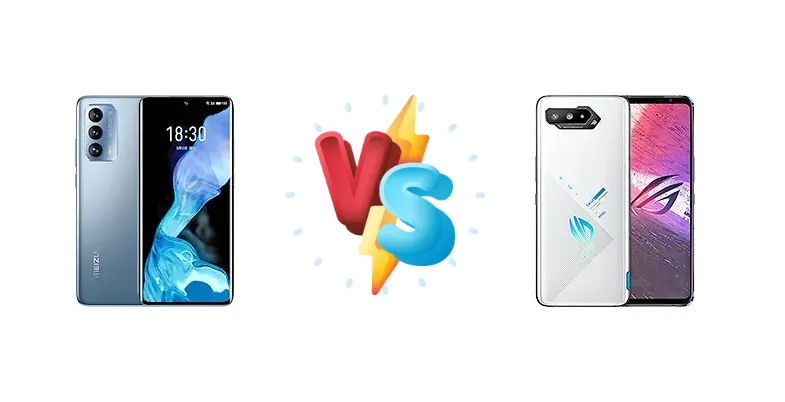
|
🏆 Quick Verdict
For the average user prioritizing portability and a refined Android experience, the Meizu 18 offers a compelling package. However, gamers and power users will find the Asus ROG Phone 5s’s superior cooling, faster charging, and gaming-centric features worth the trade-off in size and subtlety.
| PHONES | ||
|---|---|---|
| Phone Names | Meizu 18 | Asus ROG Phone 5s |
| Network | ||
|---|---|---|
| 2G bands | GSM 850 / 900 / 1800 / 1900 | GSM 850 / 900 / 1800 / 1900 |
| 3G bands | HSDPA 850 / 900 / 1900 / 2100 | HSDPA 800 / 850 / 900 / 1700(AWS) / 1800 / 1900 / 2100 - Version 1 |
| 4G bands | 1, 3, 4, 5, 7, 8, 34, 38, 39, 40, 41 | 1, 2, 3, 4, 5, 7, 8, 12, 13, 17, 18, 19, 20, 25, 26, 28, 29, 30, 32, 34, 38, 39, 40, 41, 42, 48, 66, 71 - Version 1 |
| 5G bands | 1, 3, 41, 77, 78, 79 SA/NSA | 1, 2, 3, 5, 7, 8, 12, 20, 25, 28, 38, 40, 41, 66, 71, 77, 78, 79 SA/NSA - Version 1 |
| Speed | HSPA, LTE, 5G | HSPA 42.2/5.76 Mbps, LTE (7CA) Cat20 1400/150 Mbps, 5G 4 Gbps DL |
| Technology | GSM / HSPA / LTE / 5G | GSM / HSPA / LTE / 5G |
| - | 2, 3, 5, 7, 12, 20, 25, 28, 38, 40, 66, 71, 77, 78, 79 SA/NSA - Version 4 | |
| Launch | ||
|---|---|---|
| Announced | 2021, March 03. Released 2021, March 08 | 2021, August 16 |
| Status | Discontinued | Available. Released 2021, August 26 |
| Body | ||
|---|---|---|
| Build | - | Glass front (Gorilla Glass Victus), glass back (Gorilla Glass 3), aluminum frame |
| Dimensions | 152.4 x 69.2 x 8.2 mm (6.00 x 2.72 x 0.32 in) | 172.8 x 77.3 x 9.9 mm (6.80 x 3.04 x 0.39 in) |
| SIM | Nano-SIM + Nano-SIM | Nano-SIM + Nano-SIM |
| Weight | 162 g (5.71 oz) | 238 g (8.40 oz) |
| - | RGB light panel (on the back) Pressure sensitive zones (Gaming triggers) | |
| Display | ||
|---|---|---|
| Protection | - | Corning Gorilla Glass Victus |
| Resolution | 1440 x 3200 pixels, 20:9 ratio (~563 ppi density) | 1080 x 2448 pixels (~395 ppi density) |
| Size | 6.2 inches, 93.8 cm2 (~88.9% screen-to-body ratio) | 6.78 inches, 109.5 cm2 (~82.0% screen-to-body ratio) |
| Type | Super AMOLED, 120Hz, HDR10+, 420 nits (typ), 1300 nits (peak) | AMOLED, 1B colors, 144Hz, HDR10+, 800 nits (typ), 1200 nits (peak) |
| Platform | ||
|---|---|---|
| CPU | Octa-core (1x2.84 GHz Cortex-X1 & 3x2.42 GHz Cortex-A78 & 4x1.80 GHz Cortex-A55) | Octa-core (1x2.99 GHz Cortex-X1 & 3x2.42 GHz Cortex-A78 & 4x1.80 GHz Cortex-A55) |
| Chipset | Qualcomm SM8350 Snapdragon 888 5G (5 nm) | Qualcomm SM8350 Snapdragon 888+ 5G (5 nm) |
| GPU | Adreno 660 | Adreno 660 |
| OS | Android 11, Flyme 9 | Android 11, upgradable to Android 13, ROG UI |
| Memory | ||
|---|---|---|
| Card slot | No | No |
| Internal | 128GB 8GB RAM, 256GB 8GB RAM, 256GB 12GB RAM | 128GB 8GB RAM, 128GB 12GB RAM, 256GB 12GB RAM, 256GB 16GB RAM, 512GB 16GB RAM, 512GB 18GB RAM |
| UFS 3.1 | UFS 3.1 | |
| Main Camera | ||
|---|---|---|
| Features | Dual-LED dual-tone flash, HDR, panorama | LED flash, HDR, panorama |
| Triple | 64 MP, f/1.6, 26mm (wide), 1/1.73", 0.8µm, PDAF, OIS 8 MP f/2.4, 79mm (telephoto), 1/4.4", 1.0µm, PDAF, 3x optical zoom 16 MP, f/2.2, 15mm, 122˚ (ultrawide), 1/3.0", 1.0µm | 64 MP, f/1.8, 26mm (wide), 1/1.73", 0.8µm, PDAF 13 MP, f/2.4, 11mm, 125˚ (ultrawide) 5 MP (macro) |
| Video | 4K@30/60fps, 1080p; gyro-EIS | 8K@30fps, 4K@30/60/120fps, 1080p@30/60/120/240fps, 720p@480fps; gyro-EIS |
| Selfie camera | ||
|---|---|---|
| Features | HDR | Panorama, HDR |
| Single | 20 MP, f/2.2, 26mm (wide), 1/3.4", 0.8µm | 24 MP, f/2.5, 27mm (wide), 0.9µm |
| Video | 1080p@30fps | 1080p@30fps |
| Sound | ||
|---|---|---|
| 3.5mm jack | No | Yes |
| 35mm jack | No | Yes |
| Loudspeaker | Yes, with stereo speakers | Yes, with stereo speakers (2 amplifiers) |
| - | 24-bit/192kHz audio | |
| Comms | ||
|---|---|---|
| Bluetooth | 5.2, A2DP, LE | 5.2, A2DP, LE, aptX HD, aptX Adaptive |
| NFC | Yes | Yes |
| Positioning | GPS (L1+L5), GLONASS, BDS, GALILEO, QZSS, NavIC | GPS (L1+L5), GLONASS (L1), BDS (B1I+B1c+B2a), GALILEO (E1+E5a), QZSS (L1+L5), NavIC (L5) |
| Radio | No | No |
| USB | USB Type-C | USB Type-C 3.1 (side), USB Type-C 2.0 (bottom), OTG, accessory connector |
| WLAN | Wi-Fi 802.11 а/b/g/n/ac/6e, dual-band, Wi-Fi Direct | Wi-Fi 802.11 a/b/g/n/ac/6e, dual-band, Wi-Fi Direct |
| Features | ||
|---|---|---|
| Sensors | Fingerprint (under display, ultrasonic), accelerometer, gyro, proximity, compass | Fingerprint (under display, optical), accelerometer, gyro, proximity, compass |
| Battery | ||
|---|---|---|
| Charging | 36W wired, PD3.0, QC3, 40% in 15 min, 100% in 50 min | 65W wired, PD3.0, QC5, 70% in 30 min, 100% in 52 min 10W reverse wired |
| Type | Li-Po 4000 mAh | Li-Po 6000 mAh |
| Misc | ||
|---|---|---|
| Colors | Light Blue, White, Aurora | Phantom Black, Storm White |
| Models | - | ZS676KS |
| Price | About 560 EUR | About 1030 EUR |
Meizu 18
- Compact and pocketable design
- Clean and refined software experience
- Balanced feature set for everyday use
- Slower charging speed (36W)
- Potentially less sustained performance due to thermal constraints
Asus ROG Phone 5s
- Faster charging speed (65W)
- Superior thermal management for sustained performance
- Gaming-centric features (AirTriggers, high refresh rate)
- Larger and heavier form factor
- More aggressive design may not appeal to all users
Display Comparison
While both phones utilize OLED panels, details beyond that are missing. However, the ROG Phone 5s, being a gaming phone, likely features a higher refresh rate (120Hz or 144Hz is common) compared to the Meizu 18. The ROG Phone 5s’s larger screen size will also contribute to a more immersive gaming experience. The Meizu 18’s smaller display will appeal to those who prefer a more pocketable device, but may sacrifice some visual fidelity in games and media consumption. The ROG Phone 5s likely has a higher peak brightness for better outdoor visibility.
Camera Comparison
Detailed camera specs are unavailable, but the ROG Phone 5s, despite its gaming focus, often includes capable camera systems. The Meizu 18, positioned as a flagship, likely prioritizes image quality and may offer more refined image processing. Without sensor size or aperture information, it’s difficult to definitively declare a winner. However, the ROG Phone 5s’s software may lean towards more vibrant, gaming-oriented color profiles, while the Meizu 18 might aim for more natural color reproduction. The absence of details prevents a meaningful comparison of low-light performance or video capabilities.
Performance
Both devices are equipped with the Qualcomm Snapdragon 888 chipset, but the ROG Phone 5s boasts the Snapdragon 888+, a slightly overclocked version with a peak CPU clock speed of 2.99 GHz versus the Meizu 18’s 2.84 GHz. This translates to a marginal performance increase in CPU-intensive tasks. More significantly, the ROG Phone 5s benefits from a more robust cooling system, crucial for sustaining peak performance during prolonged gaming sessions and mitigating thermal throttling. Both phones utilize an octa-core configuration with 1x Cortex-X1, 3x Cortex-A78, and 4x Cortex-A55 cores, but the ROG Phone 5s’s superior thermal management allows it to consistently leverage that power for longer.
Battery Life
The Asus ROG Phone 5s’s 65W wired charging is a significant advantage, achieving 70% charge in 30 minutes and 100% in 52 minutes. The Meizu 18’s 36W charging, while supporting PD3.0 and QC3, is considerably slower, taking 40% in 15 minutes and 100% in 50 minutes. The ROG Phone 5s also offers 10W reverse wired charging, a feature absent on the Meizu 18. While battery capacity isn’t specified, the ROG Phone 5s typically features a larger battery to support its power-hungry gaming features, offsetting the faster charging’s impact on battery health.
Buying Guide
Buy the Meizu 18 if you need a premium Android phone that easily fits in one hand and offers a clean software experience without sacrificing performance. It’s ideal for users who value discretion and a balanced feature set. Buy the Asus ROG Phone 5s if you prioritize gaming performance above all else, demand the fastest possible charging speeds, and appreciate a phone designed for extended gaming sessions with features like AirTriggers and a high refresh rate display.