
Meizu 18 Pro vs Xiaomi Redmi Note 12 Turbo: A Deep Dive into Chipset Choices
| Phones Images | |||||
|---|---|---|---|---|---|
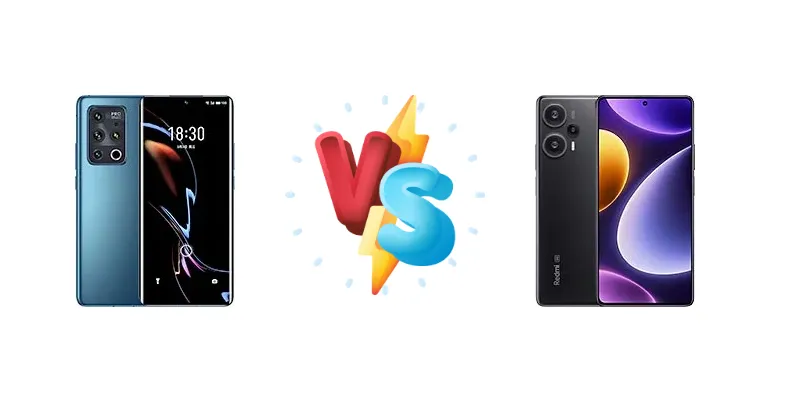
|
🏆 Quick Verdict
For most users, the Xiaomi Redmi Note 12 Turbo offers a more compelling package. Its Snapdragon 7+ Gen 2 delivers excellent performance with superior thermal management and faster charging, all at a potentially lower price point. The Meizu 18 Pro remains a viable option for those prioritizing a compact form factor and wireless charging.
| PHONES | ||
|---|---|---|
| Phone Names | Meizu 18 Pro | Xiaomi Redmi Note 12 Turbo |
| Network | ||
|---|---|---|
| 2G bands | GSM 850 / 900 / 1800 / 1900 | GSM 850 / 900 / 1800 / 1900 |
| 3G bands | HSDPA 850 / 900 / 1700(AWS) / 1900 / 2100 | HSDPA 800 / 850 / 900 / 2100 |
| 4G bands | 1, 2, 3, 4, 5, 7, 8, 12, 34, 38, 39, 40, 41 | 1, 3, 5, 8, 19, 34, 38, 39, 40, 41, 42 |
| 5G bands | 1, 3, 41, 77, 78, 79 SA/NSA | 1, 3, 5, 8, 28, 38, 41, 77, 78 SA/NSA |
| Speed | HSPA, LTE, 5G | HSPA, LTE, 5G |
| Technology | GSM / HSPA / LTE / 5G | GSM / HSPA / CDMA2000 / LTE / 5G |
| - | CDMA2000 1x | |
| Launch | ||
|---|---|---|
| Announced | 2021, March 03. Released 2021, March 08 | 2023, March 28 |
| Status | Discontinued | Available. Released 2023, March 28 |
| Body | ||
|---|---|---|
| Build | - | Glass front, plastic frame, plastic back |
| Dimensions | 162.5 x 73 x 8.1 mm (6.40 x 2.87 x 0.32 in) | 161.1 x 75 x 7.9 mm (6.34 x 2.95 x 0.31 in) |
| SIM | Nano-SIM + Nano-SIM | Nano-SIM + Nano-SIM |
| Weight | 189 g (6.67 oz) | 181 g (6.38 oz) |
| Waterproof | - | |
| Display | ||
|---|---|---|
| Protection | Corning Gorilla Glass 6 | - |
| Resolution | 1440 x 3200 pixels, 20:9 ratio (~526 ppi density) | 1080 x 2400 pixels, 20:9 ratio (~395 ppi density) |
| Size | 6.7 inches, 107.6 cm2 (~90.7% screen-to-body ratio) | 6.67 inches, 107.4 cm2 (~88.9% screen-to-body ratio) |
| Type | Super AMOLED, 120Hz, HDR10+, 420 nits (typ), 1300 nits (peak) | OLED, 68B colors, 120Hz, Dolby Vision, HDR10+, 1000 nits (HBM) |
| Platform | ||
|---|---|---|
| CPU | Octa-core (1x2.84 GHz Cortex-X1 & 3x2.42 GHz Cortex-A78 & 4x1.80 GHz Cortex-A55) | Octa-core (1x2.91 GHz Cortex-X2 & 3x2.49 GHz Cortex-A710 & 4x1.8 GHz Cortex-A510) |
| Chipset | Qualcomm SM8350 Snapdragon 888 5G (5 nm) | Qualcomm SM7475-AB Snapdragon 7+ Gen 2 (4 nm) |
| GPU | Adreno 660 | Adreno 725 |
| OS | Android 11, Flyme 9 | Android 13, MIUI 14 |
| Memory | ||
|---|---|---|
| Card slot | No | No |
| Internal | 128GB 8GB RAM, 256GB 8GB RAM, 256GB 12GB RAM | 256GB 8GB RAM, 256GB 12GB RAM, 256GB 16GB RAM, 512GB 12GB RAM, 1TB 16GB RAM |
| UFS 3.1 | UFS 3.1 | |
| Main Camera | ||
|---|---|---|
| Features | LED flash, HDR, panorama | LED flash, HDR, panorama |
| Triple | 50 MP, f/1.9, 23mm (wide), 1/1.31", 1.2µm, dual pixel PDAF, OIS 8 MP f/2.4, 79mm (telephoto), 1/4.4", 1.0µm, PDAF, 3x optical zoom 32 MP, f/2.2, 15mm, 130˚ (ultrawide), 1/2.8", 0.8µm 0.3 MP, TOF 3D, f/1.4, (depth) | 64 MP, f/1.8, (wide), 1/2.0", 0.7µm, PDAF, OIS 8 MP, f/2.2, 120˚ (ultrawide), 1/4.0", 1.12µm 2 MP (macro) |
| Video | 8K, 4K@30/60fps, 1080p; gyro-EIS | 4K@30fps, 1080p@30/60/120/240fps |
| Selfie camera | ||
|---|---|---|
| Features | HDR | - |
| Single | 44 MP, f/2.4, (wide), 1/2.65”, 0.7µm | 16 MP, f/2.5, (wide) |
| Video | 4K@30fps, 1080p@30fps | 1080p@30/60fps |
| Sound | ||
|---|---|---|
| 3.5mm jack | No | Yes |
| 35mm jack | No | Yes |
| Loudspeaker | Yes, with stereo speakers | Yes, with stereo speakers |
| - | 24-bit/192kHz audio | |
| Comms | ||
|---|---|---|
| Bluetooth | 5.2, A2DP, LE | 5.3, A2DP, LE |
| Infrared port | - | Yes |
| NFC | Yes | Yes |
| Positioning | GPS (L1+L5), GLONASS, BDS, GALILEO, QZSS, NavIC | GPS (L1), GLONASS (G1), BDS (B1I+B1c), GALILEO (E1), QZSS (L1) |
| Radio | No | No |
| USB | USB Type-C | USB Type-C 2.0, OTG |
| WLAN | Wi-Fi 802.11 а/b/g/n/ac/6e, dual-band, Wi-Fi Direct | Wi-Fi 802.11 a/b/g/n/ac/6e, dual-band |
| Features | ||
|---|---|---|
| Sensors | Fingerprint (under display, ultrasonic), accelerometer, gyro, proximity, compass | Fingerprint (side-mounted), accelerometer, gyro, proximity, compass |
| Battery | ||
|---|---|---|
| Charging | 40W wired, PD3.0, QC4, 40% in 15 min, 100% in 50 min 40W wireless 10W reverse wireless | 67W wired, PD3.0, QC4 |
| Type | Li-Po 4500 mAh | Li-Po 5000 mAh |
| Misc | ||
|---|---|---|
| Colors | Blue, White, Gray | Black, Blue, White, Harry Potter Edition |
| Models | - | 23049RAD8C |
| Price | About 640 EUR | About 270 EUR |
Meizu 18 Pro
- Compact flagship form factor
- Wireless charging support
- Potentially superior camera system
- Snapdragon 888 prone to throttling
- Older chipset architecture
- Potentially higher price
Xiaomi Redmi Note 12 Turbo
- More efficient Snapdragon 7+ Gen 2
- Faster 67W wired charging
- Better value for money
- Lacks wireless charging
- May not have the same camera capabilities
- Larger form factor (likely)
Display Comparison
Neither device's display specifications are provided, so a direct comparison is limited. However, given the Meizu 18 Pro's flagship positioning, it likely features a higher-quality panel with potentially better color accuracy and peak brightness. The Redmi Note 12 Turbo, being a mid-range device, will likely prioritize cost-effectiveness. Bezels are likely comparable, but the Meizu's smaller size may result in a higher pixel density.
Camera Comparison
Without detailed camera specs, analysis is limited. However, the Meizu 18 Pro, as a former flagship, likely features a larger main sensor and more sophisticated image processing algorithms. The Redmi Note 12 Turbo will likely focus on delivering good image quality for its price point, but may lack the advanced features and low-light performance of the Meizu. We can assume both phones will have multiple lenses, but the Meizu is more likely to include features like optical image stabilization (OIS).
Performance
The core difference lies in the chipsets. The Meizu 18 Pro's Snapdragon 888 (5nm) boasts a Cortex-X1 prime core clocked at 2.84GHz, while the Redmi Note 12 Turbo utilizes the Snapdragon 7+ Gen 2 (4nm) with a Cortex-X2 prime core at 2.91GHz. While the 7+ Gen 2's clock speed is slightly higher, the 4nm process node provides a significant advantage in power efficiency and thermal performance. The Redmi Note 12 Turbo's newer architecture (Cortex-A710 vs A78) also contributes to improved sustained performance. The 888 is known to throttle under heavy load, a problem the 7+ Gen 2 largely avoids.
Battery Life
The Meizu 18 Pro offers both 40W wired and 40W wireless charging, alongside 10W reverse wireless. The Redmi Note 12 Turbo steps up the wired charging to 67W, but lacks wireless charging. The 67W charging on the Redmi Note 12 Turbo will significantly reduce charging times – a full charge in under 45 minutes is likely, compared to the Meizu’s 50 minutes. While battery capacity isn't specified, the Redmi Note 12 Turbo's more efficient chipset will likely translate to longer real-world battery life despite potentially having a similar or smaller battery capacity.
Buying Guide
Buy the Meizu 18 Pro if you absolutely need a smaller phone with a premium build and the convenience of wireless charging. You're willing to accept potentially more thermal throttling during extended gaming sessions. Buy the Xiaomi Redmi Note 12 Turbo if you prioritize sustained performance, faster charging speeds, and value for money. It's the better choice for gamers and power users who demand consistent responsiveness.