
Meizu 18 Pro vs. vivo X60 Pro+: A Deep Dive into Snapdragon 888 Flagships
| Phones Images | |||||
|---|---|---|---|---|---|
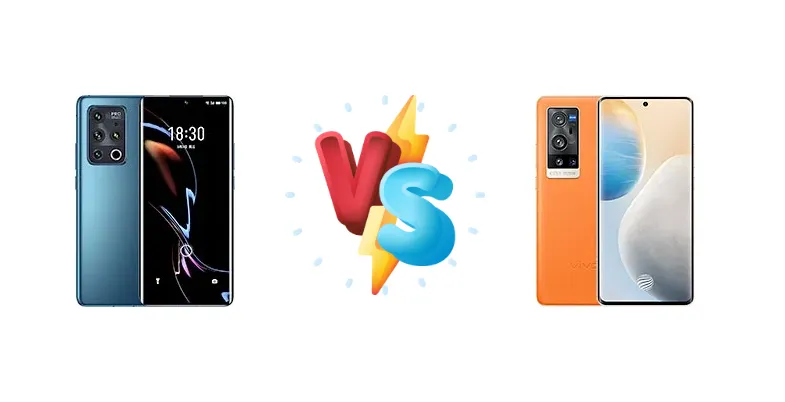
|
🏆 Quick Verdict
For most users, the vivo X60 Pro+ emerges as the stronger contender. Its 55W wired charging and reported 91-hour endurance rating provide a tangible advantage over the Meizu 18 Pro’s 40W charging and unspecified battery capacity. While both share the same processor, the X60 Pro+’s overall package offers a more refined and practical experience.
| PHONES | ||
|---|---|---|
| Phone Names | Meizu 18 Pro | vivo X60 Pro+ |
| Network | ||
|---|---|---|
| 2G bands | GSM 850 / 900 / 1800 / 1900 | GSM 850 / 900 / 1800 / 1900 |
| 3G bands | HSDPA 850 / 900 / 1700(AWS) / 1900 / 2100 | HSDPA 850 / 900 / 1700(AWS) / 1900 / 2100 |
| 4G bands | 1, 2, 3, 4, 5, 7, 8, 12, 34, 38, 39, 40, 41 | 1, 2, 3, 4, 5, 7, 8, 12, 17, 18, 19, 20, 26, 28, 34, 38, 39, 40, 41 - International |
| 5G bands | 1, 3, 41, 77, 78, 79 SA/NSA | 1, 28, 41, 77, 78 SA/NSA - International |
| Speed | HSPA, LTE, 5G | HSPA, LTE, 5G |
| Technology | GSM / HSPA / LTE / 5G | GSM / CDMA / HSPA / CDMA2000 / LTE / 5G |
| Launch | ||
|---|---|---|
| Announced | 2021, March 03. Released 2021, March 08 | 2021, January 21 |
| Status | Discontinued | Available. Released 2021, January 30 |
| Body | ||
|---|---|---|
| Build | - | Glass front, eco leather back, aluminum frame |
| Dimensions | 162.5 x 73 x 8.1 mm (6.40 x 2.87 x 0.32 in) | 158.6 x 73.4 x 9.1 mm (6.24 x 2.89 x 0.36 in) |
| SIM | Nano-SIM + Nano-SIM | Nano-SIM + Nano-SIM |
| Weight | 189 g (6.67 oz) | 191 g (6.74 oz) |
| Waterproof | - | |
| Display | ||
|---|---|---|
| Protection | Corning Gorilla Glass 6 | - |
| Resolution | 1440 x 3200 pixels, 20:9 ratio (~526 ppi density) | 1080 x 2376 pixels (~398 ppi density) |
| Size | 6.7 inches, 107.6 cm2 (~90.7% screen-to-body ratio) | 6.56 inches, 104.6 cm2 (~89.8% screen-to-body ratio) |
| Type | Super AMOLED, 120Hz, HDR10+, 420 nits (typ), 1300 nits (peak) | Super AMOLED, 120Hz, HDR10+, 1300 nits (peak) |
| Platform | ||
|---|---|---|
| CPU | Octa-core (1x2.84 GHz Cortex-X1 & 3x2.42 GHz Cortex-A78 & 4x1.80 GHz Cortex-A55) | Octa-core (1x2.84 GHz Cortex-X1 & 3x2.42 GHz Cortex-A78 & 4x1.80 GHz Cortex-A55 |
| Chipset | Qualcomm SM8350 Snapdragon 888 5G (5 nm) | Qualcomm SM8350 Snapdragon 888 5G (5 nm) |
| GPU | Adreno 660 | Adreno 660 |
| OS | Android 11, Flyme 9 | Android 11, Funtouch 12 (International), OriginOS 1.0 (China) |
| Memory | ||
|---|---|---|
| Card slot | No | No |
| Internal | 128GB 8GB RAM, 256GB 8GB RAM, 256GB 12GB RAM | 128GB 8GB RAM, 256GB 12GB RAM |
| UFS 3.1 | - | |
| Main Camera | ||
|---|---|---|
| Features | LED flash, HDR, panorama | Laser AF, color spectrum sensor, Zeiss optics, Zeiss T* lens coating, Pixel Shift, dual-LED dual-tone flash, HDR, panorama |
| Quad | - | 50 MP, f/1.6, (wide), 1/1.31", 1.2µm, dual pixel PDAF, OIS 8 MP, f/3.4, 125mm (periscope telephoto), 1/4.0", PDAF, OIS, 5x optical zoom 32 MP, f/2.1, 50mm (telephoto), 1/2.8", 0.8µm, PDAF, 2x optical zoom 48 MP, f/2.2, 114˚ (ultrawide), 1/2.0", 0.8µm, gimbal OIS, PDAF |
| Triple | 50 MP, f/1.9, 23mm (wide), 1/1.31", 1.2µm, dual pixel PDAF, OIS 8 MP f/2.4, 79mm (telephoto), 1/4.4", 1.0µm, PDAF, 3x optical zoom 32 MP, f/2.2, 15mm, 130˚ (ultrawide), 1/2.8", 0.8µm 0.3 MP, TOF 3D, f/1.4, (depth) | - |
| Video | 8K, 4K@30/60fps, 1080p; gyro-EIS | 8K@30fps, 4K@30/60fps, 1080p@30/60fps, gyro-EIS, HDR10+ |
| Selfie camera | ||
|---|---|---|
| Features | HDR | HDR |
| Single | 44 MP, f/2.4, (wide), 1/2.65”, 0.7µm | 32 MP, f/2.5, 24mm (wide), 1/2.8", 0.8µm |
| Video | 4K@30fps, 1080p@30fps | 1080p@30fps |
| Sound | ||
|---|---|---|
| 3.5mm jack | No | - |
| 35mm jack | No | No |
| Loudspeaker | Yes, with stereo speakers | Yes |
| Comms | ||
|---|---|---|
| Bluetooth | 5.2, A2DP, LE | 5.2, A2DP, LE, aptX HD |
| NFC | Yes | Yes |
| Positioning | GPS (L1+L5), GLONASS, BDS, GALILEO, QZSS, NavIC | GPS (L1+L5), GLONASS, BDS, GALILEO, NavIC |
| Radio | No | No |
| USB | USB Type-C | USB Type-C 2.0, OTG |
| WLAN | Wi-Fi 802.11 а/b/g/n/ac/6e, dual-band, Wi-Fi Direct | Wi-Fi 802.11 a/b/g/n/ac/6, dual-band, Wi-Fi Direct |
| Features | ||
|---|---|---|
| Sensors | Fingerprint (under display, ultrasonic), accelerometer, gyro, proximity, compass | Fingerprint (under display, optical), accelerometer, gyro, compass |
| Battery | ||
|---|---|---|
| Charging | 40W wired, PD3.0, QC4, 40% in 15 min, 100% in 50 min 40W wireless 10W reverse wireless | 55W wired |
| Type | Li-Po 4500 mAh | 4200 mAh |
| Misc | ||
|---|---|---|
| Colors | Blue, White, Gray | Orange, Emperor Blue |
| Models | - | V2056A, V2047 |
| Price | About 640 EUR | About 800 EUR |
| SAR | - | 0.80 W/kg (head) 0.47 W/kg (body) |
Meizu 18 Pro
- 40W Wireless Charging offers convenience.
- 10W Reverse Wireless Charging for accessories.
- Potentially more compact design (based on Meizu's history).
- Slower 40W wired charging.
- Unspecified battery capacity and endurance.
- Limited camera information.
vivo X60 Pro+
- Faster 55W wired charging.
- Excellent 91-hour endurance rating.
- Likely superior camera system (based on brand reputation).
- No wireless charging.
- Larger size potentially less comfortable for some users.
- Limited information on display technology beyond peak brightness.
Display Comparison
The vivo X60 Pro+ boasts a measured peak brightness of 816 nits, suggesting a more visible display in direct sunlight compared to the Meizu 18 Pro, for which display brightness data is unavailable. While both likely utilize high-refresh-rate AMOLED panels, the X60 Pro+'s higher peak brightness provides a clear advantage for outdoor visibility. Without further data on the Meizu 18 Pro’s panel technology (LTPO, PWM dimming rate), it’s difficult to assess its overall display quality beyond resolution assumptions.
Camera Comparison
The vivo X60 Pro+ is explicitly marketed for its camera capabilities, though specific sensor details are missing. The Meizu 18 Pro’s camera specs are also absent. Given vivo’s history of camera innovation, it’s reasonable to assume the X60 Pro+ features a more sophisticated camera system with larger sensors and advanced image processing algorithms. The absence of details on the Meizu 18 Pro’s camera makes a direct comparison impossible, but the X60 Pro+ likely excels in low-light photography and video recording due to its brand focus. We can safely ignore any potential 2MP macro lenses on either device as they offer minimal practical benefit.
Performance
Both the Meizu 18 Pro and vivo X60 Pro+ are powered by the Qualcomm SM8350 Snapdragon 888 5G (5 nm) chipset, featuring an octa-core CPU configuration with 1x2.84 GHz Cortex-X1, 3x2.42 GHz Cortex-A78, and 4x1.80 GHz Cortex-A55 cores. Performance will be largely comparable in CPU-bound tasks. However, thermal management, which isn’t specified for either device, will dictate sustained performance under heavy load. The X60 Pro+’s larger size *potentially* allows for a more effective cooling solution, mitigating thermal throttling during extended gaming sessions. Both devices likely utilize LPDDR5 RAM, but the speed (e.g., LPDDR5X) remains unknown.
Battery Life
The vivo X60 Pro+ claims an impressive endurance rating of 91 hours, indicating superior battery life compared to the Meizu 18 Pro. While the Meizu 18 Pro offers both 40W wired and 40W wireless charging, along with 10W reverse wireless charging, the X60 Pro+ counters with a faster 55W wired charging solution. The X60 Pro+'s faster charging, combined with its longer endurance, makes it the more convenient option for users who prioritize minimizing downtime. The Meizu 18 Pro’s 40W wired charging reaches 40% in 15 minutes and 100% in 50 minutes, while the X60 Pro+'s 55W charging is expected to be faster, though specific times are unavailable.
Buying Guide
Buy the Meizu 18 Pro if you prioritize wireless charging convenience with its 40W capability and appreciate a potentially more compact form factor (based on brand history). Buy the vivo X60 Pro+ if you value faster wired charging, longer battery life, and a more robust camera system geared towards photography enthusiasts. The X60 Pro+ is the better choice for power users and those who frequently capture photos and videos.