
Meizu 18 Pro vs Oppo Find X3 Pro: A Deep Dive into Flagship Performance and Charging
| Phones Images | |||||
|---|---|---|---|---|---|
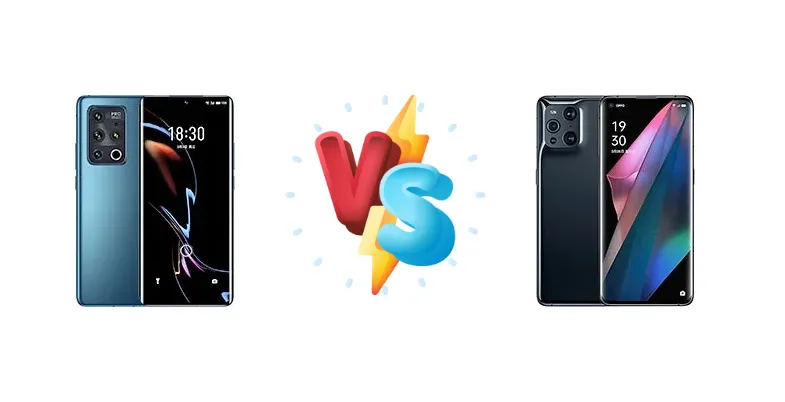
|
🏆 Quick Verdict
For most users, the Oppo Find X3 Pro emerges as the slightly stronger choice. While both phones share the Snapdragon 888, the Oppo’s superior display brightness and endurance rating, coupled with its faster wired charging, provide a more polished and versatile daily experience. However, the Meizu 18 Pro’s 40W wireless charging is a compelling alternative for those prioritizing cable-free power.
| PHONES | ||
|---|---|---|
| Phone Names | Meizu 18 Pro | Oppo Find X3 Pro |
| Network | ||
|---|---|---|
| 2G bands | GSM 850 / 900 / 1800 / 1900 | GSM 850 / 900 / 1800 / 1900 |
| 3G bands | HSDPA 850 / 900 / 1700(AWS) / 1900 / 2100 | HSDPA 800 / 850 / 900 / 1700(AWS) / 1900 / 2100 |
| 4G bands | 1, 2, 3, 4, 5, 7, 8, 12, 34, 38, 39, 40, 41 | 1, 2, 3, 4, 5, 7, 8, 12, 13, 17, 18, 19, 20, 25, 26, 28, 32, 34, 38, 39, 40, 41, 42, 66 - International |
| 5G bands | 1, 3, 41, 77, 78, 79 SA/NSA | 1, 3, 5, 7, 8, 20, 28, 38, 40, 41, 77, 78, 79 SA/NSA - International |
| Speed | HSPA, LTE, 5G | HSPA, LTE, 5G |
| Technology | GSM / HSPA / LTE / 5G | GSM / CDMA / HSPA / CDMA2000 / LTE / 5G |
| - | 1, 2, 3, 5, 7, 8, 12, 20, 28, 38, 40, 41, 66, 77, 78, 79 SA/NSA - China | |
| Launch | ||
|---|---|---|
| Announced | 2021, March 03. Released 2021, March 08 | 2021, March 11 |
| Status | Discontinued | Available. Released 2021, March 19 |
| Body | ||
|---|---|---|
| Build | - | Glass front (Gorilla Glass 5), glass back (Gorilla Glass 5), aluminum frame |
| Dimensions | 162.5 x 73 x 8.1 mm (6.40 x 2.87 x 0.32 in) | 163.6 x 74 x 8.3 mm (6.44 x 2.91 x 0.33 in) |
| SIM | Nano-SIM + Nano-SIM | Nano-SIM + eSIM |
| Weight | 189 g (6.67 oz) | 193 g (6.81 oz) |
| Waterproof | IP68 dust/water resistant (up to 1.5m for 30 min) | |
| Display | ||
|---|---|---|
| Protection | Corning Gorilla Glass 6 | Corning Gorilla Glass 5 |
| Resolution | 1440 x 3200 pixels, 20:9 ratio (~526 ppi density) | 1440 x 3216 pixels, 20:9 ratio (~525 ppi density) |
| Size | 6.7 inches, 107.6 cm2 (~90.7% screen-to-body ratio) | 6.7 inches, 108.4 cm2 (~89.6% screen-to-body ratio) |
| Type | Super AMOLED, 120Hz, HDR10+, 420 nits (typ), 1300 nits (peak) | LTPO AMOLED, 1B colors, 120Hz, HDR10+, BT.2020, 500 nits (typ), 1300 nits (peak) |
| Platform | ||
|---|---|---|
| CPU | Octa-core (1x2.84 GHz Cortex-X1 & 3x2.42 GHz Cortex-A78 & 4x1.80 GHz Cortex-A55) | Octa-core (1x2.84 GHz Cortex-X1 & 3x2.42 GHz Cortex-A78 & 4x1.80 GHz Cortex-A55) |
| Chipset | Qualcomm SM8350 Snapdragon 888 5G (5 nm) | Qualcomm SM8350 Snapdragon 888 5G (5 nm) |
| GPU | Adreno 660 | Adreno 660 |
| OS | Android 11, Flyme 9 | Android 11, upgradable to Android 14, ColorOS 14 |
| Memory | ||
|---|---|---|
| Card slot | No | No |
| Internal | 128GB 8GB RAM, 256GB 8GB RAM, 256GB 12GB RAM | 256GB 8GB RAM, 256GB 12GB RAM, 512GB 16GB RAM |
| UFS 3.1 | UFS 3.1 | |
| Main Camera | ||
|---|---|---|
| Features | LED flash, HDR, panorama | Color spectrum sensor, LED flash, HDR, panorama |
| Quad | - | 50 MP, f/1.8, 26mm (wide), 1/1.56", 1.0µm, multi-directional PDAF, OIS 13 MP, f/2.4, 52mm (telephoto), 1/3.4", 1.0µm, 2x optical zoom, PDAF 50 MP, f/2.2, 16mm, 110˚ (ultrawide), 1/1.56", 1.0µm, multi-directional PDAF 3 MP, f/3.0, (microscope), AF, ring flash, 60x magnification |
| Triple | 50 MP, f/1.9, 23mm (wide), 1/1.31", 1.2µm, dual pixel PDAF, OIS 8 MP f/2.4, 79mm (telephoto), 1/4.4", 1.0µm, PDAF, 3x optical zoom 32 MP, f/2.2, 15mm, 130˚ (ultrawide), 1/2.8", 0.8µm 0.3 MP, TOF 3D, f/1.4, (depth) | - |
| Video | 8K, 4K@30/60fps, 1080p; gyro-EIS | 4K@30/60fps, 1080p@30/60/240fps; gyro-EIS; HDR, 10‑bit video |
| Selfie camera | ||
|---|---|---|
| Features | HDR | Panorama |
| Single | 44 MP, f/2.4, (wide), 1/2.65”, 0.7µm | 32 MP, f/2.4, 26mm (wide), 1/2.8", 0.8µm |
| Video | 4K@30fps, 1080p@30fps | 1080p@30fps |
| Sound | ||
|---|---|---|
| 3.5mm jack | No | No |
| 35mm jack | No | No |
| Loudspeaker | Yes, with stereo speakers | Yes, with stereo speakers |
| Comms | ||
|---|---|---|
| Bluetooth | 5.2, A2DP, LE | 5.2, A2DP, LE, aptX HD |
| NFC | Yes | Yes |
| Positioning | GPS (L1+L5), GLONASS, BDS, GALILEO, QZSS, NavIC | GPS (L1+L5), GLONASS (L1), BDS (B1I+B1c+B2a), GALILEO (E1+E5a), QZSS (L1+L5) |
| Radio | No | No |
| USB | USB Type-C | USB Type-C 3.1, OTG |
| WLAN | Wi-Fi 802.11 а/b/g/n/ac/6e, dual-band, Wi-Fi Direct | Wi-Fi 802.11 a/b/g/n/ac/6, dual-band, Wi-Fi Direct |
| Features | ||
|---|---|---|
| Sensors | Fingerprint (under display, ultrasonic), accelerometer, gyro, proximity, compass | Fingerprint (under display, optical), accelerometer, gyro, proximity, compass |
| Battery | ||
|---|---|---|
| Charging | 40W wired, PD3.0, QC4, 40% in 15 min, 100% in 50 min 40W wireless 10W reverse wireless | 65W wired, PD, 40% in 10 min 30W wireless, 100% in 80 min 10W reverse wireless |
| Type | Li-Po 4500 mAh | Li-Po 4500 mAh |
| Misc | ||
|---|---|---|
| Colors | Blue, White, Gray | Gloss Black, Blue, White, Cosmic Mocha, Mars Edition, Photographer Edition |
| Models | - | CPH2173, PEEM00, OPG03 |
| Price | About 640 EUR | About 200 EUR |
| Tests | ||
|---|---|---|
| Battery life | - | Endurance rating 81h |
| Camera | - | Photo / Video |
| Display | - | Contrast ratio: Infinite (nominal) |
| Loudspeaker | - | -25.4 LUFS (Very good) |
| Performance | - | AnTuTu: 656467 (v8) GeekBench: 3316 (v5.1) GFXBench: 33fps (ES 3.1 onscreen) |
Meizu 18 Pro
- 40W Wireless Charging - Faster than many competitors.
- Potentially more compact design (based on brand reputation).
- Snapdragon 888 provides flagship performance.
- Limited information on display specs.
- Camera details are unknown, making comparison difficult.
Oppo Find X3 Pro
- Brighter Display - 774 nits for excellent outdoor visibility.
- Faster Wired Charging - 65W for rapid power-ups.
- Strong Endurance Rating - 81 hours of typical use.
- Wireless charging is slower than Meizu 18 Pro (30W vs 40W).
- Larger size may not appeal to all users.
Display Comparison
The Oppo Find X3 Pro boasts a significantly brighter display, reaching a measured 774 nits. While the Meizu 18 Pro’s display specs aren’t provided, the Oppo’s higher peak brightness translates to superior readability under direct sunlight. Both likely utilize high refresh rate panels, but the Oppo’s contrast ratio is listed as infinite (nominal), suggesting a deeper black level and more vibrant colors. The lack of detailed display information for the Meizu makes a direct comparison challenging, but the Oppo clearly holds an advantage in raw display performance.
Camera Comparison
Both devices are listed as having Photo/Video capabilities, but detailed camera specifications are absent for the Meizu 18 Pro. The Oppo Find X3 Pro is known for its innovative camera system, though specific sensor details aren’t provided here. The absence of information regarding sensor size, OIS, and lens apertures on the Meizu makes a meaningful comparison impossible. We can assume both utilize multi-camera setups, but the Oppo’s reputation suggests a more sophisticated imaging experience. Ignoring potential 2MP macro sensors, the Oppo likely offers a more versatile and capable camera system.
Performance
Both the Meizu 18 Pro and Oppo Find X3 Pro are powered by the Qualcomm SM8350 Snapdragon 888 5G (5 nm) chipset, featuring the same Octa-core CPU configuration (1x2.84 GHz Cortex-X1, 3x2.42 GHz Cortex-A78, 4x1.80 GHz Cortex-A55). This means CPU performance will be virtually identical. However, thermal management and RAM speed (likely LPDDR5 in both) could create minor differences. The 5nm process node helps mitigate throttling, but sustained workloads could still lead to performance dips. Without specific thermal testing data, it’s difficult to declare a clear winner, but the Oppo’s larger chassis *may* offer slightly better heat dissipation.
Battery Life
The Oppo Find X3 Pro has an endurance rating of 81 hours, indicating solid battery life. While the Meizu 18 Pro’s battery capacity isn’t specified, the charging speeds are a key differentiator. The Oppo supports 65W wired charging, achieving 40% charge in just 10 minutes, while the Meizu tops out at 40W, taking 15 minutes for 40% and 50 minutes for a full charge. The Oppo also offers a faster wireless charging solution at 30W (100% in 80 minutes) compared to the Meizu’s 40W wireless. Both offer 10W reverse wireless charging. The Oppo’s faster wired charging is a significant advantage for users who frequently need to quickly top up their battery.
Buying Guide
Buy the Meizu 18 Pro if you prioritize a more compact flagship experience and value the convenience of 40W wireless charging. It’s ideal for users who frequently use wireless charging and prefer a phone that’s easier to handle. Buy the Oppo Find X3 Pro if you prioritize display quality, particularly outdoor visibility, and want a phone with consistently fast wired charging. This is the better choice for media consumers and photography enthusiasts.