
Meizu 18 Pro vs Meizu 20 Pro: A Detailed Showdown
| Phones Images | |||||
|---|---|---|---|---|---|
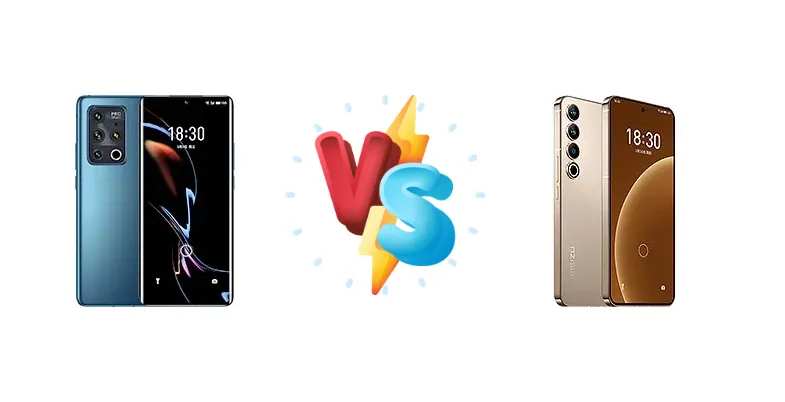
|
🏆 Quick Verdict
The Meizu 20 Pro is the clear winner, boasting a significantly faster Snapdragon 8 Gen 2 chipset, faster charging, and improved wireless charging. While the 18 Pro remains a capable device, the 20 Pro's advancements make it the superior choice for performance-focused users.
| PHONES | ||
|---|---|---|
| Phone Names | Meizu 18 Pro | Meizu 20 Pro |
| Network | ||
|---|---|---|
| 2G bands | GSM 850 / 900 / 1800 / 1900 | GSM 850 / 900 / 1800 / 1900 |
| 3G bands | HSDPA 850 / 900 / 1700(AWS) / 1900 / 2100 | HSDPA 850 / 900 / 1900 / 2100 |
| 4G bands | 1, 2, 3, 4, 5, 7, 8, 12, 34, 38, 39, 40, 41 | 1, 2, 3, 4, 5, 7, 8, 12, 28, 34, 38, 39, 40, 41 |
| 5G bands | 1, 3, 41, 77, 78, 79 SA/NSA | 1, 3, 5, 8, 28, 38, 41, 77, 78, 79 SA/NSA |
| Speed | HSPA, LTE, 5G | HSPA, LTE, 5G |
| Technology | GSM / HSPA / LTE / 5G | GSM / HSPA / LTE / 5G |
| Launch | ||
|---|---|---|
| Announced | 2021, March 03. Released 2021, March 08 | 2023, March 30 |
| Status | Discontinued | Available. Released 2023, June 20 |
| Body | ||
|---|---|---|
| Dimensions | 162.5 x 73 x 8.1 mm (6.40 x 2.87 x 0.32 in) | 164.2 x 76.4 x 7.8 mm (6.46 x 3.01 x 0.31 in) |
| SIM | Nano-SIM + Nano-SIM | Nano-SIM + Nano-SIM |
| Weight | 189 g (6.67 oz) | 209 g (7.37 oz) |
| Waterproof | IP54 | |
| Display | ||
|---|---|---|
| Protection | Corning Gorilla Glass 6 | - |
| Resolution | 1440 x 3200 pixels, 20:9 ratio (~526 ppi density) | 1440 x 3200 pixels, 20:9 ratio (~515 ppi density) |
| Size | 6.7 inches, 107.6 cm2 (~90.7% screen-to-body ratio) | 6.81 inches, 112.0 cm2 (~89.3% screen-to-body ratio) |
| Type | Super AMOLED, 120Hz, HDR10+, 420 nits (typ), 1300 nits (peak) | LTPO OLED, 120Hz, HDR10+, 500 nits (typ), 1800 nits (peak) |
| Platform | ||
|---|---|---|
| CPU | Octa-core (1x2.84 GHz Cortex-X1 & 3x2.42 GHz Cortex-A78 & 4x1.80 GHz Cortex-A55) | Octa-core (1x3.2 GHz Cortex-X3 & 2x2.8 GHz Cortex-A715 & 2x2.8 GHz Cortex-A710 & 3x2.0 GHz Cortex-A510) |
| Chipset | Qualcomm SM8350 Snapdragon 888 5G (5 nm) | Qualcomm SM8550-AB Snapdragon 8 Gen 2 (4 nm) |
| GPU | Adreno 660 | Adreno 740 |
| OS | Android 11, Flyme 9 | Android 13, Flyme 10 |
| Memory | ||
|---|---|---|
| Card slot | No | No |
| Internal | 128GB 8GB RAM, 256GB 8GB RAM, 256GB 12GB RAM | 128GB 12GB RAM, 256GB 12GB RAM, 512GB 12GB RAM |
| UFS 3.1 | UFS 4.0 - 512GB | |
| Main Camera | ||
|---|---|---|
| Features | LED flash, HDR, panorama | Ring-LED flash, panorama, HDR |
| Triple | 50 MP, f/1.9, 23mm (wide), 1/1.31", 1.2µm, dual pixel PDAF, OIS 8 MP f/2.4, 79mm (telephoto), 1/4.4", 1.0µm, PDAF, 3x optical zoom 32 MP, f/2.2, 15mm, 130˚ (ultrawide), 1/2.8", 0.8µm 0.3 MP, TOF 3D, f/1.4, (depth) | 50 MP, f/1.9, (wide), PDAF, OIS 50 MP f/1.9, (telephoto), PDAF, 2x optical zoom 50 MP, f/2.2, 129˚ (ultrawide) |
| Video | 8K, 4K@30/60fps, 1080p; gyro-EIS | 8K, 4K, 1080p; gyro-EIS |
| Selfie camera | ||
|---|---|---|
| Features | HDR | HDR |
| Single | 44 MP, f/2.4, (wide), 1/2.65”, 0.7µm | 32 MP, f/2.5, (wide) |
| Video | 4K@30fps, 1080p@30fps | Yes |
| Sound | ||
|---|---|---|
| 3.5mm jack | No | No |
| 35mm jack | No | No |
| Loudspeaker | Yes, with stereo speakers | Yes, with stereo speakers |
| Comms | ||
|---|---|---|
| Bluetooth | 5.2, A2DP, LE | 5.3, A2DP, LE |
| Infrared port | - | Yes |
| NFC | Yes | Yes |
| Positioning | GPS (L1+L5), GLONASS, BDS, GALILEO, QZSS, NavIC | GPS (L1+L5), GLONASS, BDS (B1I+B1c+B2a), GALILEO, QZSS |
| Radio | No | No |
| USB | USB Type-C | USB Type-C |
| WLAN | Wi-Fi 802.11 а/b/g/n/ac/6e, dual-band, Wi-Fi Direct | Wi-Fi 802.11 а/b/g/n/ac/6e/7, tri-band |
| Features | ||
|---|---|---|
| Sensors | Fingerprint (under display, ultrasonic), accelerometer, gyro, proximity, compass | Fingerprint (under display, ultrasonic), accelerometer, gyro, proximity, compass |
| Battery | ||
|---|---|---|
| Charging | 40W wired, PD3.0, QC4, 40% in 15 min, 100% in 50 min 40W wireless 10W reverse wireless | 80W wired, PD3 PPS, QC4+ 50W wireless |
| Type | Li-Po 4500 mAh | Li-Po 5000 mAh |
| Misc | ||
|---|---|---|
| Colors | Blue, White, Gray | Gray, Gold, Silver |
| Price | About 640 EUR | About 530 EUR |
Meizu 18 Pro
- Stylish Design
- Good Performance (Snapdragon 888)
- 40W Wired Charging
- 10W Reverse Wireless Charging
- Slower Charging than 20 Pro
- Older Chipset
- Camera not as advanced
Meizu 20 Pro
- Flagship Performance (Snapdragon 8 Gen 2)
- 80W Wired Charging
- 50W Wireless Charging
- Improved Camera
- Higher Price
- Potential Software Quirks (Meizu's Flyme OS)
Display Comparison
Both phones feature vibrant AMOLED displays, but the Meizu 20 Pro likely has a slightly higher peak brightness and potentially a more refined color calibration due to the newer generation panel. The 18 Pro's display is still excellent, offering smooth visuals and accurate colors.
Camera Comparison
While both phones offer capable camera systems, the Meizu 20 Pro likely features improved image processing and potentially a larger sensor for better low-light performance. Expect more detail and dynamic range from the 20 Pro's camera. The 18 Pro's camera is still good, but not as advanced.
Performance
The Snapdragon 8 Gen 2 in the Meizu 20 Pro offers a substantial performance leap over the Snapdragon 888 in the 18 Pro. Expect noticeably faster app loading, smoother multitasking, and improved gaming performance on the 20 Pro. The 20 Pro's CPU architecture is also more efficient.
Battery Life
The Meizu 20 Pro's 80W wired charging is a game-changer compared to the 18 Pro's 40W. The 50W wireless charging is also a significant upgrade. Both phones likely have similar battery capacities, but the 20 Pro's faster charging means quicker top-ups.
Buying Guide
The Meizu 18 Pro is a good option for budget-conscious buyers who still want a flagship experience and appreciate Meizu's design. The Meizu 20 Pro is ideal for users who demand top-tier performance, faster charging, and the latest features, and are willing to pay a premium.