
Meizu 18 Pro vs. Meizu 18: A Deep Dive into Two Compact Flagships
| Phones Images | |||||
|---|---|---|---|---|---|
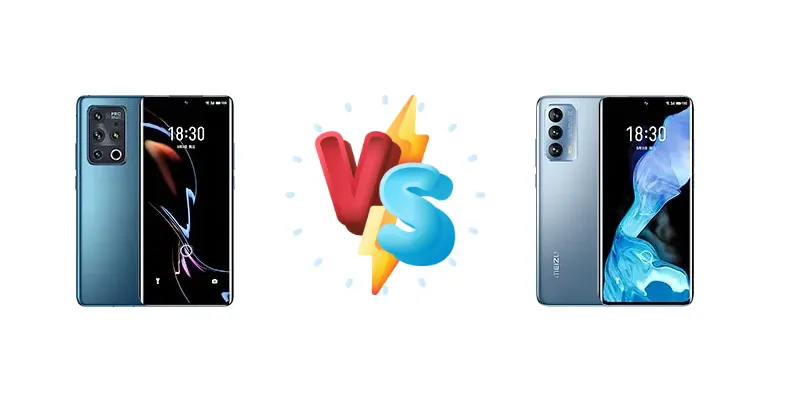
|
🏆 Quick Verdict
For most users, the Meizu 18 Pro emerges as the superior choice. Its 40W wired and wireless charging, coupled with 10W reverse wireless charging, significantly enhances convenience compared to the 18's 36W wired charging. While the core performance remains identical, the Pro's charging advantages justify the price premium.
| PHONES | ||
|---|---|---|
| Phone Names | Meizu 18 Pro | Meizu 18 |
| Network | ||
|---|---|---|
| 2G bands | GSM 850 / 900 / 1800 / 1900 | GSM 850 / 900 / 1800 / 1900 |
| 3G bands | HSDPA 850 / 900 / 1700(AWS) / 1900 / 2100 | HSDPA 850 / 900 / 1900 / 2100 |
| 4G bands | 1, 2, 3, 4, 5, 7, 8, 12, 34, 38, 39, 40, 41 | 1, 3, 4, 5, 7, 8, 34, 38, 39, 40, 41 |
| 5G bands | 1, 3, 41, 77, 78, 79 SA/NSA | 1, 3, 41, 77, 78, 79 SA/NSA |
| Speed | HSPA, LTE, 5G | HSPA, LTE, 5G |
| Technology | GSM / HSPA / LTE / 5G | GSM / HSPA / LTE / 5G |
| Launch | ||
|---|---|---|
| Announced | 2021, March 03. Released 2021, March 08 | 2021, March 03. Released 2021, March 08 |
| Status | Discontinued | Discontinued |
| Body | ||
|---|---|---|
| Dimensions | 162.5 x 73 x 8.1 mm (6.40 x 2.87 x 0.32 in) | 152.4 x 69.2 x 8.2 mm (6.00 x 2.72 x 0.32 in) |
| SIM | Nano-SIM + Nano-SIM | Nano-SIM + Nano-SIM |
| Weight | 189 g (6.67 oz) | 162 g (5.71 oz) |
| Waterproof | - | |
| Display | ||
|---|---|---|
| Protection | Corning Gorilla Glass 6 | - |
| Resolution | 1440 x 3200 pixels, 20:9 ratio (~526 ppi density) | 1440 x 3200 pixels, 20:9 ratio (~563 ppi density) |
| Size | 6.7 inches, 107.6 cm2 (~90.7% screen-to-body ratio) | 6.2 inches, 93.8 cm2 (~88.9% screen-to-body ratio) |
| Type | Super AMOLED, 120Hz, HDR10+, 420 nits (typ), 1300 nits (peak) | Super AMOLED, 120Hz, HDR10+, 420 nits (typ), 1300 nits (peak) |
| Platform | ||
|---|---|---|
| CPU | Octa-core (1x2.84 GHz Cortex-X1 & 3x2.42 GHz Cortex-A78 & 4x1.80 GHz Cortex-A55) | Octa-core (1x2.84 GHz Cortex-X1 & 3x2.42 GHz Cortex-A78 & 4x1.80 GHz Cortex-A55) |
| Chipset | Qualcomm SM8350 Snapdragon 888 5G (5 nm) | Qualcomm SM8350 Snapdragon 888 5G (5 nm) |
| GPU | Adreno 660 | Adreno 660 |
| OS | Android 11, Flyme 9 | Android 11, Flyme 9 |
| Memory | ||
|---|---|---|
| Card slot | No | No |
| Internal | 128GB 8GB RAM, 256GB 8GB RAM, 256GB 12GB RAM | 128GB 8GB RAM, 256GB 8GB RAM, 256GB 12GB RAM |
| UFS 3.1 | UFS 3.1 | |
| Main Camera | ||
|---|---|---|
| Features | LED flash, HDR, panorama | Dual-LED dual-tone flash, HDR, panorama |
| Triple | 50 MP, f/1.9, 23mm (wide), 1/1.31", 1.2µm, dual pixel PDAF, OIS 8 MP f/2.4, 79mm (telephoto), 1/4.4", 1.0µm, PDAF, 3x optical zoom 32 MP, f/2.2, 15mm, 130˚ (ultrawide), 1/2.8", 0.8µm 0.3 MP, TOF 3D, f/1.4, (depth) | 64 MP, f/1.6, 26mm (wide), 1/1.73", 0.8µm, PDAF, OIS 8 MP f/2.4, 79mm (telephoto), 1/4.4", 1.0µm, PDAF, 3x optical zoom 16 MP, f/2.2, 15mm, 122˚ (ultrawide), 1/3.0", 1.0µm |
| Video | 8K, 4K@30/60fps, 1080p; gyro-EIS | 4K@30/60fps, 1080p; gyro-EIS |
| Selfie camera | ||
|---|---|---|
| Features | HDR | HDR |
| Single | 44 MP, f/2.4, (wide), 1/2.65”, 0.7µm | 20 MP, f/2.2, 26mm (wide), 1/3.4", 0.8µm |
| Video | 4K@30fps, 1080p@30fps | 1080p@30fps |
| Sound | ||
|---|---|---|
| 3.5mm jack | No | No |
| 35mm jack | No | No |
| Loudspeaker | Yes, with stereo speakers | Yes, with stereo speakers |
| Comms | ||
|---|---|---|
| Bluetooth | 5.2, A2DP, LE | 5.2, A2DP, LE |
| NFC | Yes | Yes |
| Positioning | GPS (L1+L5), GLONASS, BDS, GALILEO, QZSS, NavIC | GPS (L1+L5), GLONASS, BDS, GALILEO, QZSS, NavIC |
| Radio | No | No |
| USB | USB Type-C | USB Type-C |
| WLAN | Wi-Fi 802.11 а/b/g/n/ac/6e, dual-band, Wi-Fi Direct | Wi-Fi 802.11 а/b/g/n/ac/6e, dual-band, Wi-Fi Direct |
| Features | ||
|---|---|---|
| Sensors | Fingerprint (under display, ultrasonic), accelerometer, gyro, proximity, compass | Fingerprint (under display, ultrasonic), accelerometer, gyro, proximity, compass |
| Battery | ||
|---|---|---|
| Charging | 40W wired, PD3.0, QC4, 40% in 15 min, 100% in 50 min 40W wireless 10W reverse wireless | 36W wired, PD3.0, QC3, 40% in 15 min, 100% in 50 min |
| Type | Li-Po 4500 mAh | Li-Po 4000 mAh |
| Misc | ||
|---|---|---|
| Colors | Blue, White, Gray | Light Blue, White, Aurora |
| Price | About 640 EUR | About 560 EUR |
Meizu 18 Pro
- Faster 40W wired charging
- 40W wireless charging support
- 10W reverse wireless charging
- Potentially better thermal management
- Likely higher price
- Potentially larger size/weight
Meizu 18
- More affordable price
- Compact and lightweight design
- Same Snapdragon 888 performance
- Still offers fast 36W wired charging
- Slower charging speeds
- No wireless charging
- No reverse wireless charging
Display Comparison
Both the Meizu 18 and 18 Pro utilize AMOLED displays, though specific details like peak brightness and refresh rate aren't provided. The shared compact form factor suggests a focus on usability and one-handed operation. Without further data, it's difficult to assess differences in color accuracy or HDR support, but the Pro model, being the higher-tier device, may benefit from slightly better panel calibration.
Camera Comparison
Detailed camera specifications are absent, but the shared chipset suggests similar image signal processing capabilities. The Pro model, as the flagship, likely features a more advanced camera system, potentially with a larger main sensor or additional features like improved optical image stabilization (OIS). The absence of details prevents a thorough comparison, but the Pro's positioning suggests a more capable photography experience. The 2MP macro cameras, common in this segment, are unlikely to be a significant differentiator.
Performance
Both devices are powered by the Qualcomm SM8350 Snapdragon 888 5G (5 nm) chipset, featuring an octa-core CPU configuration with a 2.84 GHz Cortex-X1 prime core, three 2.42 GHz Cortex-A78 performance cores, and four 1.80 GHz Cortex-A55 efficiency cores. This means identical CPU performance. The GPU performance will also be the same. However, thermal management could differ; the Pro, potentially having a larger chassis, might sustain peak performance for longer periods before throttling occurs. Both likely utilize LPDDR5 RAM, but the Pro may benefit from faster RAM speeds or larger capacity.
Battery Life
While battery capacities aren't specified, the charging speeds are a key differentiator. The Meizu 18 Pro supports 40W wired charging, 40W wireless charging, and 10W reverse wireless charging, while the Meizu 18 is limited to 36W wired charging. Both claim a 40% charge in 15 minutes and 100% in 50 minutes, but the Pro's higher wattage will likely deliver a more consistent and faster charging experience. The addition of 40W wireless and 10W reverse wireless charging on the Pro provides significant convenience for users invested in wireless ecosystems.
Buying Guide
Buy the Meizu 18 Pro if you prioritize fast and versatile charging – both wired and wireless – and appreciate the convenience of reverse wireless charging for accessories. Buy the Meizu 18 if you're seeking a more budget-friendly entry point into the flagship experience and are willing to compromise on charging speed and features. Both phones excel in offering a compact, high-performance Android experience.