
Meizu 18 Pro vs Honor Magic5 Pro: A Detailed Comparison of Flagship Android Phones
| Phones Images | |||||
|---|---|---|---|---|---|
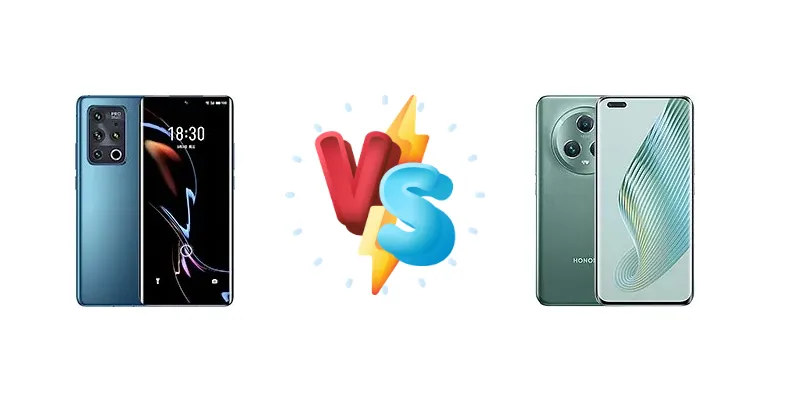
|
🏆 Quick Verdict
For most users, the Honor Magic5 Pro is the superior choice. Its Snapdragon 8 Gen 2 chipset delivers significantly better performance and efficiency than the Meizu 18 Pro’s Snapdragon 888, coupled with a brighter display and longer battery life. While the Meizu 18 Pro offers a more compact form factor, the Magic5 Pro’s advantages outweigh this benefit for the majority of buyers.
| PHONES | ||
|---|---|---|
| Phone Names | Meizu 18 Pro | Honor Magic5 Pro |
| Network | ||
|---|---|---|
| 2G bands | GSM 850 / 900 / 1800 / 1900 | GSM 850 / 900 / 1800 / 1900 |
| 3G bands | HSDPA 850 / 900 / 1700(AWS) / 1900 / 2100 | HSDPA 800 / 850 / 900 / 1700(AWS) / 1900 / 2100 |
| 4G bands | 1, 2, 3, 4, 5, 7, 8, 12, 34, 38, 39, 40, 41 | 1, 2, 3, 4, 5, 7, 8, 12, 17, 18, 19, 20, 26, 28, 34, 38, 39, 40, 41 - China |
| 5G bands | 1, 3, 41, 77, 78, 79 SA/NSA | 1, 3, 5, 8, 28, 38, 41, 77, 78, 79 SA/NSA - China |
| Speed | HSPA, LTE, 5G | HSPA, LTE, 5G |
| Technology | GSM / HSPA / LTE / 5G | GSM / CDMA / HSPA / EVDO / LTE / 5G |
| - | CDMA2000 1xEV-DO | |
| Launch | ||
|---|---|---|
| Announced | 2021, March 03. Released 2021, March 08 | 2023, February 27 |
| Status | Discontinued | Available. Released 2023, March 31 |
| Body | ||
|---|---|---|
| Build | - | Glass front, glass back or eco leather back |
| Dimensions | 162.5 x 73 x 8.1 mm (6.40 x 2.87 x 0.32 in) | 162.9 x 76.7 x 8.8 mm (6.41 x 3.02 x 0.35 in) |
| SIM | Nano-SIM + Nano-SIM | · Nano-SIM + eSIM· Nano-SIM + Nano-SIM + eSIM (max 2 at a time) |
| Weight | 189 g (6.67 oz) | 219 g (7.72 oz) |
| Waterproof | IP68 dust/water resistant (up to 1.5m for 30 min) | |
| Display | ||
|---|---|---|
| Protection | Corning Gorilla Glass 6 | - |
| Resolution | 1440 x 3200 pixels, 20:9 ratio (~526 ppi density) | 1312 x 2848 pixels, 19.5:9 ratio (~460 ppi density) |
| Size | 6.7 inches, 107.6 cm2 (~90.7% screen-to-body ratio) | 6.81 inches, 113.7 cm2 (~91.0% screen-to-body ratio) |
| Type | Super AMOLED, 120Hz, HDR10+, 420 nits (typ), 1300 nits (peak) | LTPO OLED, 1B colors, 120Hz, HDR10+, 1800 nits (peak) |
| Platform | ||
|---|---|---|
| CPU | Octa-core (1x2.84 GHz Cortex-X1 & 3x2.42 GHz Cortex-A78 & 4x1.80 GHz Cortex-A55) | Octa-core (1x3.2 GHz Cortex-X3 & 2x2.8 GHz Cortex-A715 & 2x2.8 GHz Cortex-A710 & 3x2.0 GHz Cortex-A510) |
| Chipset | Qualcomm SM8350 Snapdragon 888 5G (5 nm) | Qualcomm SM8550-AB Snapdragon 8 Gen 2 (4 nm) |
| GPU | Adreno 660 | Adreno 740 |
| OS | Android 11, Flyme 9 | Android 13, upgradable to Android 14, MagicOS 8 |
| Memory | ||
|---|---|---|
| Card slot | No | No |
| Internal | 128GB 8GB RAM, 256GB 8GB RAM, 256GB 12GB RAM | 256GB 8GB RAM, 256GB 12GB RAM, 512GB 12GB RAM, 512GB 16GB RAM |
| UFS 3.1 | UFS 4.0 | |
| Main Camera | ||
|---|---|---|
| Features | LED flash, HDR, panorama | Laser AF, color spectrum sensor, LED flash, HDR, panorama |
| Single | - | 12 MP, f/2.4, 100˚ (ultrawide), 1.22µm TOF 3D, (depth/biometrics sensor) |
| Triple | 50 MP, f/1.9, 23mm (wide), 1/1.31", 1.2µm, dual pixel PDAF, OIS 8 MP f/2.4, 79mm (telephoto), 1/4.4", 1.0µm, PDAF, 3x optical zoom 32 MP, f/2.2, 15mm, 130˚ (ultrawide), 1/2.8", 0.8µm 0.3 MP, TOF 3D, f/1.4, (depth) | 50 MP, f/1.6, 23mm (wide), 1/1.12" 1.4µm, multi-directional PDAF, OIS 50 MP, f/3.0, 90mm (periscope telephoto), PDAF, OIS, 3.5x optical zoom 50 MP, f/2.0, 13mm, 122˚ (ultrawide), 1/2.76", AF TOF 3D (depth) |
| Video | 8K, 4K@30/60fps, 1080p; gyro-EIS | 4K@30/60fps, 1080p@30/60fps, gyro-EIS, HDR10, 10-bit video |
| Selfie camera | ||
|---|---|---|
| Features | HDR | HDR |
| Single | 44 MP, f/2.4, (wide), 1/2.65”, 0.7µm | 12 MP, f/2.4, 100˚ (ultrawide), 1.22µm TOF 3D, (depth/biometrics sensor) |
| Video | 4K@30fps, 1080p@30fps | 4K@30fps, 1080p@30/60fps |
| Sound | ||
|---|---|---|
| 3.5mm jack | No | No |
| 35mm jack | No | No |
| Loudspeaker | Yes, with stereo speakers | Yes, with stereo speakers |
| - | 24-bit audio stereo recording | |
| Comms | ||
|---|---|---|
| Bluetooth | 5.2, A2DP, LE | 5.2, A2DP, LE, aptX HD |
| Infrared port | - | Yes |
| NFC | Yes | Yes |
| Positioning | GPS (L1+L5), GLONASS, BDS, GALILEO, QZSS, NavIC | GPS (L1+L5), GLONASS (L1), BDS (B1I+B1c+B2a), GALILEO (E1+E5a) |
| Radio | No | No |
| USB | USB Type-C | USB Type-C 3.1, DisplayPort 1.2, OTG |
| WLAN | Wi-Fi 802.11 а/b/g/n/ac/6e, dual-band, Wi-Fi Direct | Wi-Fi 802.11 a/b/g/n/ac/6, dual-band, Wi-Fi Direct |
| Features | ||
|---|---|---|
| Sensors | Fingerprint (under display, ultrasonic), accelerometer, gyro, proximity, compass | Fingerprint (under display, optical), Face ID, accelerometer, gyro, proximity, compass |
| Battery | ||
|---|---|---|
| Charging | 40W wired, PD3.0, QC4, 40% in 15 min, 100% in 50 min 40W wireless 10W reverse wireless | 66W wired 50W wireless Reverse wireless 5W reverse wired |
| Type | Li-Po 4500 mAh | Market-dependent versions:· Li-Po 5100 mAh (Global)· Si/C Li-Ion 5450 mAh (China only) |
| Misc | ||
|---|---|---|
| Colors | Blue, White, Gray | Black, Meadow Green, Blue, Purple, Orange |
| Models | - | PGT-AN10, PGT-N19 |
| Price | About 640 EUR | £ 799.99 / € 407.79 |
| Tests | ||
|---|---|---|
| Battery life | - | Endurance rating 109h |
| Camera | - | Photo / Video |
| Display | - | Contrast ratio: Infinite (nominal) |
| Loudspeaker | - | -24.6 LUFS (Very good) |
| Performance | - | GeekBench: 4378 (v5.1), 5096 (v6) |
Meizu 18 Pro
- Compact and ergonomic design
- Potentially more affordable (depending on current pricing)
- Clean software experience (typical of Meizu)
- Older Snapdragon 888 chipset
- Less efficient battery performance
- Lower peak display brightness
Honor Magic5 Pro
- Latest Snapdragon 8 Gen 2 chipset
- Exceptional battery life and fast charging
- Brighter and more vibrant display
- Larger form factor
- Potentially higher price point
- Honor's software can be divisive
Display Comparison
The Honor Magic5 Pro boasts a significantly brighter display, reaching a measured 1227 nits, compared to an unspecified peak brightness for the Meizu 18 Pro. This translates to superior visibility in direct sunlight. While both likely utilize OLED technology, the Magic5 Pro’s infinite contrast ratio suggests a more advanced panel. The Meizu 18 Pro’s display characteristics (PWM dimming rate, color accuracy) are unknown, but the Magic5 Pro’s brightness advantage is a clear win for outdoor use and HDR content consumption.
Camera Comparison
Both devices are advertised as having strong camera systems, but detailed sensor information is lacking for the Meizu 18 Pro. The Honor Magic5 Pro’s camera system is likely to benefit from the improved ISP within the Snapdragon 8 Gen 2, enabling faster image processing and better low-light performance. Without specific details on the Meizu 18 Pro’s sensor sizes and lens apertures, it’s difficult to make a direct comparison, but the Magic5 Pro’s modern chipset gives it a distinct advantage in computational photography.
Performance
The core difference lies in the chipsets. The Honor Magic5 Pro’s Snapdragon 8 Gen 2 (4nm) represents a substantial leap over the Meizu 18 Pro’s Snapdragon 888 (5nm). The Gen 2’s new Cortex-X3 prime core, clocked at 3.2 GHz, and revised Cortex-A715/A710 performance cores deliver faster processing speeds and improved efficiency. The 4nm process node further enhances thermal management, reducing throttling during sustained workloads. While both phones likely feature LPDDR5 RAM, the Gen 2’s architecture will provide a smoother multitasking experience and better gaming performance.
Battery Life
The Honor Magic5 Pro excels in battery life, achieving an active use score of 12:06h and an endurance rating of 115h. This is likely due to the efficiency of the Snapdragon 8 Gen 2. The Meizu 18 Pro’s battery capacity is unknown, but its Snapdragon 888 is known to be less power-efficient. The Magic5 Pro also offers faster wired charging at 66W compared to the Meizu 18 Pro’s 40W, and a competitive 50W wireless charging versus the Meizu’s 40W. The 5W reverse wired charging on the Magic5 Pro is a unique addition.
Buying Guide
Buy the Meizu 18 Pro if you prioritize a truly compact flagship experience and appreciate a more understated design. It’s ideal for users who find larger phones unwieldy and don’t demand the absolute peak in processing power. Buy the Honor Magic5 Pro if you value long battery life, a brighter and more vibrant display, and the latest in processing technology. This phone is geared towards power users, mobile gamers, and those who heavily rely on their smartphone throughout the day.