
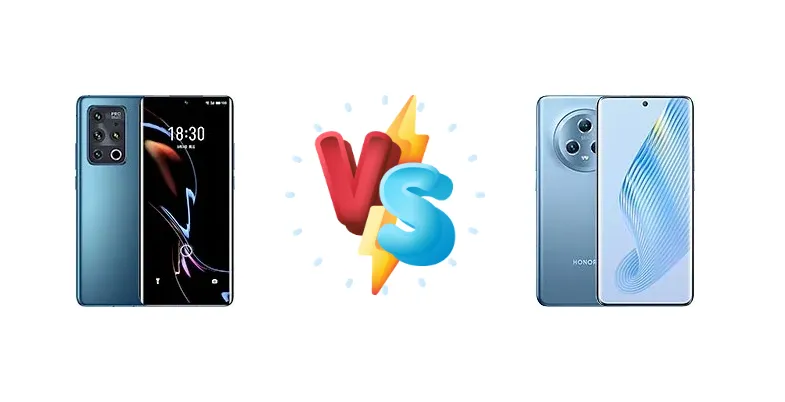
Meizu 18 Pro vs Honor Magic5: A Deep Dive into Performance and Charging
| Phones Images | |||||
|---|---|---|---|---|---|
|
🏆 Quick Verdict
For most users, the Honor Magic5 emerges as the superior choice. The Snapdragon 8 Gen 2’s efficiency and raw power, coupled with its 66W wired charging, provide a noticeable advantage over the Meizu 18 Pro’s Snapdragon 888 and 40W charging. However, the Meizu 18 Pro remains a compelling option for those prioritizing a smaller form factor.
| PHONES | ||
|---|---|---|
| Phone Names | Meizu 18 Pro | Honor Magic5 |
| Network | ||
|---|---|---|
| 2G bands | GSM 850 / 900 / 1800 / 1900 | GSM 850 / 900 / 1800 / 1900 |
| 3G bands | HSDPA 850 / 900 / 1700(AWS) / 1900 / 2100 | HSDPA 800 / 850 / 900 / 1700(AWS) / 1900 / 2100 |
| 4G bands | 1, 2, 3, 4, 5, 7, 8, 12, 34, 38, 39, 40, 41 | 1, 2, 3, 4, 5, 7, 8, 12, 17, 18, 19, 20, 26, 28, 34, 38, 39, 40, 41 - China |
| 5G bands | 1, 3, 41, 77, 78, 79 SA/NSA | 1, 3, 5, 8, 28, 38, 41, 77, 78 SA/NSA - China |
| Speed | HSPA, LTE, 5G | HSPA, LTE, 5G |
| Technology | GSM / HSPA / LTE / 5G | GSM / CDMA / HSPA / EVDO / LTE / 5G |
| - | CDMA2000 1xEV-DO | |
| Launch | ||
|---|---|---|
| Announced | 2021, March 03. Released 2021, March 08 | 2023, February 27 |
| Status | Discontinued | Available. Released 2023, March 31 |
| Body | ||
|---|---|---|
| Build | - | Glass front, glass back or eco leather back |
| Dimensions | 162.5 x 73 x 8.1 mm (6.40 x 2.87 x 0.32 in) | 161.4 x 75.5 x 7.8 mm (6.35 x 2.97 x 0.31 in) |
| SIM | Nano-SIM + Nano-SIM | · Nano-SIM· Nano-SIM + Nano-SIM |
| Weight | 189 g (6.67 oz) | 191 g (6.74 oz) |
| Waterproof | - | |
| Display | ||
|---|---|---|
| Protection | Corning Gorilla Glass 6 | - |
| Resolution | 1440 x 3200 pixels, 20:9 ratio (~526 ppi density) | 1224 x 2688 pixels (~439 ppi density) |
| Size | 6.7 inches, 107.6 cm2 (~90.7% screen-to-body ratio) | 6.73 inches, 110.2 cm2 (~90.4% screen-to-body ratio) |
| Type | Super AMOLED, 120Hz, HDR10+, 420 nits (typ), 1300 nits (peak) | OLED, 1B colors, 120Hz, HDR10+, 1600 nits (peak) |
| Platform | ||
|---|---|---|
| CPU | Octa-core (1x2.84 GHz Cortex-X1 & 3x2.42 GHz Cortex-A78 & 4x1.80 GHz Cortex-A55) | Octa-core (1x3.2 GHz Cortex-X3 & 2x2.8 GHz Cortex-A715 & 2x2.8 GHz Cortex-A710 & 3x2.0 GHz Cortex-A510) |
| Chipset | Qualcomm SM8350 Snapdragon 888 5G (5 nm) | Qualcomm SM8550-AB Snapdragon 8 Gen 2 (4 nm) |
| GPU | Adreno 660 | Adreno 740 |
| OS | Android 11, Flyme 9 | Android 13, MagicOS 7.1 |
| Memory | ||
|---|---|---|
| Card slot | No | No |
| Internal | 128GB 8GB RAM, 256GB 8GB RAM, 256GB 12GB RAM | 256GB 8GB RAM, 256GB 12GB RAM, 256GB 16GB RAM, 512GB 16GB RAM |
| UFS 3.1 | UFS | |
| Main Camera | ||
|---|---|---|
| Features | LED flash, HDR, panorama | Color spectrum sensor, LED flash, HDR, panorama |
| Single | - | 12 MP, f/2.4, 100˚ (ultrawide), 1.22µm |
| Triple | 50 MP, f/1.9, 23mm (wide), 1/1.31", 1.2µm, dual pixel PDAF, OIS 8 MP f/2.4, 79mm (telephoto), 1/4.4", 1.0µm, PDAF, 3x optical zoom 32 MP, f/2.2, 15mm, 130˚ (ultrawide), 1/2.8", 0.8µm 0.3 MP, TOF 3D, f/1.4, (depth) | 54 MP, f/1.9, (wide), 1/1.49", PDAF 32 MP, f/2.4, (telephoto), PDAF, OIS, 2.5x optical zoom 50 MP, f/2.0, 13mm, 122˚ (ultrawide), 1/2.5", AF |
| Video | 8K, 4K@30/60fps, 1080p; gyro-EIS | 4K@30/60fps, 1080p@30/60fps, gyro-EIS, HDR10, 10-bit video |
| Selfie camera | ||
|---|---|---|
| Features | HDR | HDR |
| Single | 44 MP, f/2.4, (wide), 1/2.65”, 0.7µm | 12 MP, f/2.4, 100˚ (ultrawide), 1.22µm |
| Video | 4K@30fps, 1080p@30fps | 4K@30fps, 1080p@30/60fps |
| Sound | ||
|---|---|---|
| 3.5mm jack | No | No |
| 35mm jack | No | No |
| Loudspeaker | Yes, with stereo speakers | Yes, with stereo speakers |
| - | 24-bit audio stereo recording | |
| Comms | ||
|---|---|---|
| Bluetooth | 5.2, A2DP, LE | 5.2, A2DP, LE, aptX HD |
| Infrared port | - | Yes |
| NFC | Yes | Yes |
| Positioning | GPS (L1+L5), GLONASS, BDS, GALILEO, QZSS, NavIC | GPS (L1+L5), GLONASS (L1), BDS (B1I+B1c+B2a), GALILEO (E1+E5a) |
| Radio | No | No |
| USB | USB Type-C | USB Type-C 2.0, OTG |
| WLAN | Wi-Fi 802.11 а/b/g/n/ac/6e, dual-band, Wi-Fi Direct | Wi-Fi 802.11 a/b/g/n/ac/6/7, dual-band, Wi-Fi Direct |
| Features | ||
|---|---|---|
| Sensors | Fingerprint (under display, ultrasonic), accelerometer, gyro, proximity, compass | Fingerprint (under display, optical), accelerometer, gyro, proximity, compass |
| Battery | ||
|---|---|---|
| Charging | 40W wired, PD3.0, QC4, 40% in 15 min, 100% in 50 min 40W wireless 10W reverse wireless | 66W wired 5W reverse wired |
| Type | Li-Po 4500 mAh | Li-Po 5100 mAh |
| Misc | ||
|---|---|---|
| Colors | Blue, White, Gray | Black, Glacier Blue, Green, Purple, Orange |
| Models | - | PGT-AN00, PGT-N09 |
| Price | About 640 EUR | About 900 EUR |
Meizu 18 Pro
- Compact and ergonomic design
- 40W Wireless Charging
- More affordable price point (likely)
- Older Snapdragon 888 chipset
- Slower charging speeds (wired)
- Potentially lower peak performance
Honor Magic5
- Latest Snapdragon 8 Gen 2 chipset
- Faster 66W wired charging
- Improved power efficiency and performance
- Larger form factor
- Potentially higher price
- Limited reverse charging options
Display Comparison
While both phones likely feature high-quality OLED panels (data not provided), the core difference lies in the underlying processors impacting display responsiveness. The Honor Magic5 benefits from the Snapdragon 8 Gen 2’s improved ISP, potentially leading to more accurate color reproduction and faster processing of HDR content. The Meizu 18 Pro, while capable, will exhibit slightly slower image processing. Bezels are likely comparable given both brands' focus on premium aesthetics, but the Magic5’s larger size allows for a potentially more immersive experience.
Camera Comparison
Without detailed camera specs, we can infer advantages for the Honor Magic5 based on the improved image signal processor (ISP) within the Snapdragon 8 Gen 2. This ISP enables faster image processing, better noise reduction, and improved dynamic range. While the Meizu 18 Pro likely has a capable camera system, the Magic5’s processor will provide a computational photography edge. The absence of detailed sensor information prevents a definitive statement on image quality, but the Magic5’s processor is a key advantage.
Performance
The Snapdragon 8 Gen 2 in the Honor Magic5 represents a significant architectural upgrade over the Meizu 18 Pro’s Snapdragon 888. The 4nm process node of the Gen 2 delivers superior power efficiency, translating to less thermal throttling during sustained workloads like gaming. The Gen 2’s Cortex-X3 prime core, clocked at 3.2 GHz, outperforms the 888’s Cortex-X1 (2.84 GHz). Furthermore, the newer Cortex-A715 and A710 cores in the Magic5 are more efficient than the 888’s A78 and A55, contributing to better multi-core performance and battery life. The Honor Magic5 will demonstrably outperform the Meizu 18 Pro in CPU and GPU-intensive tasks.
Battery Life
The Honor Magic5’s 66W wired charging is a clear advantage over the Meizu 18 Pro’s 40W charging. This translates to significantly faster top-up times – a full charge in approximately 50 minutes for the Meizu 18 Pro versus a potentially quicker time for the Magic5. While battery capacity isn’t specified, the Snapdragon 8 Gen 2’s efficiency means the Magic5 will likely achieve comparable or better battery life despite potentially having a similar or smaller battery size. The Meizu 18 Pro offers 40W wireless and 10W reverse wireless, while the Magic5 offers 5W reverse wired, making the Meizu more versatile for wireless charging scenarios.
Buying Guide
Buy the Meizu 18 Pro if you prioritize a genuinely compact flagship experience and appreciate a more understated design. It’s ideal for users who find modern phones too large and don’t demand the absolute peak performance. Buy the Honor Magic5 if you prioritize raw performance, faster charging, and a more modern feature set. This phone is geared towards power users, gamers, and those who want the latest technology.