
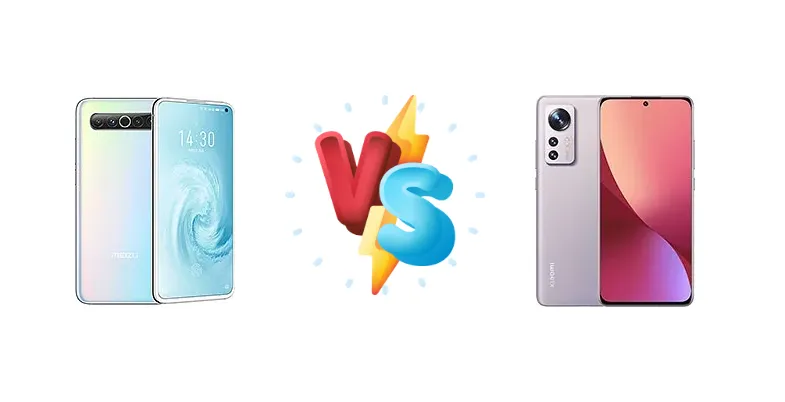
Meizu 17 vs Xiaomi 12: A Deep Dive into Two Snapdragon Flagships
| Phones Images | |||||
|---|---|---|---|---|---|
|
🏆 Quick Verdict
For most users, the Xiaomi 12 emerges as the better choice. Its newer Snapdragon 8 Gen 1 chipset, significantly faster 67W charging, and brighter display outweigh the Meizu 17’s more compact form factor. However, budget-conscious users prioritizing a smaller phone may find the Meizu 17 a compelling option.
| PHONES | ||
|---|---|---|
| Phone Names | Meizu 17 | Xiaomi 12 |
| Network | ||
|---|---|---|
| 2G bands | GSM 850 / 900 / 1800 / 1900 | GSM 850 / 900 / 1800 / 1900 |
| 3G bands | HSDPA 850 / 900 / 1900 / 2100 | HSDPA 800 / 850 / 900 / 1700(AWS) / 1900 / 2100 |
| 4G bands | 1, 3, 5, 7, 8, 34, 38, 39, 40, 41 | 1, 2, 3, 4, 5, 7, 8, 12, 13, 17, 18, 19, 20, 25, 26, 28, 32, 38, 39, 40, 41, 42, 48, 66 - International |
| 5G bands | 41, 78, 79 SA/NSA | 1, 3, 5, 7, 8, 20, 28, 38, 40, 41, 66, 77, 78, 79 SA/NSA - International |
| Speed | HSPA, LTE, 5G | HSPA, LTE, 5G |
| Technology | GSM / CDMA / HSPA / LTE / 5G | GSM / CDMA / HSPA / EVDO / LTE / 5G |
| CDMA 800 & TD-SCDMA | 1, 3, 5, 8, 28, 41, 77, 78, 79 SA/NSA - China | |
| Launch | ||
|---|---|---|
| Announced | 2020, May 08. Released 2020, May 11 | 2021, December 28 |
| Status | Discontinued | Available. Released 2021, December 31 |
| Body | ||
|---|---|---|
| Build | - | Glass front (Gorilla Glass Victus), glass back (Gorilla Glass 5), aluminum frame |
| Dimensions | 160 x 77.2 x 8.5 mm (6.30 x 3.04 x 0.33 in) | 152.7 x 69.9 x 8.2 mm (6.01 x 2.75 x 0.32 in) |
| SIM | Nano-SIM + Nano-SIM | Nano-SIM + Nano-SIM |
| Weight | 199 g (7.02 oz) | 179 g or 180 g (6.31 oz) |
| Display | ||
|---|---|---|
| Protection | - | Corning Gorilla Glass Victus |
| Resolution | 1080 x 2340 pixels, 19.5:9 ratio (~390 ppi density) | 1080 x 2400 pixels, 20:9 ratio (~419 ppi density) |
| Size | 6.6 inches, 106.9 cm2 (~86.6% screen-to-body ratio) | 6.28 inches, 95.2 cm2 (~89.2% screen-to-body ratio) |
| Type | Super AMOLED, 120Hz, HDR10+, 700 nits (typ) | AMOLED, 68B colors, 120Hz, Dolby Vision, HDR10+, 1100 nits (peak) |
| Platform | ||
|---|---|---|
| CPU | Octa-core (1x2.84 GHz Cortex-A77 & 3x2.42 GHz Cortex-A77 & 4x1.80 GHz Cortex-A55) | Octa-core (1x3.00 GHz Cortex-X2 & 3x2.50 GHz Cortex-A710 & 4x1.80 GHz Cortex-A510) |
| Chipset | Qualcomm SM8250 Snapdragon 865 5G (7 nm+) | Qualcomm SM8450 Snapdragon 8 Gen 1 (4 nm) |
| GPU | Adreno 650 | Adreno 730 |
| OS | Android 10, Flyme 8.1 | Android 12, MIUI 13 |
| Memory | ||
|---|---|---|
| Card slot | No | No |
| Internal | 128GB 8GB RAM, 256GB 8GB RAM | 128GB 8GB RAM, 256GB 8GB RAM, 256GB 12GB RAM |
| UFS 3.1 | UFS 3.1 | |
| Main Camera | ||
|---|---|---|
| Features | 5-LED dual-tone flash, Auto-HDR, panorama | Color spectrum sensor, Dual-LED dual-tone flash, HDR, panorama |
| Quad | 64 MP, f/1.8, 26mm (wide), 1/1.72", 0.8µm, PDAF 12 MP, f/1.9, 24mm (wide), 1/2.55", 1.4µm, PDAF 8 MP, f/2.2, 16mm, 118˚ (ultrawide), 1/4.0", 1.12µm 5 MP (macro) | - |
| Single | - | 32 MP, f/2.5, 26mm (wide), 0.7µm |
| Triple | - | 50 MP, f/1.9, 26mm (wide), 1/1.56", 1.0µm, PDAF, OIS 13 MP, f/2.4, 12mm, 123˚ (ultrawide), 1/3.06", 1.12µm 5 MP, f/2.4, 50mm (telephoto macro), AF |
| Video | 4K@30/60fps, 1080p; gyro-EIS | 8K@24fps (HDR), 4K@30/60fps (HDR10+), 1080p@30/120/240/960fps, 720p@1920fps, gyro-EIS |
| Selfie camera | ||
|---|---|---|
| Features | HDR | HDR, panorama |
| Single | 20 MP, f/2.2, (wide), 0.8µm | 32 MP, f/2.5, 26mm (wide), 0.7µm |
| Video | 1080p@30fps | 1080p@30/60fps, 720p@120fps, HDR |
| Sound | ||
|---|---|---|
| 3.5mm jack | No | No |
| 35mm jack | No | No |
| Loudspeaker | Yes, with stereo speakers | Yes, with stereo speakers |
| - | 24-bit/192kHz audio Tuned by Harman Kardon | |
| Comms | ||
|---|---|---|
| Bluetooth | 5.1, A2DP, LE | 5.2, A2DP, LE, aptX HD, aptX Adaptive |
| Infrared port | - | Yes |
| NFC | Yes | Yes (market/region dependent) |
| Positioning | GPS (L1+L5), GLONASS, BDS | GPS (L1+L5), GLONASS (L1), BDS (B1I+B1c+B2a), GALILEO (E1+E5a), QZSS (L1+L5), NavIC (L5) |
| Radio | No | No |
| USB | USB Type-C 2.0 | USB Type-C 2.0, OTG |
| WLAN | Wi-Fi 802.11 а/b/g/n/ac/6, dual-band, Wi-Fi Direct | Wi-Fi 802.11 a/b/g/n/ac/6 or 6e (market dependent), dual-band, Wi-Fi Direct |
| Features | ||
|---|---|---|
| Sensors | Fingerprint (under display, optical), accelerometer, gyro, proximity, compass | Fingerprint (under display, optical), accelerometer, gyro, compass |
| - | Virtual Proximity Sensing | |
| Battery | ||
|---|---|---|
| Charging | 30W wired, QC3, 45% in 30 min | 67W wired, PD3.0, QC4, 100% in 39 min 50W wireless, 100% in 53 min 10W reverse wireless |
| Type | Li-Po 4500 mAh | Li-Po 4500 mAh |
| Misc | ||
|---|---|---|
| Colors | Green, Gray, Aurora White | Gray, Blue, Purple, Green |
| Models | - | 2201123G, 2201123C |
| Price | About 530 EUR | $ 284.99 / € 149.99 |
| SAR | - | 1.09 W/kg (head) 0.91 W/kg (body) |
| SAR EU | - | 0.60 W/kg (head) 1.00 W/kg (body) |
| Tests | ||
|---|---|---|
| Battery life | - | Endurance rating 82h |
| Camera | - | Photo / Video |
| Display | - | Contrast ratio: Infinite (nominal) |
| Loudspeaker | - | -25.3 LUFS (Very good) |
| Performance | - | AnTuTu: 985115 (v9) GeekBench: 3652 (v5.1) GFXBench: 75fps (ES 3.1 onscreen) |
Meizu 17
- More compact and pocketable design.
- Potentially lower price point due to age.
- Clean and minimalist software experience (typical of Meizu).
- Older Snapdragon 865 chipset.
- Slower 30W charging.
- Less detailed display specifications.
Xiaomi 12
- Faster Snapdragon 8 Gen 1 chipset.
- Significantly faster 67W wired and 50W wireless charging.
- Brighter and higher contrast display.
- Larger size may be less comfortable for some users.
- Potentially higher price.
- Xiaomi’s MIUI software can be divisive.
Display Comparison
The Xiaomi 12 boasts a significantly brighter display, reaching a measured 896 nits, compared to an unspecified brightness for the Meizu 17. While both likely utilize AMOLED panels, the Xiaomi 12’s higher peak brightness translates to better visibility in direct sunlight. The Xiaomi 12’s ‘Infinite’ (nominal) contrast ratio suggests a superior implementation of OLED technology, offering deeper blacks. The Meizu 17’s display specs are less detailed, making a direct comparison difficult, but the Xiaomi 12 clearly holds an advantage in display quality.
Camera Comparison
Both devices feature capable camera systems, but detailed sensor information for the Meizu 17 is lacking. The Xiaomi 12’s camera system, while details are limited to 'Photo / Video', benefits from the newer image signal processor (ISP) within the Snapdragon 8 Gen 1, enabling improved image processing and low-light performance. Without specific sensor sizes or aperture details for the Meizu 17, it’s difficult to make a definitive judgment, but the Xiaomi 12’s newer chipset and likely more advanced image processing algorithms give it an edge.
Performance
The Xiaomi 12’s Snapdragon 8 Gen 1 (4nm) represents a substantial leap over the Meizu 17’s Snapdragon 865 (7nm+). The 8 Gen 1 features the newer Cortex-X2 prime core clocked at 3.00 GHz, alongside Cortex-A710 performance cores, offering a significant performance uplift in both CPU and GPU tasks. The 4nm process node also contributes to improved thermal efficiency, potentially reducing throttling during sustained workloads. While the Meizu 17’s Snapdragon 865 remains capable, the Xiaomi 12 provides a smoother, more responsive experience, particularly in demanding games and applications.
Battery Life
Both phones achieve an endurance rating of 82 hours, suggesting similar real-world battery life despite differing battery capacities (not specified for the Meizu 17). However, the Xiaomi 12’s charging capabilities are dramatically superior. It supports 67W wired charging, achieving 100% charge in just 39 minutes, alongside 50W wireless charging (53 minutes) and 10W reverse wireless charging. The Meizu 17’s 30W wired charging, while supporting QC3, is significantly slower. This faster charging is a major advantage for the Xiaomi 12, minimizing downtime.
Buying Guide
Buy the Meizu 17 if you prioritize a genuinely compact flagship experience and are comfortable with slightly older technology. Its smaller size makes it ideal for one-handed use. Buy the Xiaomi 12 if you demand the latest performance, faster charging speeds, and a brighter, more vibrant display, even if it means sacrificing some pocketability.