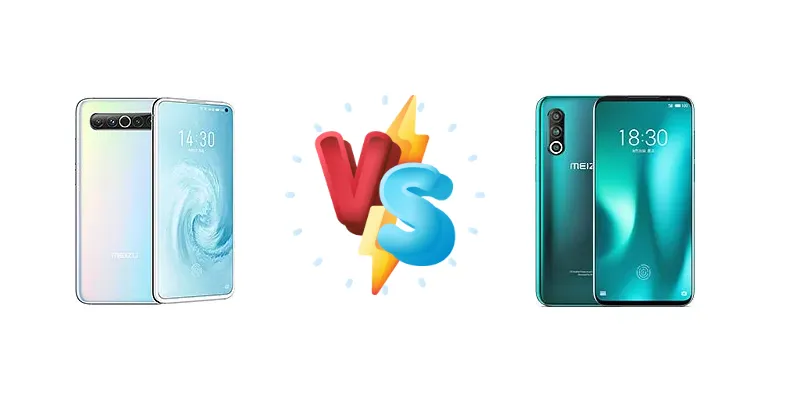
Meizu has a history of crafting stylish and feature-rich smartphones. The Meizu 17 and 16s Pro represent two generations of this ambition. But which one offers the better value and performance in today's market? Let's dive into a comprehensive comparison.
🏆 Quick Verdict
The Meizu 17 clearly edges out the 16s Pro thanks to its Snapdragon 865 chipset, faster charging, and likely improved camera capabilities. However, the 16s Pro remains a compelling option for budget-conscious buyers seeking a premium experience from a previous generation.
| Network |
|---|
| 2G bands | GSM 850 / 900 / 1800 / 1900 | GSM 850 / 900 / 1800 / 1900 |
| 3G bands | HSDPA 850 / 900 / 1900 / 2100 | HSDPA 850 / 900 / 1900 / 2100 |
| 4G bands | 1, 3, 5, 7, 8, 34, 38, 39, 40, 41 | 1, 3, 5, 8, 34, 38, 39, 40, 41 |
| 5G bands | 41, 78, 79 SA/NSA | - |
| Speed | HSPA, LTE, 5G | HSPA 42.2/5.76 Mbps, LTE (5CA) Cat18 1200/150 Mbps |
| Technology | GSM / CDMA / HSPA / LTE / 5G | GSM / CDMA / HSPA / LTE |
| | CDMA 800 & TD-SCDMA | CDMA 800 & TD-SCDMA |
| Launch |
|---|
| Announced | 2020, May 08. Released 2020, May 11 | 2019, August. Released 2019, August |
| Status | Discontinued | Discontinued |
| Body |
|---|
| Dimensions | 160 x 77.2 x 8.5 mm (6.30 x 3.04 x 0.33 in) | 151.9 x 73.4 x 7.7 mm (5.98 x 2.89 x 0.30 in) |
| SIM | Nano-SIM + Nano-SIM | Nano-SIM + Nano-SIM |
| Weight | 199 g (7.02 oz) | 166 g (5.86 oz) |
| Display |
|---|
| Resolution | 1080 x 2340 pixels, 19.5:9 ratio (~390 ppi density) | 1080 x 2232 pixels, 18.5:9 ratio (~403 ppi density) |
| Size | 6.6 inches, 106.9 cm2 (~86.6% screen-to-body ratio) | 6.2 inches, 95.8 cm2 (~85.9% screen-to-body ratio) |
| Type | Super AMOLED, 120Hz, HDR10+, 700 nits (typ) | Super AMOLED |
| Platform |
|---|
| CPU | Octa-core (1x2.84 GHz Cortex-A77 & 3x2.42 GHz Cortex-A77 & 4x1.80 GHz Cortex-A55) | Octa-core (1x2.96 GHz Kryo 485 & 3x2.42 GHz Kryo 485 & 4x1.78 GHz Kryo 485) |
| Chipset | Qualcomm SM8250 Snapdragon 865 5G (7 nm+) | Qualcomm SM8150 Snapdragon 855+ (7 nm) |
| GPU | Adreno 650 | Adreno 640 (700 MHz) |
| OS | Android 10, Flyme 8.1 | Android 9.0 (Pie), Flyme 8 |
| Memory |
|---|
| Card slot | No | No |
| Internal | 128GB 8GB RAM, 256GB 8GB RAM | 128GB 6GB RAM, 128GB 8GB RAM, 256GB 8GB RAM |
| | UFS 3.1 | UFS 3.0 |
| Main Camera |
|---|
| Features | 5-LED dual-tone flash, Auto-HDR, panorama | Six-LED dual-tone flash, Auto-HDR, panorama |
| Quad | 64 MP, f/1.8, 26mm (wide), 1/1.72", 0.8µm, PDAF
12 MP, f/1.9, 24mm (wide), 1/2.55", 1.4µm, PDAF
8 MP, f/2.2, 16mm, 118˚ (ultrawide), 1/4.0", 1.12µm
5 MP (macro) | - |
| Triple | - | 48 MP, f/1.7, (wide), 1/2.0", 0.8µm, PDAF, OIS
20MP, f/2.6, (telephoto), 1/2.8", 1.0µm, PDAF
16 MP, f/2.2, 16mm (ultrawide), 1/3.6", 1.0µm |
| Video | 4K@30/60fps, 1080p; gyro-EIS | 4K@30/60fps, 1080p@30fps (gyro-EIS) |
| Selfie camera |
|---|
| Features | HDR | HDR |
| Single | 20 MP, f/2.2, (wide), 0.8µm | 20MP, f/2.2 |
| Video | 1080p@30fps | 1080p@30fps |
| Sound |
|---|
| 3.5mm jack | No | No |
| 35mm jack | No | No |
| Loudspeaker | Yes, with stereo speakers | Yes |
| Comms |
|---|
| Bluetooth | 5.1, A2DP, LE | 5.0, A2DP, LE |
| NFC | Yes | Yes |
| Positioning | GPS (L1+L5), GLONASS, BDS | GPS (L1+L5), GLONASS, BDS, GALILEO |
| Radio | No | No |
| USB | USB Type-C 2.0 | USB Type-C 2.0 |
| WLAN | Wi-Fi 802.11 а/b/g/n/ac/6, dual-band, Wi-Fi Direct | Wi-Fi 802.11 а/b/g/n/ac, dual-band, Wi-Fi Direct |
| Features |
|---|
| Sensors | Fingerprint (under display, optical), accelerometer, gyro, proximity, compass | Fingerprint (under display, optical), accelerometer, gyro, proximity, compass |
| Battery |
|---|
| Charging | 30W wired, QC3, 45% in 30 min | 24W wired |
| Type | Li-Po 4500 mAh | Li-Po 3600 mAh, non-removable |
| Misc |
|---|
| Colors | Green, Gray, Aurora White | Twilight Forest, Dream Unicorn, Black Mirror, White story |
| Price | About 530 EUR | About 340 EUR |
Meizu 17
- Faster Snapdragon 865 Chipset
- 30W Fast Charging
- Likely Improved Camera
- 5G Connectivity
- Modern Design
- Potentially Higher Price
- Meizu's Limited Global Availability
Meizu 16s Pro
- More Affordable
- Premium Design and Build Quality
- Good Performance for the Price
- Excellent AMOLED Display
- Slower Charging
- Older Snapdragon 855+ Chipset
- No 5G
- Limited Software Updates
Display Comparison
Both phones feature AMOLED displays, likely with vibrant colors and deep blacks. The Meizu 17 likely has a slightly higher refresh rate (90Hz or 120Hz) compared to the 16s Pro (likely 60Hz or 90Hz), resulting in smoother scrolling and animations. Screen sizes are likely similar, around 6.5 inches, with minimal bezels.
Camera Comparison
While specific camera specs are not fully detailed, the Meizu 17 likely boasts improvements in image processing and sensor technology. Expect better low-light performance, more detailed photos, and potentially improved video recording capabilities. Both phones likely feature a triple-camera setup with a primary wide-angle lens, an ultrawide lens, and a telephoto lens.
Performance
The Meizu 17's Snapdragon 865 offers a noticeable performance boost over the 16s Pro's Snapdragon 855+. Expect faster app loading times, smoother multitasking, and better gaming performance on the 17. The 865 also supports 5G connectivity, which the 855+ lacks.
Battery Life
The Meizu 17's 30W fast charging is a significant advantage over the 16s Pro's 24W charging. Expect noticeably faster charging times on the 17. Battery capacities are likely similar, around 4000-4500 mAh, so real-world battery life should be comparable, assuming similar usage patterns.
Buying Guide
The Meizu 17 is ideal for users who prioritize performance, fast charging, and the latest technology. The Meizu 16s Pro is a great choice for those looking for a premium Meizu experience at a more affordable price point, especially if they don't need the absolute latest hardware.
Frequently Asked Questions
❓ Is the Meizu 17 worth the extra cost over the 16s Pro?
If you prioritize performance, 5G, and faster charging, the Meizu 17 is worth the investment. However, the 16s Pro remains a solid choice for those on a tighter budget.
❓ What is the software support like for these Meizu phones?
Meizu's software support has historically been limited. Expect fewer major Android updates compared to other brands. However, FlymeOS offers a unique and customizable user experience.