
Meizu 17 Pro vs Samsung Galaxy S20+ 5G: A Detailed Performance and Feature Comparison
| Phones Images | |||||
|---|---|---|---|---|---|
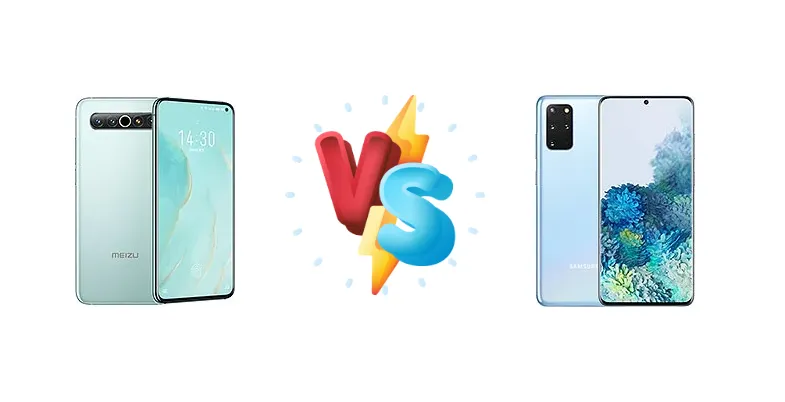
|
🏆 Quick Verdict
For the average user prioritizing consistent performance and a more refined software experience, the Samsung Galaxy S20+ 5G (specifically the Snapdragon variant) is the better choice. However, the Meizu 17 Pro offers compelling value and faster charging for those willing to accept potential software quirks.
| PHONES | ||
|---|---|---|
| Phone Names | Meizu 17 Pro | Samsung Galaxy S20+ 5G |
| Network | ||
|---|---|---|
| 2G bands | GSM 850 / 900 / 1800 / 1900 | GSM 850 / 900 / 1800 / 1900 |
| 3G bands | HSDPA 850 / 900 / 1900 / 2100 | HSDPA 850 / 900 / 1700(AWS) / 1900 / 2100 |
| 4G bands | 1, 3, 5, 7, 8, 34, 38, 39, 40, 41 | 1, 2, 3, 4, 5, 7, 8, 12, 13, 17, 18, 19, 20, 25, 26, 28, 32, 38, 39, 40, 41, 66 - SM-G986B |
| 5G bands | 41, 78, 79 SA/NSA | 1, 3, 5, 7, 8, 28, 40, 77, 78 SA/NSA/Sub6 - SM-G986B |
| Speed | HSPA, LTE, 5G | HSPA 42.2/5.76 Mbps, LTE (7CA) Cat20 2000/200 Mbps, 5G (5+ Gbps DL) |
| Technology | GSM / CDMA / HSPA / LTE / 5G | GSM / CDMA / HSPA / EVDO / LTE / 5G |
| CDMA 800 & TD-SCDMA | - | |
| Launch | ||
|---|---|---|
| Announced | 2020, May 08. Released 2020, May 11 | 2020, February 11 |
| Status | Discontinued | Available. Released 2020, March 06 |
| Body | ||
|---|---|---|
| Build | Glass front, ceramic back, ceramic frame | Glass front (Gorilla Glass 6), glass back (Gorilla Glass 6), aluminum frame |
| Dimensions | 160 x 77.2 x 8.5 mm (6.30 x 3.04 x 0.33 in) | 161.9 x 73.7 x 7.8 mm (6.37 x 2.90 x 0.31 in) |
| SIM | Nano-SIM + Nano-SIM | · Nano-SIM + eSIM· Nano-SIM + Nano-SIM |
| Weight | 219 g (7.72 oz) | 188 g (6.63 oz) |
| Display | ||
|---|---|---|
| Protection | - | Corning Gorilla Glass 6 |
| Resolution | 1080 x 2340 pixels, 19.5:9 ratio (~390 ppi density) | 1440 x 3200 pixels, 20:9 ratio (~525 ppi density) |
| Size | 6.6 inches, 106.9 cm2 (~86.6% screen-to-body ratio) | 6.7 inches, 108.0 cm2 (~90.5% screen-to-body ratio) |
| Type | Super AMOLED, 120Hz, HDR10+, 700 nits (typ) | Dynamic AMOLED 2X, 120Hz, HDR10+, 1200 nits (peak) |
| Platform | ||
|---|---|---|
| CPU | Octa-core (1x2.84 GHz Cortex-A77 & 3x2.42 GHz Cortex-A77 & 4x1.80 GHz Cortex-A55) | Octa-core (2x2.73 GHz Mongoose M5 & 2x2.50 GHz Cortex-A76 & 4x2.0 GHz Cortex-A55) - GlobalOcta-core (1x2.84 GHz Cortex-A77 & 3x2.42 GHz Cortex-A77 & 4x1.80 GHz Cortex-A55) - USA |
| Chipset | Qualcomm SM8250 Snapdragon 865 5G (7 nm+) | Exynos 990 (7 nm+) - GlobalQualcomm SM8250 Snapdragon 865 5G (7 nm+) - USA |
| GPU | Adreno 650 | Mali-G77 MP11 - GlobalAdreno 650 - USA |
| OS | Android 10, Flyme 8.1 | Android 10, upgradable to Android 13, One UI 5.1 |
| Memory | ||
|---|---|---|
| Card slot | No | microSDXC (uses shared SIM slot) |
| Internal | 128GB 8GB RAM, 256GB 12GB RAM | 128GB 8GB RAM, 128GB 12GB RAM, 256GB 12GB RAM, 512GB 12GB RAM |
| UFS 3.1 | - | |
| Main Camera | ||
|---|---|---|
| Features | 5-LED dual-tone flash, Auto-HDR, panorama | LED flash, auto-HDR, panorama |
| Triple | 64 MP, f/1.8, 26mm (wide), 1/1.72", 0.8µm, PDAF 8 MP, f/2.4, 79mm (telephoto), 1.0µm, PDAF 32 MP, f/2.2, 15mm, 129˚ (ultrawide), 1/2.8", 0.8µm 0.3 MP, TOF 3D, f/1.4, (depth) | 12 MP, f/1.8, 26mm (wide), 1/1.76", 1.8µm, dual pixel PDAF, OIS 64 MP, f/2.0, 29mm (telephoto), 1/1.72", 0.8µm, PDAF, OIS, 1.1x optical zoom, 3x hybrid zoom 12 MP, f/2.2, 13mm, 120˚ (ultrawide), 1/2.55" 1.4µm, Super Steady video 0.3 MP, TOF 3D, f/1.0, (depth) |
| Video | 4K@30/60fps, 1080p; gyro-EIS | 8K@24fps, 4K@30/60fps, 1080p@30/60/240fps, 720p@960fps, HDR10+, stereo sound rec., gyro-EIS & OIS |
| Selfie camera | ||
|---|---|---|
| Features | HDR | HDR |
| Single | 20 MP, f/2.2, (wide), 0.8µm | 10 MP, f/2.2, 26mm (wide), 1/3.24", 1.22µm, dual pixel PDAF |
| Video | 1080p@30fps | 4K@30/60fps, 1080p@30fps |
| Sound | ||
|---|---|---|
| 3.5mm jack | No | No |
| 35mm jack | No | No |
| Loudspeaker | Yes, with stereo speakers | Yes, with stereo speakers |
| Comms | ||
|---|---|---|
| Bluetooth | 5.1, A2DP, LE | 5.0, A2DP, LE |
| NFC | Yes | Yes |
| Positioning | GPS (L1+L5), GLONASS, BDS | GPS, GLONASS, BDS, GALILEO |
| Radio | No | FM radio (Snapdragon model only; market/operator dependent) |
| USB | USB Type-C 2.0 | USB Type-C 3.2, OTG |
| WLAN | Wi-Fi 802.11 а/b/g/n/ac/6, dual-band, Wi-Fi Direct | Wi-Fi 802.11 a/b/g/n/ac/6, dual-band, Wi-Fi Direct |
| Features | ||
|---|---|---|
| Sensors | Fingerprint (under display, optical), accelerometer, gyro, proximity, compass | Fingerprint (under display, ultrasonic), accelerometer, gyro, proximity, compass, barometer |
| Battery | ||
|---|---|---|
| Charging | 30W wired, QC3, 45% in 30 min 27W wireless | 25W wired, PD3.0 15W wireless (Qi) 4.5W reverse wireless |
| Type | Li-Po 4500 mAh | Li-Ion 4500 mAh |
| Misc | ||
|---|---|---|
| Colors | Mint, Black, White | Cosmic Black, Cosmic Grey, Cloud Blue, Cloud White, Aura Red, Aura Blue |
| Models | - | SM-G986, SM-G986F, SM-G986F/DS, SM-G986U, SM-G986U1, SM-G9860, SM-G986B/DS, SM-G986N, SM-G986B, SM-G986W, SCG02 |
| Price | About 560 EUR | $ 174.17 / C$ 684.99 / € 299.97 |
| SAR | - | 1.08 W/kg (head) 1.02 W/kg (body) |
| SAR EU | - | 1.09 W/kg (head) 1.57 W/kg (body) |
Meizu 17 Pro
- Faster wired and wireless charging
- Potentially better value for money
- Snapdragon 865 variant offers competitive performance
- Less established brand reputation
- Software experience may be less polished
- Limited global availability
Samsung Galaxy S20+ 5G
- Polished and feature-rich software
- Strong brand recognition and support
- Excellent display quality (likely)
- Exynos 990 variant may suffer from throttling
- Slower charging speeds
- Higher price point
Display Comparison
While both devices utilize 7nm+ fabrication, display specifics are missing. Assuming both employ AMOLED panels (typical for this class), the key differentiator would be peak brightness and color calibration. Samsung historically excels in display technology, likely offering a more vibrant and color-accurate experience. The absence of refresh rate data is a significant omission; however, the S20+ was available with a 120Hz option, which would be a major advantage if present. Bezels are likely comparable, given the similar design philosophies of minimizing them.
Camera Comparison
Detailed camera specs are limited. Both phones likely feature multi-camera systems, but the sensor sizes and lens apertures are critical. Without this data, it’s difficult to make a definitive judgment. However, the presence of OIS (Optical Image Stabilization) is crucial for video recording and low-light photography, and is expected on both. The Meizu 17 Pro’s image processing style is likely to be more saturated and contrasty, typical of Chinese smartphone manufacturers, while Samsung generally aims for a more natural look. The inclusion of a 2MP macro camera on either device is largely a marketing gimmick and unlikely to significantly impact image quality.
Performance
The chipset is the core battleground. The USA-market S20+ 5G and the Meizu 17 Pro both feature the Qualcomm Snapdragon 865 5G (7nm+), utilizing the same octa-core CPU configuration (1x2.84 GHz Cortex-A77, 3x2.42 GHz Cortex-A77, 4x1.80 GHz Cortex-A55). This suggests near-identical CPU performance. However, the global S20+ uses the Exynos 990 (7nm+), which employs a different CPU architecture (2x2.73 GHz Mongoose M5, 2x2.50 GHz Cortex-A76, 4x2.0 GHz Cortex-A55). The Mongoose M5, while powerful, has historically been less efficient than the Cortex-A77, potentially leading to more thermal throttling under sustained load. The Meizu 17 Pro’s cooling solution, not specified here, will be crucial in maintaining peak performance. Both devices likely utilize LPDDR5 RAM, but the speed (e.g., 5500MHz vs 6400MHz) is unknown and could impact multitasking.
Battery Life
Battery capacity is not provided, making a direct comparison difficult. However, the charging speeds are a clear differentiator. The Meizu 17 Pro boasts 30W wired charging with QC3 support and a remarkable 27W wireless charging capability. The S20+ 5G offers 25W wired charging with PD3.0 and 15W wireless charging (Qi). The Meizu’s faster charging, both wired and wireless, translates to significantly less downtime. The 4.5W reverse wireless charging on the S20+ is a niche feature, useful for charging accessories but not a primary selling point. The actual 0-100% charge times will depend on battery capacity, but the Meizu 17 Pro is expected to be considerably faster.
Buying Guide
Buy the Meizu 17 Pro if you prioritize maximizing performance-per-dollar and require exceptionally fast charging speeds, and are comfortable with a less mainstream software experience. Buy the Samsung Galaxy S20+ 5G if you value a polished, feature-rich software ecosystem, a more established brand reputation, and broader accessory availability, even if it means paying a premium.