
Meizu 17 Pro vs 18s Pro: A Detailed Comparison of Flagship Performance
| Phones Images | |||||
|---|---|---|---|---|---|
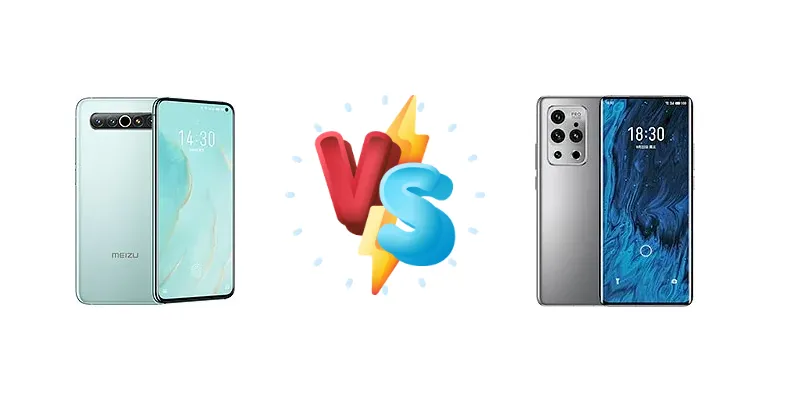
|
🏆 Quick Verdict
For most users, the Meizu 18s Pro is the superior choice. The Snapdragon 888+ provides a noticeable performance uplift, particularly in demanding tasks, and the faster 40W wired and wireless charging significantly reduces downtime. While the 17 Pro remains a capable device, the 18s Pro’s improvements justify the price difference.
| PHONES | ||
|---|---|---|
| Phone Names | Meizu 17 Pro | Meizu 18s Pro |
| Network | ||
|---|---|---|
| 2G bands | GSM 850 / 900 / 1800 / 1900 | GSM 850 / 900 / 1800 / 1900 |
| 3G bands | HSDPA 850 / 900 / 1900 / 2100 | HSDPA 850 / 900 / 1700(AWS) / 1900 / 2100 |
| 4G bands | 1, 3, 5, 7, 8, 34, 38, 39, 40, 41 | 1, 2, 3, 4, 5, 7, 8, 12, 34, 38, 39, 40, 41 |
| 5G bands | 41, 78, 79 SA/NSA | 1, 3, 41, 77, 78, 79 SA/NSA |
| Speed | HSPA, LTE, 5G | HSPA, LTE, 5G |
| Technology | GSM / CDMA / HSPA / LTE / 5G | GSM / HSPA / LTE / 5G |
| CDMA 800 & TD-SCDMA | - | |
| Launch | ||
|---|---|---|
| Announced | 2020, May 08. Released 2020, May 11 | 2021, September 22. Released 2021, September 23 |
| Status | Discontinued | Discontinued |
| Body | ||
|---|---|---|
| Build | Glass front, ceramic back, ceramic frame | - |
| Dimensions | 160 x 77.2 x 8.5 mm (6.30 x 3.04 x 0.33 in) | 162.5 x 73 x 8.1 mm (6.40 x 2.87 x 0.32 in) |
| SIM | Nano-SIM + Nano-SIM | Nano-SIM + Nano-SIM |
| Weight | 219 g (7.72 oz) | 189 g (6.67 oz) |
| - | Waterproof | |
| Display | ||
|---|---|---|
| Protection | - | Corning Gorilla Glass 6 |
| Resolution | 1080 x 2340 pixels, 19.5:9 ratio (~390 ppi density) | 1440 x 3200 pixels, 20:9 ratio (~526 ppi density) |
| Size | 6.6 inches, 106.9 cm2 (~86.6% screen-to-body ratio) | 6.7 inches, 107.6 cm2 (~90.7% screen-to-body ratio) |
| Type | Super AMOLED, 120Hz, HDR10+, 700 nits (typ) | Super AMOLED, 120Hz, HDR10+, 420 nits (typ), 1300 nits (peak) |
| Platform | ||
|---|---|---|
| CPU | Octa-core (1x2.84 GHz Cortex-A77 & 3x2.42 GHz Cortex-A77 & 4x1.80 GHz Cortex-A55) | Octa-core (1x3.0 GHz Cortex-X1 & 3x2.42 GHz Cortex-A78 & 4x1.80 GHz Cortex-A55) |
| Chipset | Qualcomm SM8250 Snapdragon 865 5G (7 nm+) | Qualcomm SM8350 Snapdragon 888+ 5G (5 nm) |
| GPU | Adreno 650 | Adreno 660 |
| OS | Android 10, Flyme 8.1 | Android 11, Flyme 9.2 |
| Memory | ||
|---|---|---|
| Card slot | No | No |
| Internal | 128GB 8GB RAM, 256GB 12GB RAM | 128GB 8GB RAM, 256GB 8GB RAM, 256GB 12GB RAM |
| UFS 3.1 | UFS 3.1 | |
| Main Camera | ||
|---|---|---|
| Features | 5-LED dual-tone flash, Auto-HDR, panorama | LED flash, HDR, panorama |
| Triple | 64 MP, f/1.8, 26mm (wide), 1/1.72", 0.8µm, PDAF 8 MP, f/2.4, 79mm (telephoto), 1.0µm, PDAF 32 MP, f/2.2, 15mm, 129˚ (ultrawide), 1/2.8", 0.8µm 0.3 MP, TOF 3D, f/1.4, (depth) | 50 MP, f/1.9, 23mm (wide), 1/1.31", 1.2µm, dual pixel PDAF, OIS 8 MP f/2.4, 79mm (telephoto), 1/4.4", 1.0µm, PDAF, 3x optical zoom 32 MP, f/2.2, 15mm, 130˚ (ultrawide), 1/2.8", 0.8µm 0.3 MP, TOF 3D, f/1.4, (depth) |
| Video | 4K@30/60fps, 1080p; gyro-EIS | 8K, 4K@30/60fps, 1080p; gyro-EIS, HDR |
| Selfie camera | ||
|---|---|---|
| Features | HDR | HDR |
| Single | 20 MP, f/2.2, (wide), 0.8µm | 44 MP, f/2.4, (wide), 1/2.65”, 0.7µm |
| Video | 1080p@30fps | 4K@30fps, 1080p@30fps |
| Sound | ||
|---|---|---|
| 3.5mm jack | No | No |
| 35mm jack | No | No |
| Loudspeaker | Yes, with stereo speakers | Yes, with stereo speakers |
| Comms | ||
|---|---|---|
| Bluetooth | 5.1, A2DP, LE | 5.2, A2DP, LE |
| NFC | Yes | Yes |
| Positioning | GPS (L1+L5), GLONASS, BDS | GPS (L1+L5), GLONASS, BDS, GALILEO, QZSS |
| Radio | No | No |
| USB | USB Type-C 2.0 | USB Type-C |
| WLAN | Wi-Fi 802.11 а/b/g/n/ac/6, dual-band, Wi-Fi Direct | Wi-Fi 802.11 а/b/g/n/ac/6e, dual-band, Wi-Fi Direct |
| Features | ||
|---|---|---|
| Sensors | Fingerprint (under display, optical), accelerometer, gyro, proximity, compass | Fingerprint (under display, ultrasonic), accelerometer, gyro, proximity, compass |
| Battery | ||
|---|---|---|
| Charging | 30W wired, QC3, 45% in 30 min 27W wireless | 40W wired, PD3.0, QC4, 40% in 15 min, 100% in 55 min 40W wireless 10W reverse wireless |
| Type | Li-Po 4500 mAh | Li-Po 4500 mAh |
| Misc | ||
|---|---|---|
| Colors | Mint, Black, White | Blue, White, Gray |
| Models | - | M192Q |
| Price | About 560 EUR | About 610 EUR |
Meizu 17 Pro
- Potentially lower price point due to age.
- Still a capable performer for everyday tasks.
- Competent camera system.
- Older Snapdragon 865 chipset.
- Slower 30W wired charging.
- Less efficient power consumption.
Meizu 18s Pro
- Significantly faster Snapdragon 888+ chipset.
- 40W wired charging with faster charging times.
- Improved image processing and low-light performance.
- More efficient power consumption.
- Higher price point.
- Potential for thermal throttling under sustained load (though improved over 865).
Display Comparison
While specific display specs (resolution, refresh rate) aren't provided, both phones likely feature high-quality AMOLED panels typical of flagship devices. The key difference lies in the underlying processing power driving them. The Snapdragon 888+ in the 18s Pro will contribute to smoother animations and faster response times, especially when paired with a high refresh rate. The 17 Pro's Snapdragon 865 is still capable, but will exhibit slightly more latency in graphically intensive scenarios.
Camera Comparison
Without detailed camera specifications, a direct comparison is limited. However, the 18s Pro benefits from the improved image signal processor (ISP) within the Snapdragon 888+. This ISP enables faster image processing, better low-light performance, and enhanced video recording capabilities. While both phones likely feature similar sensor configurations, the 18s Pro’s processing pipeline will deliver superior image quality, particularly in challenging conditions. The 888+ also supports more advanced computational photography features.
Performance
The core of the upgrade lies in the chipset. The Meizu 18s Pro’s Snapdragon 888+ (5nm) represents a significant leap over the 17 Pro’s Snapdragon 865 (7nm+). The 888+ features the newer Cortex-X1 prime core clocked at 3.0 GHz, compared to the 865’s 2.84 GHz Cortex-A77. This translates to approximately a 25-30% improvement in CPU performance. The 888+ also boasts a more powerful Adreno 660 GPU, offering a substantial boost in graphics rendering. While both utilize LPDDR5 RAM, the 888+'s improved architecture and efficiency will result in better sustained performance and potentially less thermal throttling during extended gaming sessions.
Battery Life
The charging capabilities are a clear differentiator. The 18s Pro’s 40W wired charging (PD3.0, QC4) is a substantial upgrade over the 17 Pro’s 30W (QC3). The 18s Pro claims 40% charge in 15 minutes and 100% in 55 minutes, while the 17 Pro takes 30 minutes for 45%. Both offer 40W wireless charging, a significant convenience. While battery capacity isn't specified, the Snapdragon 888+'s 5nm process offers better power efficiency, potentially mitigating any capacity difference. The 18s Pro’s faster charging speeds are a major advantage for users who frequently need to top up their battery.
Buying Guide
Buy the Meizu 17 Pro if you prioritize value and can find it at a significantly discounted price. It still offers a smooth experience for everyday tasks and competent photography. Buy the Meizu 18s Pro if you demand the best possible performance for gaming or intensive applications, and if minimizing charging time is a high priority. The 18s Pro is the clear choice for power users.