
Meizu 17 Pro vs Huawei Mate 30: A Detailed Performance and Feature Comparison
| Phones Images | |||||
|---|---|---|---|---|---|
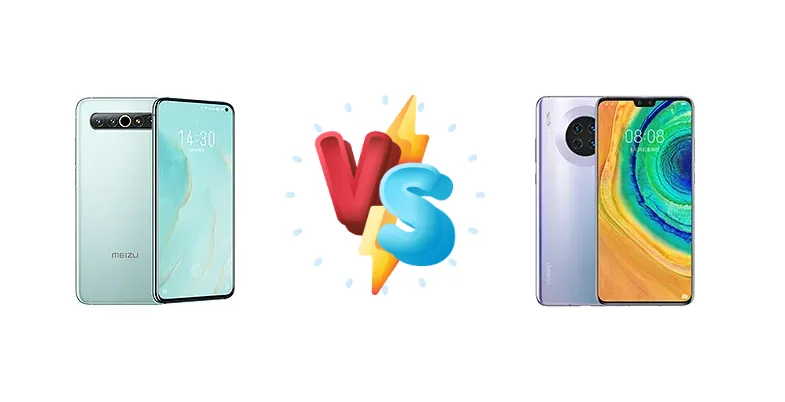
|
🏆 Quick Verdict
For the average user in 2024, the Meizu 17 Pro emerges as the stronger choice. Its Snapdragon 865 offers a more consistently powerful experience, particularly in sustained workloads, and benefits from wider software support. While the Mate 30’s camera is excellent, the lack of Google Mobile Services remains a significant drawback for many.
| PHONES | ||
|---|---|---|
| Phone Names | Meizu 17 Pro | Huawei Mate 30 |
| Network | ||
|---|---|---|
| 2G bands | GSM 850 / 900 / 1800 / 1900 | GSM 850 / 900 / 1800 / 1900 |
| 3G bands | HSDPA 850 / 900 / 1900 / 2100 | HSDPA 800 / 850 / 900 / 1700(AWS) / 1900 / 2100 |
| 4G bands | 1, 3, 5, 7, 8, 34, 38, 39, 40, 41 | 1, 2, 3, 4, 5, 6, 7, 8, 9, 12, 17, 18, 19, 20, 26, 28, 32, 34, 38, 39, 40, 41, 66 - Global |
| 5G bands | 41, 78, 79 SA/NSA | - |
| Speed | HSPA, LTE, 5G | HSPA, LTE |
| Technology | GSM / CDMA / HSPA / LTE / 5G | GSM / HSPA / LTE |
| CDMA 800 & TD-SCDMA | 1, 2, 3, 4, 5, 6, 7, 8, 9, 12, 17, 18, 19, 20, 26, 34, 38, 39, 40, 41 - China | |
| Launch | ||
|---|---|---|
| Announced | 2020, May 08. Released 2020, May 11 | 2019, September. Released 2019, September |
| Status | Discontinued | Discontinued |
| Body | ||
|---|---|---|
| Build | Glass front, ceramic back, ceramic frame | Glass front, glass back, aluminum frame |
| Dimensions | 160 x 77.2 x 8.5 mm (6.30 x 3.04 x 0.33 in) | 160.8 x 76.1 x 8.4 mm (6.33 x 3.00 x 0.33 in) |
| SIM | Nano-SIM + Nano-SIM | · Nano-SIM· Nano-SIM + Nano-SIM |
| Weight | 219 g (7.72 oz) | 196 g (6.91 oz) |
| - | IP53, dust and splash resistant | |
| Display | ||
|---|---|---|
| Resolution | 1080 x 2340 pixels, 19.5:9 ratio (~390 ppi density) | 1080 x 2340 pixels, 19.5:9 ratio (~389 ppi density) |
| Size | 6.6 inches, 106.9 cm2 (~86.6% screen-to-body ratio) | 6.62 inches, 107.6 cm2 (~87.9% screen-to-body ratio) |
| Type | Super AMOLED, 120Hz, HDR10+, 700 nits (typ) | OLED, HDR10 |
| Platform | ||
|---|---|---|
| CPU | Octa-core (1x2.84 GHz Cortex-A77 & 3x2.42 GHz Cortex-A77 & 4x1.80 GHz Cortex-A55) | Octa-core (2x2.86 GHz Cortex-A76 & 2x2.09 GHz Cortex-A76 & 4x1.86 GHz Cortex-A55) |
| Chipset | Qualcomm SM8250 Snapdragon 865 5G (7 nm+) | Kirin 990 (7 nm+) |
| GPU | Adreno 650 | Mali-G76 MP16 |
| OS | Android 10, Flyme 8.1 | Android 10, EMUI 10, no Google Play Services |
| Memory | ||
|---|---|---|
| Card slot | No | Nano Memory (uses shared SIM slot) |
| Internal | 128GB 8GB RAM, 256GB 12GB RAM | 128GB 6GB RAM, 128GB 8GB RAM |
| UFS 3.1 | UFS 3.0 | |
| Main Camera | ||
|---|---|---|
| Features | 5-LED dual-tone flash, Auto-HDR, panorama | Laser AF, Leica optics, dual-LED dual-tone flash, panorama, HDR |
| Triple | 64 MP, f/1.8, 26mm (wide), 1/1.72", 0.8µm, PDAF 8 MP, f/2.4, 79mm (telephoto), 1.0µm, PDAF 32 MP, f/2.2, 15mm, 129˚ (ultrawide), 1/2.8", 0.8µm 0.3 MP, TOF 3D, f/1.4, (depth) | 40 MP, f/1.8, 27mm (wide), 1/1.54", PDAF 8 MP, f/2.4, 80mm (telephoto), 1/4.0", PDAF, OIS, 3x optical zoom 16 MP, f/2.2, 17mm (ultrawide) |
| Video | 4K@30/60fps, 1080p; gyro-EIS | 4K@30/60fps, 1080p@30/60/120fps, 720p@960fps, gyro-EIS |
| Selfie camera | ||
|---|---|---|
| Features | HDR | HDR |
| Single | 20 MP, f/2.2, (wide), 0.8µm | 24 MP, f/2.0, 26mm (wide), 1/2.8", 0.9µm TOF 3D, (depth/biometrics sensor) |
| Video | 1080p@30fps | 1080p@30fps |
| Sound | ||
|---|---|---|
| 3.5mm jack | No | Yes |
| 35mm jack | No | Yes |
| Loudspeaker | Yes, with stereo speakers | Yes, with stereo speakers |
| - | 32-bit/384kHz audio | |
| Comms | ||
|---|---|---|
| Bluetooth | 5.1, A2DP, LE | 5.1, A2DP, aptX HD, LE |
| Infrared port | - | Yes |
| NFC | Yes | Yes |
| Positioning | GPS (L1+L5), GLONASS, BDS | GPS (L1+L5), GLONASS (L1), BDS (B1), GALILEO (E1+E5a), QZSS (L1+L5) |
| Radio | No | No |
| USB | USB Type-C 2.0 | USB Type-C 3.1, OTG |
| WLAN | Wi-Fi 802.11 а/b/g/n/ac/6, dual-band, Wi-Fi Direct | Wi-Fi 802.11 a/b/g/n/ac, dual-band, DLNA, Wi-Fi Direct |
| Features | ||
|---|---|---|
| Sensors | Fingerprint (under display, optical), accelerometer, gyro, proximity, compass | Face ID, fingerprint (under display, optical), accelerometer, gyro, proximity, barometer, compass |
| Battery | ||
|---|---|---|
| Charging | 30W wired, QC3, 45% in 30 min 27W wireless | 40W wired 27W wireless Reverse wireless |
| Type | Li-Po 4500 mAh | Li-Po 4200 mAh, non-removable |
| Misc | ||
|---|---|---|
| Colors | Mint, Black, White | Black, Space Silver, Cosmic Purple, Emerald Green |
| Models | - | TAS-L09, TAS-L29, TAS-AL00, TAS-TL00 |
| Price | About 560 EUR | About 550 EUR |
Meizu 17 Pro
- Superior sustained performance with Snapdragon 865
- Full Google Mobile Services support
- Wider 5G compatibility
- Clean Android experience
- Slower wired charging (30W vs 40W)
- Camera not as refined as the Mate 30
Huawei Mate 30
- Faster wired charging (40W)
- Excellent camera system with strong low-light performance
- Reverse wireless charging
- Huawei’s unique camera processing style
- Lacks Google Mobile Services
- Kirin 990 may throttle under sustained load
- Software ecosystem limitations
Display Comparison
Neither device boasts cutting-edge display technology by 2024 standards, but both offer solid viewing experiences. While specific panel details (like peak brightness in nits) are unavailable, both utilize 7nm+ fabrication processes which indirectly contribute to power efficiency and potentially better display performance. The focus here is on the overall experience; both likely offer vibrant colors and good viewing angles. The absence of high refresh rate panels (90Hz or 120Hz) is a noticeable omission compared to later flagships, but typical for the 2020 timeframe.
Camera Comparison
The Huawei Mate 30 is renowned for its camera capabilities, though detailed sensor specifications are limited. It excels in low-light photography and offers a versatile zoom range. The Meizu 17 Pro, while capable, doesn’t quite reach the same level of image processing sophistication. The Mate 30’s image processing leans towards vibrant, saturated colors, while the Meizu 17 Pro aims for a more natural look. The absence of detailed sensor size information makes a direct comparison difficult, but the Mate 30’s reputation suggests a larger main sensor and more advanced computational photography algorithms.
Performance
The core difference lies in the chipsets. The Meizu 17 Pro’s Snapdragon 865, built on a 7nm+ process, features an octa-core configuration with a prime Cortex-A77 clocked at 2.84 GHz. This is paired with three more Cortex-A77 cores at 2.42 GHz and four Cortex-A55 cores at 1.80 GHz. The Huawei Mate 30’s Kirin 990, also on 7nm+, employs a different core arrangement: two Cortex-A76 cores at 2.86 GHz, two more Cortex-A76 cores at 2.09 GHz, and four Cortex-A55 cores at 1.86 GHz. While clock speeds are similar, the Snapdragon 865 generally exhibits superior GPU performance and sustained CPU performance due to Qualcomm’s optimizations and thermal design. The Snapdragon 865 also has a built-in 5G modem, offering broader compatibility than the Mate 30’s 5G implementation (which may require an external modem in some regions).
Battery Life
Both phones offer 27W wireless charging, a competitive feature for the time. The Mate 30 boasts 40W wired charging, providing a faster 0-100% charge compared to the Meizu 17 Pro’s 30W wired charging. However, the actual real-world impact depends on battery capacity (which isn’t specified in the provided data). The Mate 30 also includes reverse wireless charging, allowing it to charge other devices wirelessly – a feature absent on the Meizu 17 Pro. The faster wired charging of the Mate 30 is a clear advantage for users who prioritize quick top-ups.
Buying Guide
Buy the Meizu 17 Pro if you prioritize consistent performance for gaming and demanding applications, and require access to the full Google ecosystem. It’s ideal for users who value a clean Android experience and future-proof 5G connectivity. Buy the Huawei Mate 30 if you are deeply invested in the Huawei ecosystem, prioritize camera versatility above all else, and are comfortable operating without Google Play Services, relying instead on Huawei’s AppGallery.