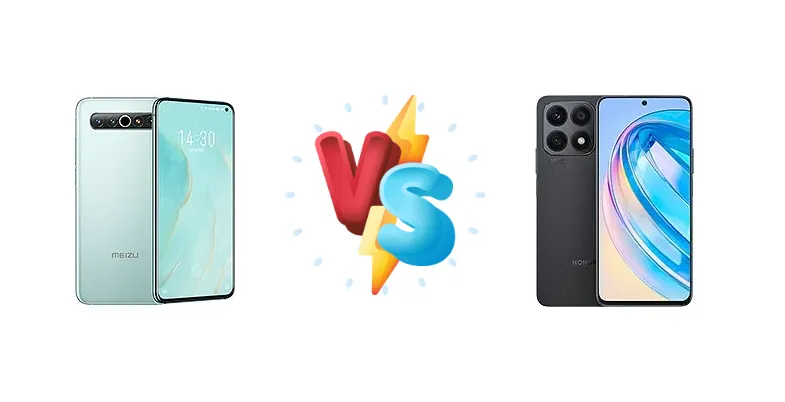
The Meizu 17 Pro, released as a flagship in 2020, now finds itself in a different market segment as prices fall. We pit it against the newer Honor X8a, a budget-focused device, to determine which offers the best experience for today's user. This isn't simply a spec-sheet comparison; it's about understanding where the older, more powerful hardware justifies the potential price premium, and where the X8a's efficiency and affordability shine.
🏆 Quick Verdict
For users prioritizing raw performance and faster charging, the Meizu 17 Pro is the clear winner. Its Snapdragon 865 offers a significant leap in processing power over the Honor X8a's Helio G88. However, the Honor X8a provides excellent value for budget-conscious buyers who prioritize battery life and a modern design.
| Network |
|---|
| 2G bands | GSM 850 / 900 / 1800 / 1900 | GSM 850 / 900 / 1800 / 1900 |
| 3G bands | HSDPA 850 / 900 / 1900 / 2100 | HSDPA 850 / 900 / 2100 |
| 4G bands | 1, 3, 5, 7, 8, 34, 38, 39, 40, 41 | LTE |
| 5G bands | 41, 78, 79 SA/NSA | - |
| Speed | HSPA, LTE, 5G | HSPA, LTE |
| Technology | GSM / CDMA / HSPA / LTE / 5G | GSM / HSPA / LTE |
| | CDMA 800 & TD-SCDMA | Virtual proximity sensing |
| Launch |
|---|
| Announced | 2020, May 08. Released 2020, May 11 | 2023, February 08 |
| Status | Discontinued | Available. Released 2023, February 11 |
| Body |
|---|
| Build | Glass front, ceramic back, ceramic frame | Glass front, plastic frame, plastic back |
| Dimensions | 160 x 77.2 x 8.5 mm (6.30 x 3.04 x 0.33 in) | 162.9 x 74.5 x 7.5 mm (6.41 x 2.93 x 0.30 in) |
| SIM | Nano-SIM + Nano-SIM | Nano-SIM + Nano-SIM |
| Weight | 219 g (7.72 oz) | 179 g (6.31 oz) |
| Display |
|---|
| Resolution | 1080 x 2340 pixels, 19.5:9 ratio (~390 ppi density) | 1080 x 2388 pixels (~391 ppi density) |
| Size | 6.6 inches, 106.9 cm2 (~86.6% screen-to-body ratio) | 6.7 inches, 108.7 cm2 (~89.6% screen-to-body ratio) |
| Type | Super AMOLED, 120Hz, HDR10+, 700 nits (typ) | IPS LCD, 90Hz |
| Platform |
|---|
| CPU | Octa-core (1x2.84 GHz Cortex-A77 & 3x2.42 GHz Cortex-A77 & 4x1.80 GHz Cortex-A55) | Octa-core (2x2.0 GHz Cortex-A75 & 6x1.8 GHz Cortex-A55) |
| Chipset | Qualcomm SM8250 Snapdragon 865 5G (7 nm+) | Mediatek MT6769H Helio G88 (12 nm) |
| GPU | Adreno 650 | Mali-G52 MC2 |
| OS | Android 10, Flyme 8.1 | Android 12, Magic UI 6.1 |
| Memory |
|---|
| Card slot | No | No |
| Internal | 128GB 8GB RAM, 256GB 12GB RAM | 128GB 4GB RAM, 128GB 6GB RAM, 128GB 8GB RAM, 128GB 12GB RAM, 256GB 4GB RAM, 256GB 8GB RAM |
| | UFS 3.1 | - |
| Main Camera |
|---|
| Features | 5-LED dual-tone flash, Auto-HDR, panorama | LED flash, panorama, HDR |
| Single | - | 16 MP, f/2.5 |
| Triple | 64 MP, f/1.8, 26mm (wide), 1/1.72", 0.8µm, PDAF
8 MP, f/2.4, 79mm (telephoto), 1.0µm, PDAF
32 MP, f/2.2, 15mm, 129˚ (ultrawide), 1/2.8", 0.8µm
0.3 MP, TOF 3D, f/1.4, (depth) | 100 MP, f/1.9, (wide), AF
5 MP, f/2.2, (ultrawide)
2 MP (macro) |
| Video | 4K@30/60fps, 1080p; gyro-EIS | 1080p@30fps |
| Selfie camera |
|---|
| Features | HDR | - |
| Single | 20 MP, f/2.2, (wide), 0.8µm | 16 MP, f/2.5 |
| Video | 1080p@30fps | 1080p@30fps |
| Sound |
|---|
| 3.5mm jack | No | No |
| 35mm jack | No | No |
| Loudspeaker | Yes, with stereo speakers | Yes |
| Comms |
|---|
| Bluetooth | 5.1, A2DP, LE | 5.1, A2DP, LE |
| NFC | Yes | Yes (CRT-LX1 only) |
| Positioning | GPS (L1+L5), GLONASS, BDS | GPS, GLONASS, GALILEO, BDS |
| Radio | No | No |
| USB | USB Type-C 2.0 | USB Type-C 2.0, OTG |
| WLAN | Wi-Fi 802.11 а/b/g/n/ac/6, dual-band, Wi-Fi Direct | Wi-Fi 802.11 a/b/g/n/ac, dual-band, Wi-Fi Direct |
| Features |
|---|
| Sensors | Fingerprint (under display, optical), accelerometer, gyro, proximity, compass | Fingerprint (side-mounted), accelerometer, compass |
| Battery |
|---|
| Charging | 30W wired, QC3, 45% in 30 min
27W wireless | 22.5W wired, 50% in 30 min |
| Type | Li-Po 4500 mAh | Li-Po 4500 mAh |
| Misc |
|---|
| Colors | Mint, Black, White | Cyan Lake, Titanium Silver, Midnight Black |
| Models | - | CRT-LX1, CRT-LX2, CRT-LX3 |
| Price | About 560 EUR | About 170 EUR |
Meizu 17 Pro
- Significantly faster processor for demanding tasks
- Faster wired and wireless charging capabilities
- Likely superior camera system with OIS and better ISP
- Older device, potentially limited software support
- May be harder to find and potentially more expensive
Honor X8a
- More affordable price point
- Modern design and potentially longer software support
- Decent battery life for everyday use
- Noticeably slower processor for gaming and multitasking
- Slower charging speeds
- Likely inferior camera performance
Display Comparison
While display specs aren't provided for the Honor X8a, its market positioning suggests an LCD panel. The Meizu 17 Pro, being a former flagship, likely features a higher-quality AMOLED display with superior contrast and color accuracy. The difference in chipset manufacturing processes – 7nm+ for the Snapdragon 865 versus 12nm for the Helio G88 – indirectly impacts display capabilities, as the 865 can drive higher resolution and refresh rate panels more efficiently. The X8a's focus is likely on maximizing screen real estate at a lower cost, while the 17 Pro prioritizes visual fidelity.
Camera Comparison
Without detailed camera specs for either device, we can infer based on their market segments. The Meizu 17 Pro, as a flagship, likely features a more sophisticated camera system with a larger sensor and optical image stabilization (OIS). While the Honor X8a may offer a high megapixel count, it likely relies on software processing to compensate for a smaller sensor and lack of OIS. The Snapdragon 865’s image signal processor (ISP) is also more advanced, enabling better dynamic range and low-light performance. The 17 Pro will likely excel in capturing detailed photos and videos, while the X8a will be adequate for casual photography.
Performance
The core difference lies in the chipsets. The Meizu 17 Pro’s Snapdragon 865, built on a 7nm+ process, boasts a more powerful CPU configuration – an octa-core setup with a prime Cortex-A77 clocked at 2.84 GHz – compared to the Honor X8a’s Helio G88. The G88’s CPU, featuring two Cortex-A75 cores at 2.0 GHz, is geared towards efficiency rather than peak performance. This translates to significantly faster app loading times, smoother multitasking, and superior gaming performance on the Meizu 17 Pro. The Snapdragon 865 also benefits from a more capable Adreno GPU, crucial for graphically intensive tasks. The 12nm process of the Helio G88 will likely result in higher power consumption for similar workloads.
Battery Life
The Meizu 17 Pro offers 30W wired charging and 27W wireless charging, allowing for a 45% charge in 30 minutes. The Honor X8a’s 22.5W wired charging achieves 50% in the same timeframe. While the X8a charges slightly faster initially, the 17 Pro’s higher wattage suggests it will complete a full charge more quickly. The efficiency of the Snapdragon 865, despite its power, could offset the larger battery capacity (not specified for either device) in real-world usage, potentially leading to comparable battery life depending on usage patterns. The 17 Pro's wireless charging is a significant advantage the X8a lacks.
Buying Guide
Buy the Meizu 17 Pro if you need a phone capable of handling demanding games and applications, and if you value faster charging speeds. It's ideal for users coming from older flagships or those who frequently multitask. Buy the Honor X8a if you prefer a more affordable device with a focus on battery life and a sleek aesthetic. It's a great choice for everyday tasks, social media, and casual gaming.
Frequently Asked Questions
❓ Will the Snapdragon 865 in the Meizu 17 Pro still handle modern games like Genshin Impact or Call of Duty Mobile?
Yes, the Snapdragon 865 remains a capable chipset for gaming. While it won't match the performance of the latest Snapdragon 8 Gen series, it can comfortably run most popular titles at medium to high settings. Expect smooth gameplay, though you might encounter some thermal throttling during extended gaming sessions.
❓ Does the Honor X8a support Google Play Services and receive regular software updates?
Yes, the Honor X8a fully supports Google Play Services and runs on a modern version of Android with Magic UI on top. Honor has committed to providing regular software updates, including security patches and feature enhancements, ensuring a secure and up-to-date user experience.
❓ Is the 22.5W charging on the Honor X8a fast enough for daily use?
While not the fastest charging available, 22.5W is sufficient for overnight charging and topping up the battery throughout the day. The 50% charge in 30 minutes is a reasonable speed for most users, and the Helio G88's efficiency helps minimize battery drain.