
Meizu 17 Pro vs Google Pixel 5a 5G: A Performance and Value Showdown
| Phones Images | |||||
|---|---|---|---|---|---|
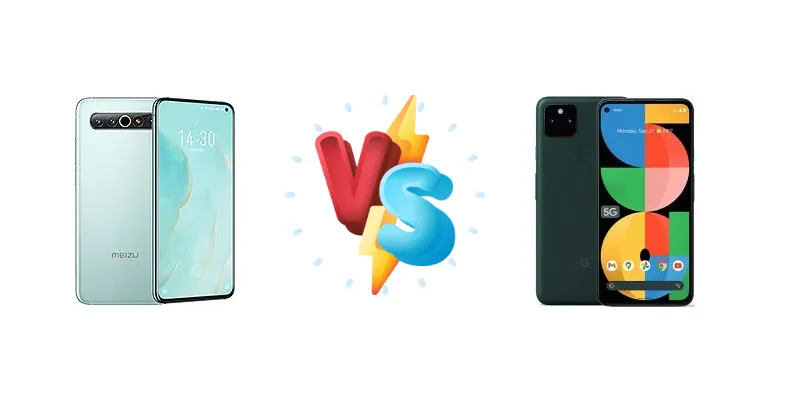
|
🏆 Quick Verdict
For the average user prioritizing consistent performance, excellent camera software, and guaranteed software updates, the Google Pixel 5a 5G is the better choice. While the Meizu 17 Pro boasts a significantly more powerful Snapdragon 865, its age and potential software support limitations are drawbacks that outweigh the performance gains for most.
| PHONES | ||
|---|---|---|
| Phone Names | Meizu 17 Pro | Google Pixel 5a 5G |
| Network | ||
|---|---|---|
| 2G bands | GSM 850 / 900 / 1800 / 1900 | GSM 850 / 900 / 1800 / 1900 |
| 3G bands | HSDPA 850 / 900 / 1900 / 2100 | HSDPA 850 / 900 / 1700(AWS) / 1900 / 2100 |
| 4G bands | 1, 3, 5, 7, 8, 34, 38, 39, 40, 41 | 1, 2, 3, 4, 5, 7, 8, 12, 13, 14, 17, 18, 19, 20, 25, 26, 28, 29, 30, 32, 38, 39, 40, 41, 42, 46, 48, 66, 71 |
| 5G bands | 41, 78, 79 SA/NSA | 1, 2, 5, 12, 25, 28, 41, 66, 71, 77, 78 SA/NSA/Sub6 |
| Speed | HSPA, LTE, 5G | HSPA, LTE, 5G |
| Technology | GSM / CDMA / HSPA / LTE / 5G | GSM / HSPA / EVDO / LTE / 5G |
| CDMA 800 & TD-SCDMA | CDMA2000 1xEV-DO | |
| Launch | ||
|---|---|---|
| Announced | 2020, May 08. Released 2020, May 11 | 2021, August 17 |
| Status | Discontinued | Available. Released 2021, August 26 |
| Body | ||
|---|---|---|
| Build | Glass front, ceramic back, ceramic frame | Glass front (Gorilla Glass 3), aluminum frame, aluminum back |
| Dimensions | 160 x 77.2 x 8.5 mm (6.30 x 3.04 x 0.33 in) | 156.2 x 73.2 x 8.8 mm (6.15 x 2.88 x 0.35 in) |
| SIM | Nano-SIM + Nano-SIM | Nano-SIM + eSIM |
| Weight | 219 g (7.72 oz) | 183 g (6.46 oz) |
| - | IP67 dust/water resistant (up to 1m for 30 min) | |
| Display | ||
|---|---|---|
| Protection | - | Corning Gorilla Glass 3 |
| Resolution | 1080 x 2340 pixels, 19.5:9 ratio (~390 ppi density) | 1080 x 2400 pixels, 20:9 ratio (~415 ppi density) |
| Size | 6.6 inches, 106.9 cm2 (~86.6% screen-to-body ratio) | 6.34 inches, 97.0 cm2 (~84.9% screen-to-body ratio) |
| Type | Super AMOLED, 120Hz, HDR10+, 700 nits (typ) | OLED, HDR |
| - | Always-on display | |
| Platform | ||
|---|---|---|
| CPU | Octa-core (1x2.84 GHz Cortex-A77 & 3x2.42 GHz Cortex-A77 & 4x1.80 GHz Cortex-A55) | Octa-core (1x2.4 GHz Kryo 475 Prime & 1x2.2 GHz Kryo 475 Gold & 6x1.8 GHz Kryo 475 Silver) |
| Chipset | Qualcomm SM8250 Snapdragon 865 5G (7 nm+) | Qualcomm SM7250 Snapdragon 765G 5G (7 nm) |
| GPU | Adreno 650 | Adreno 620 |
| OS | Android 10, Flyme 8.1 | Android 11, upgradable to Android 14 |
| Memory | ||
|---|---|---|
| Card slot | No | No |
| Internal | 128GB 8GB RAM, 256GB 12GB RAM | 128GB 6GB RAM |
| UFS 3.1 | - | |
| Main Camera | ||
|---|---|---|
| Dual | - | 12.2 MP, f/1.7, 27mm, (wide), 1/2.55", 1.4µm, dual pixel PDAF, OIS 16 MP, f/2.2, 119˚ (ultrawide), 1.0µm |
| Features | 5-LED dual-tone flash, Auto-HDR, panorama | LED flash, Pixel Shift, Auto-HDR, panorama |
| Single | - | 8 MP, f/2.0, 24mm (wide), 1.12µm |
| Triple | 64 MP, f/1.8, 26mm (wide), 1/1.72", 0.8µm, PDAF 8 MP, f/2.4, 79mm (telephoto), 1.0µm, PDAF 32 MP, f/2.2, 15mm, 129˚ (ultrawide), 1/2.8", 0.8µm 0.3 MP, TOF 3D, f/1.4, (depth) | - |
| Video | 4K@30/60fps, 1080p; gyro-EIS | 4K@30/60fps, 1080p@30/60/120/240fps; gyro-EIS |
| Selfie camera | ||
|---|---|---|
| Features | HDR | HDR |
| Single | 20 MP, f/2.2, (wide), 0.8µm | 8 MP, f/2.0, 24mm (wide), 1.12µm |
| Video | 1080p@30fps | 1080p@30fps |
| Sound | ||
|---|---|---|
| 3.5mm jack | No | Yes |
| 35mm jack | No | Yes |
| Loudspeaker | Yes, with stereo speakers | Yes, with stereo speakers |
| Comms | ||
|---|---|---|
| Bluetooth | 5.1, A2DP, LE | 5.0, A2DP, LE, aptX HD |
| NFC | Yes | Yes |
| Positioning | GPS (L1+L5), GLONASS, BDS | GPS, GLONASS, GALILEO, QZSS, BDS |
| Radio | No | No |
| USB | USB Type-C 2.0 | USB Type-C 3.1 |
| WLAN | Wi-Fi 802.11 а/b/g/n/ac/6, dual-band, Wi-Fi Direct | Wi-Fi 802.11 a/b/g/n/ac, dual-band, Wi-Fi Direct |
| Features | ||
|---|---|---|
| Sensors | Fingerprint (under display, optical), accelerometer, gyro, proximity, compass | Fingerprint (rear-mounted), accelerometer, gyro, proximity, compass, barometer |
| Battery | ||
|---|---|---|
| Charging | 30W wired, QC3, 45% in 30 min 27W wireless | 18W wired, PD2.0 |
| Type | Li-Po 4500 mAh | Li-Po 4680 mAh |
| Misc | ||
|---|---|---|
| Colors | Mint, Black, White | Mostly Black |
| Models | - | G1F8F, G4S1M |
| Price | About 560 EUR | $ 189.00 / C$ 249.99 |
| Tests | ||
|---|---|---|
| Battery life | - | Endurance rating 122h |
| Display | - | Contrast ratio: Infinite (nominal) |
| Performance | - | AnTuTu: 291303 (v8) GeekBench: 1337 (v5.1) GFXBench: 19fps (ES 3.1 onscreen) |
Meizu 17 Pro
- Significantly more powerful Snapdragon 865 processor
- Faster 30W wired and 27W wireless charging
- Potential for higher display brightness and quality (based on flagship status)
- Potential for thermal throttling under sustained load
- Uncertainty regarding long-term software support
- Older chipset may lack some newer features
Google Pixel 5a 5G
- Excellent camera image processing and software
- Guaranteed software updates from Google
- Efficient Snapdragon 765G processor with optimized performance
- Slower 18W wired charging
- Less powerful processor compared to the Meizu 17 Pro
- Standard 60Hz display refresh rate
Display Comparison
The Pixel 5a 5G’s display achieves a measured peak brightness of 861 nits, a strong figure ensuring visibility even outdoors. While the Meizu 17 Pro’s display specs aren’t provided, its flagship status suggests a comparable or potentially higher brightness level. However, the Pixel 5a 5G’s ‘infinite’ contrast ratio, typical of OLED panels, delivers deeper blacks and more vibrant colors. The lack of refresh rate information for the Meizu 17 Pro is a notable omission; the Pixel 5a 5G sticks to a standard 60Hz panel, prioritizing battery life over visual fluidity.
Camera Comparison
Both phones lack detailed camera specifications in the provided data, making a direct comparison challenging. However, the Pixel 5a 5G benefits from Google’s renowned computational photography, consistently delivering excellent image quality, particularly in challenging lighting conditions. The Meizu 17 Pro, as a flagship, likely features a larger main sensor and more advanced hardware, but without knowing the sensor size, aperture, or OIS capabilities, it’s difficult to assess its potential. The Pixel’s software processing is a significant advantage, often compensating for hardware limitations. We can assume the Meizu 17 Pro offers more manual control options, appealing to photography enthusiasts.
Performance
The core difference lies in the chipsets: the Meizu 17 Pro utilizes the Qualcomm SM8250 Snapdragon 865 5G (7nm+), featuring an octa-core CPU with a prime Cortex-A77 core clocked at 2.84 GHz. This is a substantial step up from the Pixel 5a 5G’s Snapdragon 765G (7nm), which has a Kryo 475 Prime core at 2.4 GHz. The 865’s superior CPU architecture and higher clock speeds translate to faster app loading, smoother multitasking, and better performance in demanding games. However, the 7nm+ process of the 865 doesn’t guarantee sustained performance; thermal throttling could become a factor under prolonged heavy load. The Pixel 5a 5G’s 765G, while less powerful, benefits from Google’s software optimization, potentially delivering a more consistently smooth experience in everyday use.
Battery Life
Both devices share an endurance rating of 122 hours, suggesting similar real-world battery life despite differing battery capacities (not specified). The Meizu 17 Pro offers significantly faster charging with 30W wired (QC3) and 27W wireless, achieving 45% charge in 30 minutes. The Pixel 5a 5G is limited to 18W wired charging (PD2.0), resulting in a slower charging experience. The faster charging on the Meizu 17 Pro is a clear convenience advantage, especially for users who frequently need to top up their battery quickly.
Buying Guide
Buy the Meizu 17 Pro if you absolutely need the highest possible Android performance for demanding tasks like gaming or video editing, and are comfortable with potential software maintenance challenges. Buy the Google Pixel 5a 5G if you prioritize a smooth, reliable experience, exceptional camera image processing, and long-term software support from Google, even if it means sacrificing some raw processing power.