
Meizu 17 Pro vs. iPhone 11 Pro Max: A Detailed Comparison of Flagship Power
| Phones Images | |||||
|---|---|---|---|---|---|
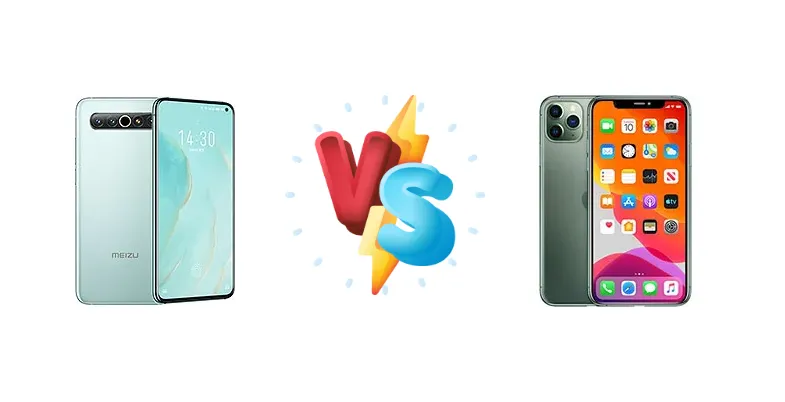
|
🏆 Quick Verdict
For the average user prioritizing long-term software support and consistent performance, the iPhone 11 Pro Max remains a strong contender, especially at its current price point. However, the Meizu 17 Pro offers faster charging and 5G connectivity, making it a viable option for those seeking cutting-edge features.
| PHONES | ||
|---|---|---|
| Phone Names | Meizu 17 Pro | Apple iPhone 11 Pro Max |
| Network | ||
|---|---|---|
| 2G bands | GSM 850 / 900 / 1800 / 1900 | GSM 850 / 900 / 1800 / 1900 |
| 3G bands | HSDPA 850 / 900 / 1900 / 2100 | HSDPA 850 / 900 / 1700(AWS) / 1900 / 2100 |
| 4G bands | 1, 3, 5, 7, 8, 34, 38, 39, 40, 41 | 1, 2, 3, 4, 5, 7, 8, 11, 12, 13, 17, 18, 19, 20, 21, 25, 26, 28, 29, 30, 32, 34, 38, 39, 40, 41, 42, 46, 48, 66 - A2218 |
| 5G bands | 41, 78, 79 SA/NSA | - |
| Speed | HSPA, LTE, 5G | HSPA, LTE 1.6 Gbps DL, EV-DO Rev.A 3.1 Mbps |
| Technology | GSM / CDMA / HSPA / LTE / 5G | GSM / CDMA / HSPA / EVDO / LTE |
| CDMA 800 & TD-SCDMA | 1, 2, 3, 4, 5, 7, 8, 12, 13, 14, 17, 18, 19, 20, 25, 26, 29, 30, 34, 38, 39, 40, 41, 42, 46, 48, 66, 71 - A2161, A2220 | |
| Launch | ||
|---|---|---|
| Announced | 2020, May 08. Released 2020, May 11 | 2019, September 10 |
| Status | Discontinued | Available. Released 2019, September 20 |
| Body | ||
|---|---|---|
| Build | Glass front, ceramic back, ceramic frame | Glass front (Corning-made glass), glass back (Corning-made glass), stainless steel frame |
| Dimensions | 160 x 77.2 x 8.5 mm (6.30 x 3.04 x 0.33 in) | 158 x 77.8 x 8.1 mm (6.22 x 3.06 x 0.32 in) |
| SIM | Nano-SIM + Nano-SIM | · Nano-SIM + eSIM· Nano-SIM + Nano-SIM (China) |
| Weight | 219 g (7.72 oz) | 226 g (7.97 oz) |
| - | IP68 dust/water resistant (up to 4m for 30 min) Apple Pay (Visa, MasterCard, AMEX certified) | |
| Display | ||
|---|---|---|
| Protection | - | Scratch-resistant glass |
| Resolution | 1080 x 2340 pixels, 19.5:9 ratio (~390 ppi density) | 1242 x 2688 pixels, 19.5:9 ratio (~458 ppi density) |
| Size | 6.6 inches, 106.9 cm2 (~86.6% screen-to-body ratio) | 6.5 inches, 102.9 cm2 (~83.7% screen-to-body ratio) |
| Type | Super AMOLED, 120Hz, HDR10+, 700 nits (typ) | Super Retina XDR OLED, HDR10, Dolby Vision, 800 nits (HBM), 1200 nits (peak) |
| Platform | ||
|---|---|---|
| CPU | Octa-core (1x2.84 GHz Cortex-A77 & 3x2.42 GHz Cortex-A77 & 4x1.80 GHz Cortex-A55) | Hexa-core (2x2.65 GHz Lightning + 4x1.8 GHz Thunder) |
| Chipset | Qualcomm SM8250 Snapdragon 865 5G (7 nm+) | Apple A13 Bionic (7 nm+) |
| GPU | Adreno 650 | Apple GPU (4-core graphics) |
| OS | Android 10, Flyme 8.1 | iOS 13, upgradable to iOS 26.1 |
| Memory | ||
|---|---|---|
| Card slot | No | No |
| Internal | 128GB 8GB RAM, 256GB 12GB RAM | 64GB 4GB RAM, 256GB 4GB RAM, 512GB 4GB RAM |
| UFS 3.1 | NVMe | |
| Main Camera | ||
|---|---|---|
| Features | 5-LED dual-tone flash, Auto-HDR, panorama | Dual-LED dual-tone flash, HDR (photo/panorama) |
| Single | - | 13 MP, f/2.2, PDAF |
| Triple | 64 MP, f/1.8, 26mm (wide), 1/1.72", 0.8µm, PDAF 8 MP, f/2.4, 79mm (telephoto), 1.0µm, PDAF 32 MP, f/2.2, 15mm, 129˚ (ultrawide), 1/2.8", 0.8µm 0.3 MP, TOF 3D, f/1.4, (depth) | 12 MP, f/1.8, 26mm (wide), 1/2.55", 1.4µm, dual pixel PDAF, OIS 12 MP, f/2.0, 52mm (telephoto), 1/3.4", 1.0µm, PDAF, OIS, 2x optical zoom 12 MP, f/2.4, 120˚, 13mm (ultrawide), 1/3.6" |
| Video | 4K@30/60fps, 1080p; gyro-EIS | 4K@24/25/30/60fps, 1080p@25/30/60/120/240fps, HDR, stereo sound rec. |
| Selfie camera | ||
|---|---|---|
| Features | HDR | HDR |
| Single | 20 MP, f/2.2, (wide), 0.8µm | 12 MP, f/2.2, 23mm (wide), 1/3.6", 1.0µm SL 3D, (depth/biometrics sensor) |
| Video | 1080p@30fps | 4K@24/25/30/60fps, 1080p@25/30/60/120fps, gyro-EIS |
| Sound | ||
|---|---|---|
| 3.5mm jack | No | No |
| 35mm jack | No | No |
| Loudspeaker | Yes, with stereo speakers | Yes, with stereo speakers |
| Comms | ||
|---|---|---|
| Bluetooth | 5.1, A2DP, LE | 5.0, A2DP, LE |
| NFC | Yes | Yes |
| Positioning | GPS (L1+L5), GLONASS, BDS | GPS, GLONASS, GALILEO, QZSS |
| Radio | No | No |
| USB | USB Type-C 2.0 | Lightning, USB 2.0 |
| WLAN | Wi-Fi 802.11 а/b/g/n/ac/6, dual-band, Wi-Fi Direct | Wi-Fi 802.11 a/b/g/n/ac/6, dual-band, hotspot |
| Features | ||
|---|---|---|
| Sensors | Fingerprint (under display, optical), accelerometer, gyro, proximity, compass | Face ID, accelerometer, gyro, proximity, compass, barometer |
| - | Ultra Wideband (UWB) support | |
| Battery | ||
|---|---|---|
| Charging | 30W wired, QC3, 45% in 30 min 27W wireless | Wired, PD2.0, 50% in 30 min Wireless (Qi) |
| Type | Li-Po 4500 mAh | Li-Ion 3969 mAh, non-removable (15.04 Wh) |
| Misc | ||
|---|---|---|
| Colors | Mint, Black, White | Matte Space Gray, Matte Silver, Matte Gold, Matte Midnight Green |
| Models | - | A2218, A2161, A2220, iPhone12,5 |
| Price | About 560 EUR | $ 233.00 / C$ 369.75 / £ 226.95 / € 249.00 |
| SAR | - | 1.16 W/kg (head) 1.17 W/kg (body) |
| SAR EU | - | 0.95 W/kg (head) 0.99 W/kg (body) |
| Pricing | ||
|---|---|---|
| 256GB 4GB RAM | - | $ 874.46 |
| 512GB 4GB RAM | - | $ 1,004.31 |
| 64GB 4GB RAM | - | $ 435.00 |
| RENEWED | - | $ 485.00 |
| Tests | ||
|---|---|---|
| Audio quality | - | Noise -94.3dB / Crosstalk -81.5dB |
| Battery life | - | Endurance rating 102h |
| Camera | - | Photo / Video |
| Display | - | Contrast ratio: Infinite (nominal) |
| Loudspeaker | - | -25.6 LUFS (Very good) |
| Performance | - | AnTuTu: 459713 (v7), 536883 (v8) GeekBench: 13870 (v4.4), 3503 (v5.1) GFXBench: 57fps (ES 3.1 onscreen) |
Meizu 17 Pro
- Faster charging speeds (30W wired, 27W wireless)
- 5G connectivity for future-proofed data speeds
- Android OS offers greater customization options
- Potentially shorter software support lifespan
- Less established brand reputation
Apple iPhone 11 Pro Max
- Exceptional battery life (102h endurance rating)
- Long-term software support and updates
- Excellent camera performance and video recording
- Slower charging speeds
- Limited customization options compared to Android
Display Comparison
The iPhone 11 Pro Max boasts a measured peak brightness of 820 nits, ensuring excellent visibility outdoors. While the Meizu 17 Pro’s display specs aren’t provided, its market positioning suggests a comparable OLED panel. The iPhone’s ‘infinite’ contrast ratio, typical of OLED technology, delivers deep blacks and vibrant colors. The absence of high refresh rate technology on either device means smooth scrolling isn’t a key differentiator, but the iPhone’s color accuracy is generally considered best-in-class.
Camera Comparison
Both phones are equipped with capable camera systems, but approach image processing differently. The iPhone 11 Pro Max is renowned for its natural-looking photos and excellent video recording capabilities. The Meizu 17 Pro’s camera specs aren’t detailed enough to make a direct comparison, but its positioning suggests a focus on versatility. Without sensor size or aperture information, it’s difficult to assess low-light performance. The iPhone’s computational photography excels in dynamic range and detail preservation, while Meizu’s image processing style is likely more saturated and vibrant.
Performance
The core difference lies in the chipsets: Qualcomm’s Snapdragon 865 5G in the Meizu 17 Pro versus Apple’s A13 Bionic in the iPhone 11 Pro Max. The A13, built on a 7nm+ process, features a hexa-core CPU (2x2.65 GHz Lightning + 4x1.8 GHz Thunder) optimized for iOS. The Snapdragon 865, also 7nm+, utilizes an octa-core configuration (1x2.84 GHz Cortex-A77 & 3x2.42 GHz Cortex-A77 & 4x1.80 GHz Cortex-A55). While core count differs, Apple’s architectural advantages and software integration typically result in superior single-core performance. The iPhone’s 4GB of RAM is paired with Apple’s efficient memory management, while the Meizu 17 Pro’s RAM capacity isn’t specified, but is likely similar. Both devices should handle demanding tasks, but the A13’s sustained performance is generally more consistent.
Battery Life
The iPhone 11 Pro Max achieves an impressive endurance rating of 102 hours, indicating exceptional battery life. The Meizu 17 Pro offers 30W wired charging (45% in 30 minutes) and 27W wireless charging, significantly faster than the iPhone’s wired PD2.0 and Qi wireless charging. While the iPhone’s battery capacity isn’t specified, its endurance rating suggests a large battery optimized for efficiency. The Meizu’s faster charging mitigates the impact of potentially lower battery capacity, offering quicker top-ups.
Buying Guide
Buy the Meizu 17 Pro if you need 5G connectivity, prioritize faster charging speeds (30W wired, 27W wireless), and prefer the flexibility of the Android ecosystem. Buy the Apple iPhone 11 Pro Max if you value long-term software updates, a mature and optimized operating system, and a consistently excellent camera experience, particularly if you can find it at a discounted price.