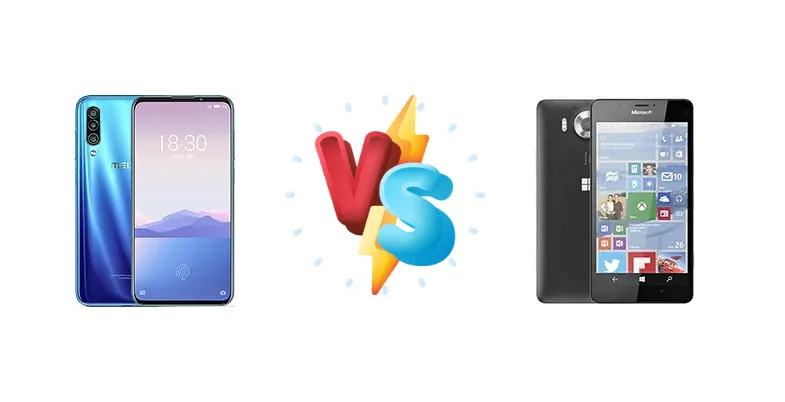
The Meizu 16Xs and Microsoft Lumia 950 represent vastly different eras of smartphone development. The Lumia 950, released in 2015, was a flagship aiming to challenge the best, while the Meizu 16Xs, from 2019, is a modern mid-range device focused on delivering a solid experience at a more accessible price point. This comparison dissects their core differences, focusing on how their respective Snapdragon chipsets and design philosophies translate into real-world usability.
🏆 Quick Verdict
For the average user in 2024, the Meizu 16Xs is the better choice. Its more efficient Snapdragon 675, coupled with modern software support, provides a smoother and more reliable experience. While the Lumia 950 offers the convenience of wireless charging, its age and older chipset are significant drawbacks.
| Network |
|---|
| 2G bands | GSM 850 / 900 / 1800 / 1900 | GSM 850 / 900 / 1800 / 1900 |
| 3G bands | HSDPA 850 / 900 / 2100 | HSDPA 850 / 900 / 1700(AWS) / 1900 / 2100 |
| 4G bands | 1, 3, 5, 8, 34, 38, 39, 40, 41 | 1, 2, 3, 4, 5, 7, 8, 12, 17, 20, 28, 38, 40 - EMEA |
| Speed | HSPA, LTE | HSPA 42.2/5.76 Mbps, LTE Cat6 300/50 Mbps |
| Technology | GSM / CDMA / HSPA / LTE | GSM / HSPA / LTE |
| | CDMA 800 & TD-SCDMA | 1, 2, 3, 4, 5, 7, 8, 12, 17, 20, 28, 38, 40, 41 - USA |
| Launch |
|---|
| Announced | 2019, May. Released 2019, June | 2015, October. Released 2015, November |
| Status | Discontinued | Discontinued |
| Body |
|---|
| Dimensions | 152 x 74.4 x 8.3 mm (5.98 x 2.93 x 0.33 in) | 145 x 73.2 x 8.2 mm (5.71 x 2.88 x 0.32 in) |
| SIM | Nano-SIM + Nano-SIM | Nano-SIM |
| Weight | 165 g (5.82 oz) | 150 g (5.29 oz) |
| Display |
|---|
| Protection | - | Corning Gorilla Glass 3 |
| Resolution | 1080 x 2232 pixels, 18.5:9 ratio (~403 ppi density) | 1440 x 2560 pixels, 16:9 ratio (~564 ppi density) |
| Size | 6.2 inches, 95.8 cm2 (~84.7% screen-to-body ratio) | 5.2 inches, 74.8 cm2 (~70.5% screen-to-body ratio) |
| Type | Super AMOLED | AMOLED |
| | - | ClearBlack display |
| Platform |
|---|
| CPU | Octa-core (2x2.0 GHz Kryo 460 Gold & 6x1.7 GHz Kryo 460 Silver) | Hexa-core (4x1.4 GHz Cortex-A53 & 2x1.8 GHz Cortex-A57) |
| Chipset | Qualcomm SDM675 Snapdragon 675 (11 nm) | Qualcomm MSM8992 Snapdragon 808 (20 nm) |
| GPU | Adreno 612 | Adreno 418 |
| OS | Android 9.0 (Pie), Flyme | Microsoft Windows 10 |
| Memory |
|---|
| Card slot | No | microSDXC (dedicated slot) |
| Internal | 64GB 6GB RAM, 128GB 6GB RAM | 32GB 3GB RAM |
| | - | eMMC 5.0 |
| Main Camera |
|---|
| Features | LED flash, HDR, panorama | Zeiss optics, triple-LED RGB flash, panorama, HDR |
| Single | - | 20 MP, f/1.9, 26mm (wide), 1/2.4", 1.12µm, AF, OIS |
| Triple | 48 MP, f/1.7, 13mm (ultrawide), 1/2.0", 0.8µm, PDAF
8 MP, f/2.2
Auxiliary lens | - |
| Video | 4K@30fps, 1080p@30fps (gyro-EIS) | 4K@30fps, stereo sound rec., 1080p@30/60fps (after SW update) |
| Selfie camera |
|---|
| Features | HDR | - |
| Single | 16 MP, f/2.2, 26mm (wide), 1/3.06", 1.0µm | 5 MP, f/2.4 |
| Video | 1080p@30fps | 1080p@30fps |
| Sound |
|---|
| 3.5mm jack | Yes | Yes |
| 35mm jack | Yes | Yes |
| Loudspeaker | Yes | Yes |
| Comms |
|---|
| Bluetooth | 5.0, A2DP, LE | 4.1, A2DP |
| NFC | No | Yes |
| Positioning | GPS, GLONASS, BDS | GPS, GLONASS, BDS |
| Radio | No | FM radio |
| USB | USB Type-C 2.0 | USB Type-C 3.1 |
| WLAN | Wi-Fi 802.11 а/b/g/n/ac, dual-band, Wi-Fi Direct | Wi-Fi 802.11 a/b/g/n/ac, dual-band, hotspot |
| Features |
|---|
| Sensors | Fingerprint (under display, optical), accelerometer, gyro, proximity, compass | Iris scanner, accelerometer, gyro, proximity, compass, barometer, sensor core |
| | - | Microsoft Continuum support |
| Battery |
|---|
| Charging | 24W wired | 18W wired
Wireless (Qi) (market dependent) |
| Music play | - | Up to 67 h |
| Stand-by | - | Up to 288 h (2G) / Up to 288 h (3G) |
| Talk time | - | Up to 23 h (2G) / Up to 18 h (3G) |
| Type | Li-Po 4000 mAh, non-removable | Li-Ion 3000 mAh, removable |
| Misc |
|---|
| Colors | Carbon Black, Pearl White, Phantom Blue | Black, White |
| Price | About 220 EUR | About 280 EUR |
| Tests |
|---|
| Audio quality | - |
Noise -91.3dB / Crosstalk -91.6dB |
| Battery life | - |
Endurance rating 48h
|
| Camera | - |
Photo / Video |
| Display | - |
Contrast ratio: Infinite (nominal), 3512 (sunlight) |
| Loudspeaker | - |
Voice 71dB / Noise 73dB / Ring 77dB
|
| Performance | - |
Basemark OS II 2.0: 1281Basemark X: 26330 |
Meizu 16Xs
- More efficient Snapdragon 675 chipset
- Modern software support and updates
- Faster 24W wired charging
- Lacks wireless charging
- Potentially less impressive camera in low light compared to the Lumia 950's prime
Microsoft Lumia 950
- Wireless (Qi) charging support
- Excellent camera performance for its time (2015)
- High contrast ratio display
- Outdated Snapdragon 808 chipset
- Limited software support and potential compatibility issues
- Slower 18W wired charging
Display Comparison
Both devices share a reported contrast ratio of Infinite (nominal) and 3512 in sunlight, suggesting similar outdoor visibility. However, the Meizu 16Xs benefits from a more modern display manufacturing process, likely resulting in better color accuracy and viewing angles. The Lumia 950’s display, while good for its time, lacks the advancements in panel technology found in the 16Xs, such as potentially higher peak brightness and improved color gamut coverage. We lack specific details on panel type for both, but the 16Xs likely uses an AMOLED panel, common in its price bracket, offering superior contrast.
Camera Comparison
Both phones feature 'Photo / Video' capabilities, but specifics are limited. The Lumia 950 was known for its excellent camera for its time, boasting features like optical image stabilization (OIS) and a large sensor. However, image processing technology has advanced significantly since 2015. The Meizu 16Xs, while likely not matching the 950’s low-light performance in its prime, benefits from modern computational photography techniques. Without sensor size details, it’s difficult to definitively declare a winner, but the 16Xs’ newer image signal processor (ISP) within the Snapdragon 675 likely provides superior dynamic range and detail in most scenarios.
Performance
The core difference lies in the chipsets. The Meizu 16Xs’ Snapdragon 675 (11nm) utilizes a more efficient manufacturing process than the Lumia 950’s Snapdragon 808 (20nm). While the 808 was a flagship chip in its day, its hexa-core configuration (2x1.8 GHz Cortex-A57 & 4x1.4 GHz Cortex-A53) is less optimized for sustained workloads compared to the 16Xs’ octa-core (2x2.0 GHz Kryo 460 Gold & 6x1.7 GHz Kryo 460 Silver). The 675’s Kryo cores offer better performance-per-watt, meaning less throttling during extended gaming or multitasking. The 16Xs also benefits from newer RAM standards (likely LPDDR4X vs the 950’s LPDDR4), further enhancing responsiveness.
Battery Life
The Lumia 950 boasts an endurance rating of 48 hours, but this is based on usage patterns from 2015. The Meizu 16Xs, with its more efficient Snapdragon 675, likely achieves comparable or even better real-world battery life despite potentially having a smaller battery capacity (data not provided). The 16Xs supports 24W wired charging, faster than the Lumia 950’s 18W wired charging. Crucially, the Lumia 950 also offers Qi wireless charging, a feature absent on the 16Xs. This is a significant advantage for users who prefer the convenience of wireless power.
Buying Guide
Buy the Meizu 16Xs if you need a phone with current software support, reliable performance for everyday tasks, and efficient power management. Buy the Microsoft Lumia 950 if you specifically desire wireless charging and are comfortable with the limitations of an older device, potentially requiring workarounds for software and app compatibility. The Lumia 950 appeals to enthusiasts who enjoy tinkering.
Frequently Asked Questions
❓ Is the Lumia 950 still usable in 2024, and will apps work correctly?
While the Lumia 950 can still function, its age presents challenges. Many modern apps may not be optimized for the older Windows 10 Mobile operating system, leading to compatibility issues or performance problems. Finding updated apps can be difficult, and security updates are no longer available.
❓ How does the Snapdragon 675 in the Meizu 16Xs handle demanding games like PUBG or Genshin Impact?
The Snapdragon 675 is capable of running PUBG Mobile at medium settings with stable frame rates. Genshin Impact may require lower settings to maintain smooth gameplay. While not a dedicated gaming chipset, the 675 provides a respectable gaming experience for casual and moderate gamers.
❓ Does the Lumia 950's wireless charging still work reliably with modern Qi chargers?
Yes, the Lumia 950's Qi wireless charging should function with most modern Qi-compatible chargers. However, charging speeds may be slower compared to newer devices that support faster wireless charging standards.
❓ What kind of software updates can I expect on the Meizu 16Xs?
The Meizu 16Xs likely received updates to Flyme OS, Meizu's custom Android skin, during its lifespan. However, it's unlikely to receive major Android version updates beyond what it originally shipped with. Security patches may also be limited.