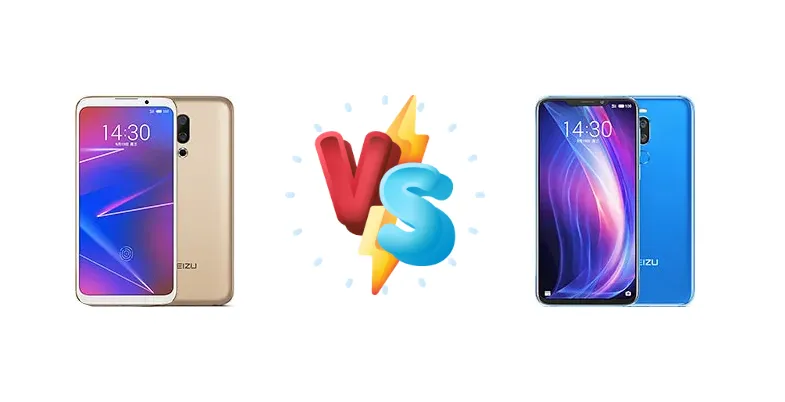
The Meizu 16X and X8 represent a fascinating case study in product differentiation. Both devices launched with the Qualcomm Snapdragon 710 chipset, targeting the competitive mid-range market. However, Meizu opted to distinguish them through design choices and subtle feature adjustments, creating two phones that, despite sharing core hardware, appeal to different user preferences. This comparison dissects those differences to help you choose the right Meizu for your needs.
🏆 Quick Verdict
For the average user prioritizing a more refined design and potentially better build quality, the Meizu 16X emerges as the slightly stronger choice. While both phones offer identical performance thanks to the Snapdragon 710, the 16X’s focus on a premium feel justifies its often higher price point. However, the X8 remains a compelling option for budget-conscious buyers.
| Network |
|---|
| 2G bands | GSM 850 / 900 / 1800 / 1900 | GSM 850 / 900 / 1800 / 1900 |
| 3G bands | HSDPA 850 / 900 / 1900 / 2100 - China | HSDPA 850 / 900 / 2100 - China |
| 4G bands | 1, 3, 4, 5, 8, 34, 38, 39, 40, 41 - China | 1, 3, 5, 8, 34, 38, 39, 40, 41 - China |
| Speed | HSPA 42.2/5.76 Mbps, LTE Cat15 800/150 Mbps | HSPA 42.2/5.76 Mbps, LTE Cat15 800/150 Mbps |
| Technology | GSM / CDMA / HSPA / LTE | GSM / CDMA / HSPA / LTE |
| | CDMA 800 & TD-SCDMA - China | CDMA 800 & TD-SCDMA - China |
| Launch |
|---|
| Announced | 2018, September. Released 2018, September | 2018, September. Released 2018, October |
| Status | Discontinued | Discontinued |
| Body |
|---|
| Dimensions | 151 x 73.5 x 7.5 mm (5.94 x 2.89 x 0.30 in) | 151.2 x 74.6 x 7.8 mm (5.95 x 2.94 x 0.31 in) |
| SIM | Nano-SIM + Nano-SIM | Nano-SIM + Nano-SIM |
| Weight | 154 g (5.43 oz) | 160 g (5.64 oz) |
| Display |
|---|
| Resolution | 1080 x 2160 pixels, 18:9 ratio (~402 ppi density) | 1080 x 2220 pixels, 18.5:9 ratio (~398 ppi density) |
| Size | 6.0 inches, 92.9 cm2 (~83.7% screen-to-body ratio) | 6.2 inches, 97.6 cm2 (~86.5% screen-to-body ratio) |
| Type | Super AMOLED | IPS LCD |
| Platform |
|---|
| CPU | Octa-core (2x2.2 GHz 360 Gold & 6x1.7 GHz Kryo 360 Silver) | Octa-core (2x2.2 GHz 360 Gold & 6x1.7 GHz Kryo 360 Silver) |
| Chipset | Qualcomm SDM710 Snapdragon 710 (10 nm) | Qualcomm SDM710 Snapdragon 710 (10 nm) |
| GPU | Adreno 616 | Adreno 616 |
| OS | Android 8.0 (Oreo), Flyme UI | Android 8.0 (Oreo), Flyme UI |
| Memory |
|---|
| Card slot | No | No |
| Internal | 64GB 6GB RAM, 128GB 6GB RAM | 64GB 4GB RAM, 64GB 6GB RAM, 128GB 6GB RAM |
| Main Camera |
|---|
| Dual | 12 MP, f/1.8, 1/2.3", 1.55µm, dual pixel PDAF, 4-axis OIS
20 MP, f/2.6, 1/2.6", 1.0µm, AF | 12 MP, f/1.9, 1/2.55", 1.4µm, dual pixel PDAF
5 MP |
| Features | Laser AF, Six-LED dual-tone flash, Auto-HDR, panorama | Dual-LED dual-tone flash, panorama |
| Video | 4K@30fps, 1080p@30fps (gyro-EIS) | 1080p@30fps |
| Selfie camera |
|---|
| Single | 20 MP, f/2.0, (wide), 1/2.8", 1.0µm | 20 MP, f/2.0, (wide), 1/2.8", 1.0µm |
| Video | 1080p@30fps | - |
| Sound |
|---|
| 3.5mm jack | Yes | Yes |
| 35mm jack | Yes | Yes |
| Loudspeaker | Yes, with stereo speakers | Yes |
| Comms |
|---|
| Bluetooth | 5.0, A2DP, LE | 5.0, A2DP, LE |
| NFC | No | No |
| Positioning | GPS, GLONASS, BDS | GPS, GLONASS |
| Radio | No | No |
| USB | USB Type-C 2.0 | USB Type-C 2.0 |
| WLAN | Wi-Fi 802.11 а/b/g/n/ac, dual-band, Wi-Fi Direct | Wi-Fi 802.11 b/g/n/ac, dual-band, Wi-Fi Direct |
| Features |
|---|
| Sensors | Fingerprint (under display, optical), accelerometer, gyro, proximity, compass | Fingerprint (rear-mounted), accelerometer, proximity, compass |
| Battery |
|---|
| Type | Li-Ion 3100 mAh, non-removable | Li-Ion 3210 mAh, non-removable |
| Misc |
|---|
| Colors | Black, White, Gold | Black, Blue, White |
| Models | - | X8 |
| Price | About 300 EUR | About 200 EUR |
Meizu 16X
- Potentially more premium build quality
- Likely better display color accuracy
- May have a superior camera system
- Generally more expensive
- May not offer significantly better performance
Meizu X8
- More affordable price point
- Identical Snapdragon 710 performance
- Good value for money
- Potentially lower build quality
- May have a less impressive display
Display Comparison
Both the Meizu 16X and X8 utilize displays driven by the Snapdragon 710’s Adreno 616 GPU. However, specific display characteristics beyond resolution (which is likely FHD+ on both) are not provided. Given the 16X’s positioning as a more premium device, it’s reasonable to infer it may have slightly better color accuracy or peak brightness. The X8, aiming for a lower price point, might utilize a less expensive panel, potentially impacting viewing angles and color reproduction. Without specific nit ratings or panel technology details (like OLED vs. IPS), a definitive comparison is impossible, but the 16X likely offers a marginally superior visual experience.
Camera Comparison
Camera specifications are absent from the provided data, making a detailed comparison challenging. However, given the market segment, both phones likely feature a multi-camera setup with a primary sensor, potentially an ultrawide, and possibly a depth sensor. The 16X, being the more premium model, *may* have a larger primary sensor or a wider aperture, resulting in better low-light performance. Image processing algorithms could also differ, with the 16X potentially offering more sophisticated scene recognition and HDR capabilities. Without specific sensor details, it’s difficult to declare a clear winner, but the 16X’s positioning suggests a slight advantage in camera quality.
Performance
The core performance of both devices is identical, stemming from the Qualcomm SDM710 Snapdragon 710 (10 nm) chipset and its Octa-core CPU configuration (2x2.2 GHz 360 Gold & 6x1.7 GHz Kryo 360 Silver). This means both phones will handle everyday tasks, social media, and even moderate gaming with ease. The 10nm process node ensures reasonable thermal efficiency, but sustained heavy workloads could lead to throttling. The absence of information regarding RAM type (LPDDR4X is likely) and storage speed (UFS 2.1 is probable) prevents a deeper performance analysis. However, the CPU and GPU are the primary performance drivers, and they are identical.
Battery Life
Battery capacity and charging wattage are not specified. However, considering the Snapdragon 710’s efficiency, both phones should offer all-day battery life with moderate usage. The X8, potentially prioritizing cost savings, might have a slightly smaller battery. Conversely, the 16X could feature faster charging capabilities, offsetting a potentially smaller battery capacity. Without concrete numbers, it’s impossible to determine which phone offers superior battery performance, but faster charging, if present on the 16X, would be a significant advantage.
Buying Guide
Buy the Meizu 16X if you value a more premium build quality, a potentially more durable design, and are willing to pay a slight premium for a more polished experience. Buy the Meizu X8 if you prioritize affordability and are comfortable with a potentially more plastic-heavy construction, while still benefiting from the capable Snapdragon 710 chipset.
Frequently Asked Questions
❓ Given both phones have the Snapdragon 710, will I notice a difference in gaming performance?
No, you likely won't notice a significant difference in gaming performance. The Snapdragon 710 is the primary determinant of gaming capabilities, and both phones share the same chipset. However, sustained gaming sessions might reveal slight thermal differences, potentially leading to minor throttling on either device depending on their cooling solutions.
❓ Is the build quality of the Meizu 16X significantly better than the X8?
While concrete material specifications are unavailable, the Meizu 16X was positioned as a more premium device. This suggests a greater use of metal and glass in its construction, potentially resulting in a more solid and durable feel compared to the X8, which may utilize more plastic components to reduce costs.
❓ Which phone is more likely to receive software updates?
Historically, Meizu's software update track record has been inconsistent. It's difficult to predict which phone will receive more updates. However, the 16X, being a slightly more prominent model, *might* receive updates for a longer period, but this is not guaranteed.