
Meizu 16s vs Xiaomi 12: A Detailed Comparison of Two Snapdragon Flagships
| Phones Images | |||||
|---|---|---|---|---|---|
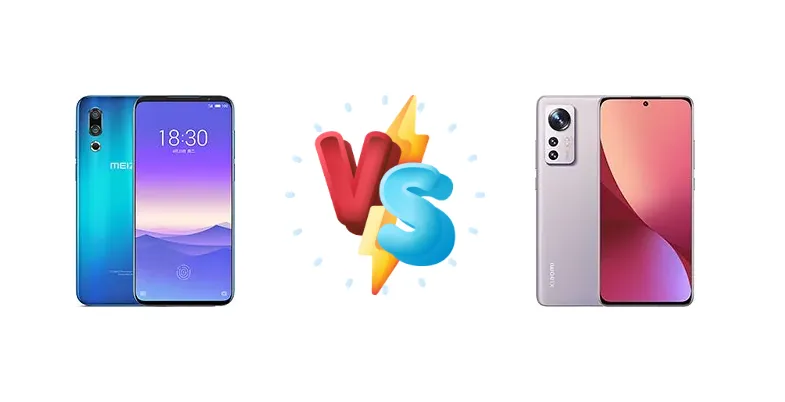
|
🏆 Quick Verdict
For most users, the Xiaomi 12 is the superior choice. Its Snapdragon 8 Gen 1 chipset, despite potential thermal concerns, delivers a noticeable performance uplift over the Meizu 16s’ Snapdragon 855. The 67W charging and 50W wireless charging are game-changers, drastically reducing downtime compared to the Meizu 16s’ 24W wired charging.
| PHONES | ||
|---|---|---|
| Phone Names | Meizu 16s | Xiaomi 12 |
| Network | ||
|---|---|---|
| 2G bands | GSM 850 / 900 / 1800 / 1900 | GSM 850 / 900 / 1800 / 1900 |
| 3G bands | HSDPA 850 / 900 / 1700(AWS) / 1900 / 2100 | HSDPA 800 / 850 / 900 / 1700(AWS) / 1900 / 2100 |
| 4G bands | 1, 2, 3, 4, 5, 7, 8, 20, 40 | 1, 2, 3, 4, 5, 7, 8, 12, 13, 17, 18, 19, 20, 25, 26, 28, 32, 38, 39, 40, 41, 42, 48, 66 - International |
| 5G bands | - | 1, 3, 5, 7, 8, 20, 28, 38, 40, 41, 66, 77, 78, 79 SA/NSA - International |
| Speed | HSPA 42.2/5.76 Mbps, LTE (5CA) Cat18 1200/150 Mbps | HSPA, LTE, 5G |
| Technology | GSM / CDMA / HSPA / LTE | GSM / CDMA / HSPA / EVDO / LTE / 5G |
| CDMA 800 & TD-SCDMA | 1, 3, 5, 8, 28, 41, 77, 78, 79 SA/NSA - China | |
| Launch | ||
|---|---|---|
| Announced | 2019, April. Released 2019, April | 2021, December 28 |
| Status | Discontinued | Available. Released 2021, December 31 |
| Body | ||
|---|---|---|
| Build | - | Glass front (Gorilla Glass Victus), glass back (Gorilla Glass 5), aluminum frame |
| Dimensions | 151.9 x 73.4 x 7.6 mm (5.98 x 2.89 x 0.30 in) | 152.7 x 69.9 x 8.2 mm (6.01 x 2.75 x 0.32 in) |
| SIM | Nano-SIM + Nano-SIM | Nano-SIM + Nano-SIM |
| Weight | 165 g (5.82 oz) | 179 g or 180 g (6.31 oz) |
| Display | ||
|---|---|---|
| Protection | - | Corning Gorilla Glass Victus |
| Resolution | 1080 x 2232 pixels, 18.5:9 ratio (~400 ppi density) | 1080 x 2400 pixels, 20:9 ratio (~419 ppi density) |
| Size | 6.2 inches, 97.2 cm2 (~87.2% screen-to-body ratio) | 6.28 inches, 95.2 cm2 (~89.2% screen-to-body ratio) |
| Type | AMOLED | AMOLED, 68B colors, 120Hz, Dolby Vision, HDR10+, 1100 nits (peak) |
| Platform | ||
|---|---|---|
| CPU | Octa-core (1x2.84 GHz Kryo 485 & 3x2.42 GHz Kryo 485 & 4x1.78 GHz Kryo 485) | Octa-core (1x3.00 GHz Cortex-X2 & 3x2.50 GHz Cortex-A710 & 4x1.80 GHz Cortex-A510) |
| Chipset | Qualcomm SM8150 Snapdragon 855 (7 nm) | Qualcomm SM8450 Snapdragon 8 Gen 1 (4 nm) |
| GPU | Adreno 640 | Adreno 730 |
| OS | Android 9.0 (Pie), Flyme 7.3 | Android 12, MIUI 13 |
| Memory | ||
|---|---|---|
| Card slot | No | No |
| Internal | 128GB 6GB RAM, 128GB 8GB RAM, 256GB 8GB RAM | 128GB 8GB RAM, 256GB 8GB RAM, 256GB 12GB RAM |
| UFS 2.1 | UFS 3.1 | |
| Main Camera | ||
|---|---|---|
| Dual | 48 MP, f/1.7, (wide), 1/2.0", 0.8µm, PDAF, OIS 20MP, f/2.6, (telephoto), PDAF | - |
| Features | Six-LED dual-tone flash, Auto-HDR, panorama | Color spectrum sensor, Dual-LED dual-tone flash, HDR, panorama |
| Single | - | 32 MP, f/2.5, 26mm (wide), 0.7µm |
| Triple | - | 50 MP, f/1.9, 26mm (wide), 1/1.56", 1.0µm, PDAF, OIS 13 MP, f/2.4, 12mm, 123˚ (ultrawide), 1/3.06", 1.12µm 5 MP, f/2.4, 50mm (telephoto macro), AF |
| Video | 4K@30fps, 1080p@30fps (gyro-EIS) | 8K@24fps (HDR), 4K@30/60fps (HDR10+), 1080p@30/120/240/960fps, 720p@1920fps, gyro-EIS |
| Selfie camera | ||
|---|---|---|
| Features | HDR | HDR, panorama |
| Single | 20MP, f/2.2 | 32 MP, f/2.5, 26mm (wide), 0.7µm |
| Video | 1080p@30fps | 1080p@30/60fps, 720p@120fps, HDR |
| Sound | ||
|---|---|---|
| 3.5mm jack | No | No |
| 35mm jack | No | No |
| Loudspeaker | Yes | Yes, with stereo speakers |
| - | 24-bit/192kHz audio Tuned by Harman Kardon | |
| Comms | ||
|---|---|---|
| Bluetooth | 5.0, A2DP, LE | 5.2, A2DP, LE, aptX HD, aptX Adaptive |
| Infrared port | - | Yes |
| NFC | Yes | Yes (market/region dependent) |
| Positioning | GPS, BDS | GPS (L1+L5), GLONASS (L1), BDS (B1I+B1c+B2a), GALILEO (E1+E5a), QZSS (L1+L5), NavIC (L5) |
| Radio | No | No |
| USB | USB Type-C 2.0 | USB Type-C 2.0, OTG |
| WLAN | Wi-Fi 802.11 а/b/g/n/ac, dual-band, Wi-Fi Direct | Wi-Fi 802.11 a/b/g/n/ac/6 or 6e (market dependent), dual-band, Wi-Fi Direct |
| Features | ||
|---|---|---|
| Sensors | Fingerprint (under display, optical), accelerometer, gyro, proximity, compass | Fingerprint (under display, optical), accelerometer, gyro, compass |
| - | Virtual Proximity Sensing | |
| Battery | ||
|---|---|---|
| Charging | 24W wired | 67W wired, PD3.0, QC4, 100% in 39 min 50W wireless, 100% in 53 min 10W reverse wireless |
| Type | Li-Po 3600 mAh, non-removable | Li-Po 4500 mAh |
| Misc | ||
|---|---|---|
| Colors | Carbon Black, Pearl White, Phantom Blue | Gray, Blue, Purple, Green |
| Models | - | 2201123G, 2201123C |
| Price | About 420 EUR | $ 284.99 / € 149.99 |
| SAR | - | 1.09 W/kg (head) 0.91 W/kg (body) |
| SAR EU | - | 0.60 W/kg (head) 1.00 W/kg (body) |
| Tests | ||
|---|---|---|
| Battery life | - | Endurance rating 82h |
| Camera | - | Photo / Video |
| Display | - | Contrast ratio: Infinite (nominal) |
| Loudspeaker | - | -25.3 LUFS (Very good) |
| Performance | - | AnTuTu: 985115 (v9) GeekBench: 3652 (v5.1) GFXBench: 75fps (ES 3.1 onscreen) |
Meizu 16s
- Compact form factor
- Mature and stable software (potentially)
- Lower price point (likely)
- Older Snapdragon 855 chipset
- Slow 24W charging
- Less advanced display technology
Xiaomi 12
- Powerful Snapdragon 8 Gen 1 chipset
- Ultra-fast 67W wired and 50W wireless charging
- Bright and modern display
- Potential for thermal throttling
- Larger size and weight
- Higher price
Display Comparison
The Xiaomi 12 boasts a significantly brighter display, reaching a measured 896 nits peak brightness, compared to an unspecified brightness for the Meizu 16s. This translates to better outdoor visibility. While both likely utilize AMOLED panels, the Xiaomi 12’s infinite (nominal) contrast ratio suggests a more refined panel. The Meizu 16s, being an older device, may lack features like adaptive refresh rates found in the Xiaomi 12, potentially impacting smoothness during scrolling and animations. The Xiaomi 12’s display is a clear upgrade for media consumption and everyday use.
Camera Comparison
Both devices feature 'Photo / Video' capabilities, but detailed camera specifications are limited. The Xiaomi 12 likely benefits from newer image processing algorithms and potentially larger sensor sizes, common trends in flagship camera development. Without specific sensor details for the Meizu 16s, it’s difficult to make a direct comparison. The Xiaomi 12’s camera system is likely more versatile and capable in low-light conditions due to advancements in sensor technology and computational photography. The absence of details regarding OIS on either device makes it impossible to assess stabilization performance.
Performance
The Xiaomi 12’s Snapdragon 8 Gen 1, fabricated on a 4nm process, represents a substantial architectural leap over the Meizu 16s’ 7nm Snapdragon 855. The 8 Gen 1 features a new core configuration – 1x Cortex-X2, 3x Cortex-A710, and 4x Cortex-A510 – offering improved performance and efficiency. While the Snapdragon 855 is still capable, the 8 Gen 1’s Cortex-X2 prime core provides a significant boost in single-core performance, crucial for responsive app launches and UI navigation. However, the 4nm node doesn’t guarantee flawless thermal performance; the 8 Gen 1 is known to throttle under sustained load, a potential drawback for extended gaming sessions. The Meizu 16s, while lacking the raw power, benefits from a more mature chipset with well-understood thermal characteristics.
Battery Life
Both phones achieve an endurance rating of 82 hours, suggesting similar real-world battery life despite the Meizu 16s having an unspecified battery capacity. However, the Xiaomi 12’s charging capabilities are dramatically superior. Its 67W wired charging can replenish the battery to 100% in just 39 minutes, a massive improvement over the Meizu 16s’ 24W charging. The addition of 50W wireless charging and 10W reverse wireless charging further enhances the Xiaomi 12’s convenience. While battery life may be comparable, the Xiaomi 12’s charging speed significantly reduces downtime and offers greater flexibility.
Buying Guide
Buy the Meizu 16s if you prioritize a compact form factor and are seeking a capable, but now budget-friendly, flagship experience. It’s ideal for users who don’t demand the absolute latest performance or fastest charging. Buy the Xiaomi 12 if you value cutting-edge performance, significantly faster charging speeds (both wired and wireless), and a brighter, more modern display. It’s the better choice for power users, gamers, and those who frequently rely on their phone throughout the day.