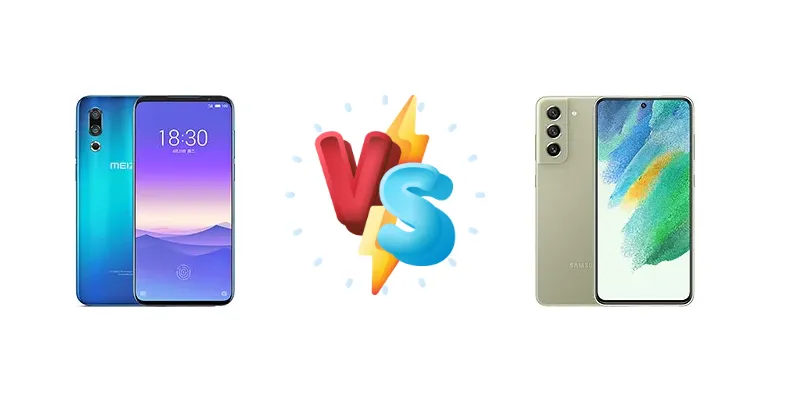
The Meizu 16s, released in 2019, represents a high point for the brand's focus on design and a clean Android experience. The Samsung Galaxy S21 FE 5G, arriving in early 2022, aims to deliver a flagship experience at a more accessible price point. This comparison examines whether the S21 FE’s newer hardware justifies its price premium over the still-capable Meizu 16s, particularly for users prioritizing value and a compact form factor.
🏆 Quick Verdict
For most users, the Samsung Galaxy S21 FE 5G is the better choice. Its Snapdragon 888 (or Exynos 2100) chipset provides a substantial performance uplift over the Meizu 16s’ Snapdragon 855, and features like 25W fast charging and wireless charging add significant convenience. However, the Meizu 16s remains a compelling option for those seeking a smaller device and a more streamlined software experience on a budget.
| Network |
|---|
| 2G bands | GSM 850 / 900 / 1800 / 1900 | GSM 850 / 900 / 1800 / 1900 |
| 3G bands | HSDPA 850 / 900 / 1700(AWS) / 1900 / 2100 | HSDPA 850 / 900 / 1700(AWS) / 1900 / 2100 |
| 4G bands | 1, 2, 3, 4, 5, 7, 8, 20, 40 | 1, 2, 3, 4, 5, 7, 8, 12, 17, 20, 26, 28, 32, 38, 40, 41, 66 - International |
| 5G bands | - | 1, 3, 5, 8, 20, 28, 38, 40, 41, 66, 78 SA/NSA/Sub6 - International |
| Speed | HSPA 42.2/5.76 Mbps, LTE (5CA) Cat18 1200/150 Mbps | HSPA 42.2/5.76 Mbps, LTE (5CA) Cat19 1600/200 Mbps, 5G |
| Technology | GSM / CDMA / HSPA / LTE | GSM / CDMA / HSPA / EVDO / LTE / 5G |
| | CDMA 800 & TD-SCDMA | 41, 66, 71, 260, 261 SA/NSA/Sub6/mmWave - USA |
| Launch |
|---|
| Announced | 2019, April. Released 2019, April | 2022, January 04 |
| Status | Discontinued | Available. Released 2022, January 07 |
| Body |
|---|
| Build | - | Glass front (Gorilla Glass Victus), plastic back, aluminum frame |
| Dimensions | 151.9 x 73.4 x 7.6 mm (5.98 x 2.89 x 0.30 in) | 155.7 x 74.5 x 7.9 mm (6.13 x 2.93 x 0.31 in) |
| SIM | Nano-SIM + Nano-SIM | · Nano-SIM· Nano-SIM + Nano-SIM |
| Weight | 165 g (5.82 oz) | 177 g (6.24 oz) |
| | - | IP68 dust/water resistant (up to 1.5m for 30 min) |
| Display |
|---|
| Protection | - | Corning Gorilla Glass Victus |
| Resolution | 1080 x 2232 pixels, 18.5:9 ratio (~400 ppi density) | 1080 x 2340 pixels, 19.5:9 ratio (~403 ppi density) |
| Size | 6.2 inches, 97.2 cm2 (~87.2% screen-to-body ratio) | 6.4 inches, 100.5 cm2 (~86.7% screen-to-body ratio) |
| Type | AMOLED | Dynamic AMOLED 2X, 120Hz, HDR10+ |
| | - | Always-on display |
| Platform |
|---|
| CPU | Octa-core (1x2.84 GHz Kryo 485 & 3x2.42 GHz Kryo 485 & 4x1.78 GHz Kryo 485) | Octa-core (1x2.84 GHz Cortex-X1 & 3x2.42 GHz Cortex-A78 & 4x1.80 GHz Cortex-A55) - Version 1Octa-core (1x2.9 GHz Cortex-X1 & 3x2.80 GHz Cortex-A78 & 4x2.2 GHz Cortex-A55) - Version 2 |
| Chipset | Qualcomm SM8150 Snapdragon 855 (7 nm) | Qualcomm SM8350 Snapdragon 888 5G (5 nm) - Version 1Exynos 2100 (5 nm) - Version 2 |
| GPU | Adreno 640 | Adreno 660 - Version 1Mali-G78 MP14 - Version 2 |
| OS | Android 9.0 (Pie), Flyme 7.3 | Android 12, up to 4 major Android upgrades, One UI 8 |
| Memory |
|---|
| Card slot | No | No |
| Internal | 128GB 6GB RAM, 128GB 8GB RAM, 256GB 8GB RAM | 128GB 6GB RAM, 128GB 8GB RAM, 256GB 6GB RAM, 256GB 8GB RAM |
| | UFS 2.1 | - |
| Main Camera |
|---|
| Dual | 48 MP, f/1.7, (wide), 1/2.0", 0.8µm, PDAF, OIS
20MP, f/2.6, (telephoto), PDAF | - |
| Features | Six-LED dual-tone flash, Auto-HDR, panorama | LED flash, auto-HDR, panorama |
| Single | - | 32 MP, f/2.2, 26mm (wide), 1/2.74", 0.8µm |
| Triple | - | 12 MP, f/1.8, 26mm (wide), 1/1.76", 1.8µm, dual pixel PDAF, OIS
8 MP, f/2.4, 76mm (telephoto), 1/4.5", 1.0µm, PDAF, OIS, 3x optical zoom
12 MP, f/2.2, 13mm, 123˚ (ultrawide), 1/3.0", 1.12µm |
| Video | 4K@30fps, 1080p@30fps (gyro-EIS) | 4K@30/60fps, 1080p@30/60/120/240fps, HDR10+, gyro-EIS |
| Selfie camera |
|---|
| Features | HDR | HDR |
| Single | 20MP, f/2.2 | 32 MP, f/2.2, 26mm (wide), 1/2.74", 0.8µm |
| Video | 1080p@30fps | 4K@30/60fps, 1080p@30/60fps, gyro-EIS |
| Sound |
|---|
| 3.5mm jack | No | No |
| 35mm jack | No | No |
| Loudspeaker | Yes | Yes, with stereo speakers |
| | - | 32-bit/384kHz audio |
| Comms |
|---|
| Bluetooth | 5.0, A2DP, LE | 5.0, A2DP, LE |
| NFC | Yes | Yes |
| Positioning | GPS, BDS | GPS, GLONASS, BDS, GALILEO |
| Radio | No | Unspecified |
| USB | USB Type-C 2.0 | USB Type-C, OTG |
| WLAN | Wi-Fi 802.11 а/b/g/n/ac, dual-band, Wi-Fi Direct | Wi-Fi 802.11 a/b/g/n/ac/6, dual-band, Wi-Fi Direct |
| Features |
|---|
| Sensors | Fingerprint (under display, optical), accelerometer, gyro, proximity, compass | Fingerprint (under display, optical), accelerometer, gyro, proximity, compass |
| | - | Bixby natural language commands and dictation
Samsung Pay (Visa, MasterCard certified)
Samsung DeX (desktop experience support) |
| Battery |
|---|
| Charging | 24W wired | 25W wired, PD3.0, 50% in 30 min
15W wireless
Reverse wireless |
| Type | Li-Po 3600 mAh, non-removable | Li-Ion 4500 mAh |
| Misc |
|---|
| Colors | Carbon Black, Pearl White, Phantom Blue | White, Graphite, Lavender, Olive |
| Models | - | SM-G990B, SM-G990B/DS, SM-G990U, SM-G990U1, SM-G990W, SM-G990E, SM-G9900, SM-G990B2, SM-G990U2, SM-G990W2, SM-G990U3 |
| Price | About 420 EUR | € 199.00 / $ 143.95 / £ 154.99 / ₹ 29,990 |
| SAR | - | 0.77 W/kg (head) 0.90 W/kg (body) |
| SAR EU | - | 0.95 W/kg (head) 1.48 W/kg (body) |
| Tests |
|---|
| Battery life | - |
Endurance rating 92h
|
| Camera | - |
Photo / Video |
| Display | - |
Contrast ratio: Infinite (nominal) |
| Loudspeaker | - |
-26.9 LUFS (Good)
|
| Performance | - |
AnTuTu: 566529 (v8), 719696 (v9)
GeekBench: 3049 (v5.1)
GFXBench: 56fps (ES 3.1 onscreen) |
Meizu 16s
- Compact and lightweight design
- Clean and minimalist software experience
- Excellent value for money (given its age)
- Older Snapdragon 855 chipset
- Slower charging speeds (24W)
- Less versatile camera system
Samsung Galaxy S21 FE 5G
- Powerful Snapdragon 888 or Exynos 2100 chipset
- Faster 25W wired and 15W wireless charging
- More versatile camera system with OIS
- Potential for thermal throttling with Snapdragon 888
- Larger and heavier design
- Samsung’s One UI software may not appeal to all users
Display Comparison
The Samsung Galaxy S21 FE 5G boasts a significantly brighter display, reaching a measured 792 nits, compared to the Meizu 16s’ unspecified peak brightness. While the Meizu 16s likely offers good color accuracy, the S21 FE’s higher brightness improves visibility in direct sunlight. Both displays feature an 'infinite' contrast ratio (typical for OLED panels), but the S21 FE’s larger size and higher resolution contribute to a sharper image. The S21 FE’s 120Hz refresh rate (not specified for the 16s) also provides a smoother scrolling experience.
Camera Comparison
Both devices offer capable camera systems, but the S21 FE provides more versatility. While both are described as having 'Photo / Video' capabilities, the S21 FE likely features a more advanced image signal processor (ISP) within its Snapdragon 888 or Exynos 2100 chipset. The S21 FE’s camera system likely includes optical image stabilization (OIS), a feature not confirmed for the Meizu 16s. The S21 FE’s sensor size and lens apertures are likely larger, resulting in better low-light performance and dynamic range. The Meizu 16s may offer a unique aesthetic, but the S21 FE’s more modern camera system provides a more comprehensive photographic experience.
Performance
The core difference lies in the chipsets. The Samsung Galaxy S21 FE 5G utilizes either the Qualcomm Snapdragon 888 (5nm) or the Exynos 2100 (5nm), both representing a significant generational leap over the Meizu 16s’ Snapdragon 855 (7nm). The Snapdragon 888’s Cortex-X1 prime core and more efficient 5nm process deliver substantially improved CPU and GPU performance. While both phones feature an octa-core CPU configuration, the S21 FE’s newer architecture translates to faster application loading, smoother multitasking, and better gaming performance. The S21 FE also benefits from faster RAM (likely LPDDR5 vs LPDDR4X in the 16s), further enhancing responsiveness. However, the Snapdragon 888 is known for potential thermal throttling under sustained load, a concern less prevalent with the Snapdragon 855.
Battery Life
The Samsung Galaxy S21 FE 5G achieves an endurance rating of 92 hours, indicating solid battery life. While the Meizu 16s’ battery capacity is unknown, the S21 FE’s 25W wired charging (with PD3.0 and 50% charge in 30 minutes) and 15W wireless charging offer significantly faster and more convenient charging options. The addition of reverse wireless charging on the S21 FE further enhances its usability. The S21 FE’s more efficient chipset also contributes to better battery life despite potentially having a similar capacity to the Meizu 16s.
Buying Guide
Buy the Meizu 16s if you prioritize a compact, well-built device with a clean software experience and are comfortable with older hardware. It’s ideal for users who don’t demand the absolute latest performance and value a minimalist aesthetic. Buy the Samsung Galaxy S21 FE 5G if you need a more powerful processor for demanding games and applications, benefit from faster charging and wireless charging, and want a more versatile camera system with modern features.
Frequently Asked Questions
❓ Does the Snapdragon 888 in the S21 FE overheat during prolonged gaming sessions?
The Snapdragon 888 is known to generate more heat than previous generations, potentially leading to thermal throttling during extended gaming. However, Samsung implemented thermal management solutions in the S21 FE to mitigate this issue. While some throttling may still occur, it’s generally manageable and doesn’t significantly impact performance for most users.
❓ Is the 2MP macro camera on the S21 FE actually useful for taking detailed close-up shots?
Generally, 2MP macro cameras on smartphones offer limited detail and image quality. While the S21 FE includes one, it’s primarily a marketing feature. Results are often soft and lack the sharpness of dedicated macro lenses or higher-resolution sensors. It's usable for casual close-ups, but don't expect professional-grade results.
❓ Can the Samsung Galaxy S21 FE 5G consistently maintain 60fps in demanding games like PUBG Mobile?
The S21 FE 5G, with its Snapdragon 888 or Exynos 2100, can generally maintain 60fps in PUBG Mobile at high graphics settings. However, prolonged gaming sessions may lead to some frame rate drops due to thermal throttling. Optimizing in-game settings and ensuring adequate cooling can help maintain consistent performance.
❓ Is the software experience on the Meizu 16s still secure and up-to-date, considering its age?
Software support for the Meizu 16s is limited. While it originally launched with Android Pie, updates have likely ceased. This means it may be vulnerable to security threats and lack the latest features found in newer Android versions. Users should exercise caution when using the device for sensitive tasks.