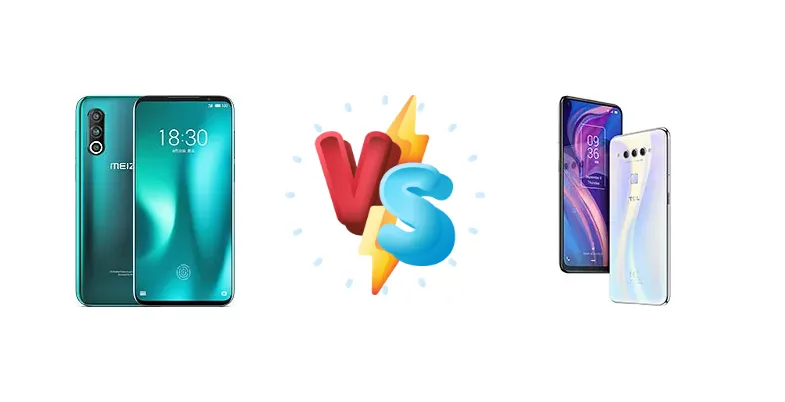
The Meizu 16s Pro, released as a late-2019 flagship, now finds itself competing in a different market segment against newer contenders like the TCL Plex. This comparison examines whether the older, more powerful hardware of the Meizu 16s Pro can still justify its existence against the TCL Plex’s more modern, value-focused approach. We’ll dissect the core differences in chipset, charging, and overall user experience to determine which device offers the best bang for your buck.
🏆 Quick Verdict
For users prioritizing raw performance and sustained gaming, the Meizu 16s Pro is the clear winner thanks to its Snapdragon 855+ chipset. However, the TCL Plex offers a more balanced package with faster charging and a more modern software experience, making it the better choice for everyday users and those on a tighter budget.
| Network |
|---|
| 2G bands | GSM 850 / 900 / 1800 / 1900 | GSM 850 / 900 / 1800 / 1900 |
| 3G bands | HSDPA 850 / 900 / 1900 / 2100 | HSDPA 850 / 900 / 1900 / 2100 |
| 4G bands | 1, 3, 5, 8, 34, 38, 39, 40, 41 | 1, 3, 5, 7, 8, 20, 28, 38, 40 |
| Speed | HSPA 42.2/5.76 Mbps, LTE (5CA) Cat18 1200/150 Mbps | HSPA 42.2/5.76 Mbps, LTE (2CA) Cat6 400/75 Mbps |
| Technology | GSM / CDMA / HSPA / LTE | GSM / HSPA / LTE |
| | CDMA 800 & TD-SCDMA | - |
| Launch |
|---|
| Announced | 2019, August. Released 2019, August | 2019, September. Released 2019, October |
| Status | Discontinued | Discontinued |
| Body |
|---|
| Build | - | Glass front, glass back, aluminum frame |
| Dimensions | 151.9 x 73.4 x 7.7 mm (5.98 x 2.89 x 0.30 in) | 162.2 x 76.6 x 8 mm (6.39 x 3.02 x 0.31 in) |
| SIM | Nano-SIM + Nano-SIM | · Nano-SIM· Nano-SIM + Nano-SIM |
| Weight | 166 g (5.86 oz) | 192 g (6.77 oz) |
| Display |
|---|
| Resolution | 1080 x 2232 pixels, 18.5:9 ratio (~403 ppi density) | 1080 x 2340 pixels, 19.5:9 ratio (~395 ppi density) |
| Size | 6.2 inches, 95.8 cm2 (~85.9% screen-to-body ratio) | 6.53 inches, 104.7 cm2 (~84.2% screen-to-body ratio) |
| Type | Super AMOLED | IPS LCD |
| Platform |
|---|
| CPU | Octa-core (1x2.96 GHz Kryo 485 & 3x2.42 GHz Kryo 485 & 4x1.78 GHz Kryo 485) | Octa-core (2x2.0 GHz Kryo 460 Gold & 6x1.7 GHz Kryo 460 Silver) |
| Chipset | Qualcomm SM8150 Snapdragon 855+ (7 nm) | Qualcomm SDM675 Snapdragon 675 (11 nm) |
| GPU | Adreno 640 (700 MHz) | Adreno 612 |
| OS | Android 9.0 (Pie), Flyme 8 | Android 9.0 (Pie), upgradable to Android 10 |
| Memory |
|---|
| Card slot | No | microSDXC (uses shared SIM slot) |
| Internal | 128GB 6GB RAM, 128GB 8GB RAM, 256GB 8GB RAM | 128GB 6GB RAM |
| | UFS 3.0 | UFS 2.1 |
| Main Camera |
|---|
| Features | Six-LED dual-tone flash, Auto-HDR, panorama | Dual-LED flash, HDR, panorama |
| Triple | 48 MP, f/1.7, (wide), 1/2.0", 0.8µm, PDAF, OIS
20MP, f/2.6, (telephoto), 1/2.8", 1.0µm, PDAF
16 MP, f/2.2, 16mm (ultrawide), 1/3.6", 1.0µm | 48 MP, f/1.8, 26mm (wide), 1/2.0", 0.8µm, PDAF
16 MP, f/2.4, 13mm (ultrawide), 1/3.1", 1.0µm
2 MP, f/1.8 |
| Video | 4K@30/60fps, 1080p@30fps (gyro-EIS) | 4K@30fps, 1080p@30/60/120fps, 720p@960fps, gyro-EIS |
| Selfie camera |
|---|
| Features | HDR | - |
| Single | 20MP, f/2.2 | 24 MP, f/2.0, 26mm (wide), 1/2.8", 0.9µm |
| Video | 1080p@30fps | 1080p@30fps |
| Sound |
|---|
| 3.5mm jack | No | Yes |
| 35mm jack | No | Yes |
| Loudspeaker | Yes | Yes |
| Comms |
|---|
| Bluetooth | 5.0, A2DP, LE | 5.0, A2DP, LE, aptX |
| NFC | Yes | Yes |
| Positioning | GPS (L1+L5), GLONASS, BDS, GALILEO | GPS |
| Radio | No | FM radio |
| USB | USB Type-C 2.0 | USB Type-C 2.0 |
| WLAN | Wi-Fi 802.11 а/b/g/n/ac, dual-band, Wi-Fi Direct | Wi-Fi 802.11 a/b/g/n/ac, dual-band, Wi-Fi Direct |
| Features |
|---|
| Sensors | Fingerprint (under display, optical), accelerometer, gyro, proximity, compass | Fingerprint (rear-mounted), accelerometer, gyro, proximity, compass |
| Battery |
|---|
| Charging | 24W wired | 18W wired, QC3, 50% in 32 min |
| Stand-by | - | Up to 396 h (3G) |
| Talk time | - | Up to 12 h (2G) / Up to 25 h (3G) |
| Type | Li-Po 3600 mAh, non-removable | Li-Ion 3820 mAh, non-removable |
| Misc |
|---|
| Colors | Twilight Forest, Dream Unicorn, Black Mirror, White story | Obsidian Black, Opal White |
| Models | - | T780H |
| Price | About 340 EUR | About 330 EUR |
Meizu 16s Pro
- Significantly more powerful Snapdragon 855+ processor
- Potentially superior display quality (AMOLED, brightness)
- Likely better camera sensor and image processing
- Slower charging speed (24W without QC)
- Potentially outdated software and security updates
- May experience more thermal throttling under sustained load
TCL Plex
- Faster charging with Quick Charge 3.0 (18W, 50% in 32 min)
- More modern software experience
- Better value for money
- Significantly less powerful Snapdragon 675 processor
- Potentially lower display quality (LCD or less advanced AMOLED)
- Camera performance likely inferior to the Meizu 16s Pro
Display Comparison
Neither device's display specifications are provided, so we must infer. Given the Meizu 16s Pro's flagship positioning, it likely features a higher-quality AMOLED panel with potentially higher peak brightness and color accuracy compared to the TCL Plex. The TCL Plex, being a mid-range device, likely utilizes an LCD or a less advanced AMOLED. The absence of refresh rate data suggests neither phone boasts a high refresh rate display, a common omission in this price bracket. Bezels are likely comparable, with the Meizu potentially having slightly slimmer bezels due to its flagship status.
Camera Comparison
Without detailed camera specifications, a direct comparison is difficult. However, given the Meizu 16s Pro’s flagship status, it likely features a more sophisticated camera system with a larger sensor and potentially optical image stabilization (OIS). The TCL Plex, while capable, likely relies on software processing to compensate for a less advanced sensor. The absence of information regarding lens apertures makes it difficult to assess low-light performance, but a larger aperture on the Meizu would be expected. We can assume the TCL Plex may include a variety of lenses, but the quality of those lenses will likely be lower than the Meizu's primary sensor.
Performance
The core difference lies in the chipsets. The Meizu 16s Pro’s Snapdragon 855+ (7nm) is a significant leap ahead of the TCL Plex’s Snapdragon 675 (11nm). The 855+ features an octa-core configuration with a 2.96 GHz Kryo 485 prime core, while the 675 utilizes a dual-core 2.0 GHz Kryo 460 Gold setup. This translates to substantially faster CPU and GPU performance on the Meizu, particularly in demanding applications. The 7nm process node of the 855+ also offers better thermal efficiency, potentially leading to less throttling during prolonged gaming sessions. The TCL Plex’s 675 is designed for efficient everyday tasks, but will struggle with graphically intensive games at higher settings. The Meizu's superior processing power benefits gamers, video editors, and power users.
Battery Life
Battery capacity is not specified for either device. However, the charging speeds provide a clear advantage to the TCL Plex. Its 18W wired charging with Quick Charge 3.0 support and a claimed 50% charge in 32 minutes is faster than the Meizu 16s Pro’s 24W charging. While the Meizu’s wattage is higher, the lack of Quick Charge support suggests a slower overall charging time. The TCL Plex’s faster charging is a significant convenience factor for users who need to quickly top up their battery.
Buying Guide
Buy the Meizu 16s Pro if you absolutely need the highest possible Android performance for demanding tasks like gaming or video editing, and are willing to accept potentially older software and a slower charging speed. Buy the TCL Plex if you prioritize a smooth, everyday experience, faster charging, and a more modern software experience, even if it means sacrificing some raw processing power.
Frequently Asked Questions
❓ Will the Snapdragon 675 in the TCL Plex struggle with demanding games like PUBG or Call of Duty?
Yes, the Snapdragon 675 is a mid-range chipset and will likely require reduced graphics settings and frame rates to achieve a playable experience in demanding games. Expect some stuttering and frame drops, especially during intense action sequences. The Meizu 16s Pro’s Snapdragon 855+ will handle these games with significantly more ease.
❓ How important is Quick Charge 3.0 on the TCL Plex compared to the Meizu 16s Pro's 24W charging?
Quick Charge 3.0 allows the TCL Plex to intelligently manage the charging process, delivering power more efficiently and resulting in faster overall charging times. While the Meizu 16s Pro has a higher wattage, the lack of Quick Charge means it won't be able to utilize that power as effectively, leading to a slower 0-100% charge time.
❓ Given the Meizu 16s Pro is an older device, are software updates and security patches still being provided?
This is a significant concern. Meizu's update track record has been inconsistent, and it's likely the 16s Pro is no longer receiving regular security updates. This poses a security risk and may limit compatibility with newer apps and services. The TCL Plex, being a more recent device, is more likely to receive ongoing software support.