
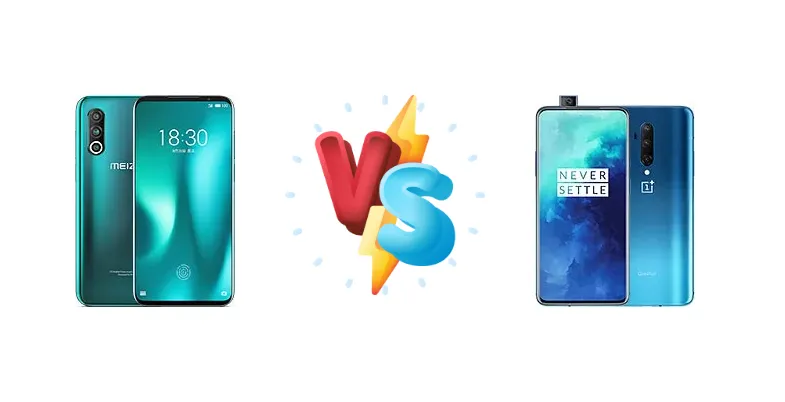
Meizu 16s Pro vs OnePlus 7T Pro: A Detailed Comparison of 2019 Flagships
| Phones Images | |||||
|---|---|---|---|---|---|
|
🏆 Quick Verdict
For the average user in 2024, the OnePlus 7T Pro emerges as the slightly better choice. While both phones share the same Snapdragon 855+ chipset, the OnePlus 7T Pro’s faster 30W charging and generally wider availability of software support give it a practical edge. The Meizu 16s Pro remains a compelling option for those seeking a unique design and a purer Android experience.
| PHONES | ||
|---|---|---|
| Phone Names | Meizu 16s Pro | OnePlus 7T Pro |
| Network | ||
|---|---|---|
| 2G bands | GSM 850 / 900 / 1800 / 1900 | GSM 850 / 900 / 1800 / 1900 |
| 3G bands | HSDPA 850 / 900 / 1900 / 2100 | HSDPA 800 / 850 / 900 / 1700(AWS) / 1800 / 1900 / 2100 |
| 4G bands | 1, 3, 5, 8, 34, 38, 39, 40, 41 | 1, 2, 3, 4, 5, 7, 8, 12, 13, 17, 18, 19, 20, 25, 26, 28, 29, 32, 34, 38, 39, 40, 41, 66 |
| Speed | HSPA 42.2/5.76 Mbps, LTE (5CA) Cat18 1200/150 Mbps | HSPA 42.2/5.76 Mbps, LTE (5CA) Cat18 1200/150 Mbps |
| Technology | GSM / CDMA / HSPA / LTE | GSM / CDMA / HSPA / LTE |
| CDMA 800 & TD-SCDMA | CDMA 800 / 1900 & TD-SCDMA | |
| Launch | ||
|---|---|---|
| Announced | 2019, August. Released 2019, August | 2019, October 10 |
| Status | Discontinued | Available. Released 2019, October 12 |
| Body | ||
|---|---|---|
| Build | - | Glass front (Gorilla Glass 5), glass back (Gorilla Glass 5), aluminum frame |
| Dimensions | 151.9 x 73.4 x 7.7 mm (5.98 x 2.89 x 0.30 in) | 162.6 x 75.9 x 8.8 mm (6.40 x 2.99 x 0.35 in) |
| SIM | Nano-SIM + Nano-SIM | Nano-SIM + Nano-SIM |
| Weight | 166 g (5.86 oz) | 206 g (7.27 oz) |
| Display | ||
|---|---|---|
| Protection | - | Corning Gorilla Glass 5 |
| Resolution | 1080 x 2232 pixels, 18.5:9 ratio (~403 ppi density) | 1440 x 3120 pixels, 19.5:9 ratio (~516 ppi density) |
| Size | 6.2 inches, 95.8 cm2 (~85.9% screen-to-body ratio) | 6.67 inches, 108.8 cm2 (~88.1% screen-to-body ratio) |
| Type | Super AMOLED | Fluid AMOLED, 90Hz, HDR10+ |
| Platform | ||
|---|---|---|
| CPU | Octa-core (1x2.96 GHz Kryo 485 & 3x2.42 GHz Kryo 485 & 4x1.78 GHz Kryo 485) | Octa-core (1x2.96 GHz Kryo 485 & 3x2.42 GHz Kryo 485 & 4x1.78 GHz Kryo 485) |
| Chipset | Qualcomm SM8150 Snapdragon 855+ (7 nm) | Qualcomm SM8150 Snapdragon 855+ (7 nm) |
| GPU | Adreno 640 (700 MHz) | Adreno 640 (700 MHz) |
| OS | Android 9.0 (Pie), Flyme 8 | Android 10, upgradable to Android 12, OxygenOS 12.1 |
| Memory | ||
|---|---|---|
| Card slot | No | No |
| Internal | 128GB 6GB RAM, 128GB 8GB RAM, 256GB 8GB RAM | 256GB 8GB RAM, 256GB 12GB RAM |
| UFS 3.0 | 12GB RAM - McLaren Edition only UFS 3.0 | |
| Main Camera | ||
|---|---|---|
| Features | Six-LED dual-tone flash, Auto-HDR, panorama | Laser AF, Dual-LED flash, HDR, panorama |
| Triple | 48 MP, f/1.7, (wide), 1/2.0", 0.8µm, PDAF, OIS 20MP, f/2.6, (telephoto), 1/2.8", 1.0µm, PDAF 16 MP, f/2.2, 16mm (ultrawide), 1/3.6", 1.0µm | 48 MP, f/1.6, (wide), 1/2.0", 0.8µm, PDAF, OIS 8 MP, f/2.4, 78mm (telephoto), 3x optical zoom, PDAF, OIS 16 MP, f/2.2, 17mm (ultrawide), AF |
| Video | 4K@30/60fps, 1080p@30fps (gyro-EIS) | 4K@30/60fps, 1080p@30/60/240fps, 720p@960fps, Auto HDR, gyro-EIS |
| Selfie camera | ||
|---|---|---|
| Features | HDR | HDR |
| Single | 20MP, f/2.2 | Motorized pop-up 16 MP, f/2.0, 25mm (wide), 1/3.06", 1.0µm |
| Video | 1080p@30fps | 1080p@30fps, gyro-EIS |
| Sound | ||
|---|---|---|
| 3.5mm jack | No | No |
| 35mm jack | No | No |
| Loudspeaker | Yes | Yes, with stereo speakers |
| Comms | ||
|---|---|---|
| Bluetooth | 5.0, A2DP, LE | 5.0, A2DP, LE, aptX HD |
| NFC | Yes | Yes |
| Positioning | GPS (L1+L5), GLONASS, BDS, GALILEO | GPS (L1+L5), GLONASS (G1), BDS (B1), GALILEO (E1+E5a) |
| Radio | No | No |
| USB | USB Type-C 2.0 | USB Type-C 3.1, OTG |
| WLAN | Wi-Fi 802.11 а/b/g/n/ac, dual-band, Wi-Fi Direct | Wi-Fi 802.11 a/b/g/n/ac, dual-band, Wi-Fi Direct, DLNA |
| Features | ||
|---|---|---|
| Sensors | Fingerprint (under display, optical), accelerometer, gyro, proximity, compass | Fingerprint (under display, optical), accelerometer, gyro, compass |
| - | Virtual proximity sensing | |
| Battery | ||
|---|---|---|
| Charging | 24W wired | 30W wired |
| Type | Li-Po 3600 mAh, non-removable | Li-Po 4085 mAh, non-removable |
| Misc | ||
|---|---|---|
| Colors | Twilight Forest, Dream Unicorn, Black Mirror, White story | Haze Blue, McLaren Edition |
| Models | - | HD1911, HD1913, HD1910 |
| Price | About 340 EUR | About 1030 EUR |
| Tests | ||
|---|---|---|
| Audio quality | - | Noise -93.7dB / Crosstalk -91.0dB |
| Battery life | - | Endurance rating 100h |
| Camera | - | Photo / Video |
| Display | - | Contrast ratio: Infinite (nominal) |
| Loudspeaker | - | Voice 90dB / Noise 75dB / Ring 82dB |
| Performance | - | AnTuTu: 395868 (v7), 493901 (v8) GeekBench: 11246 (v4.4), 2803 (v5.1) GFXBench: 24fps (ES 3.1 onscreen) |
Meizu 16s Pro
- Minimalist and unique design aesthetic.
- Potentially cleaner software experience (depending on Flyme OS version).
- Emphasis on natural image processing.
- Slower 24W charging.
- Potentially limited software update support.
- Less mainstream brand recognition.
OnePlus 7T Pro
- Faster 30W Warp Charge technology.
- More robust software support and updates.
- Pop-up camera for a truly full-screen experience.
- OxygenOS can be more feature-heavy and less minimalist.
- Image processing may be overly saturated for some users.
- Pop-up camera mechanism introduces a potential point of failure.
Display Comparison
Both the Meizu 16s Pro and OnePlus 7T Pro feature displays with an 'infinite' (nominal) contrast ratio, suggesting excellent black levels likely achieved through OLED technology. However, specific details like peak brightness and color accuracy are missing. Given OnePlus’s history, the 7T Pro likely employed a higher peak brightness for better outdoor visibility. The 7T Pro’s pop-up camera allowed for a truly full-screen experience, maximizing screen real estate, while the Meizu 16s Pro likely had a smaller notch or bezel. The absence of refresh rate data suggests both were likely 60Hz panels, standard for the time.
Camera Comparison
Both phones are listed as having 'Photo / Video' capabilities, but lack specific details. The Meizu 16s Pro was known for its emphasis on image quality and color science, while OnePlus typically focused on versatility. Without sensor size or aperture information, it’s difficult to make a definitive judgment. However, OnePlus’s software processing often leaned towards more vibrant, social media-friendly images, while Meizu aimed for a more natural look. The absence of details suggests neither phone featured particularly groundbreaking camera technology compared to competitors at the time.
Performance
Both devices are equipped with the Qualcomm SM8150 Snapdragon 855+ (7 nm) chipset, featuring an octa-core CPU configuration (1x2.96 GHz Kryo 485, 3x2.42 GHz Kryo 485, and 4x1.78 GHz Kryo 485). This means CPU performance will be virtually identical. The key differentiator lies in thermal management and sustained performance. OnePlus historically prioritized aggressive thermal throttling to maintain consistent performance, while Meizu’s approach was less defined. RAM speed (LPDDR4X is assumed for both) and storage type (UFS 3.0 is likely) would have had minimal real-world impact given the chipset’s capabilities.
Battery Life
Both the Meizu 16s Pro and OnePlus 7T Pro boast an endurance rating of 100 hours, indicating similar battery life under typical usage. However, the OnePlus 7T Pro’s 30W wired charging significantly outperforms the Meizu 16s Pro’s 24W charging. This translates to a much faster 0-100% charge time for the OnePlus device, a crucial advantage for users who prioritize convenience. While battery capacity isn’t specified, the faster charging speed effectively mitigates any potential capacity differences.
Buying Guide
Buy the Meizu 16s Pro if you prioritize a minimalist design, a clean software experience, and are comfortable with potentially limited software updates. It’s ideal for users who value form and function over a plethora of features. Buy the OnePlus 7T Pro if you prefer faster charging, a more robust software ecosystem with longer support, and a feature-rich experience. This phone is best suited for users who want a reliable, all-around flagship that continues to receive updates and offers a smoother user experience.