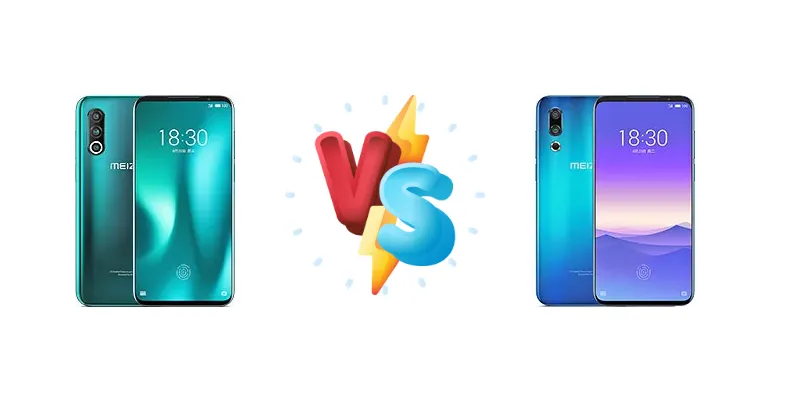
The Meizu 16s and 16s Pro represent a fascinating point in Android history – a time when flagship specs were becoming increasingly accessible. Both phones share a striking design and core features, but a key difference lies under the hood. This comparison dissects the nuances between the Snapdragon 855 and 855+ chipsets, and the impact of the Pro model's slightly faster charging, to help you determine which device offers the best value.
🏆 Quick Verdict
For most users, the Meizu 16s delivers excellent performance and value. However, the Meizu 16s Pro edges ahead for power users and gamers who demand sustained peak performance, thanks to the Snapdragon 855+’s higher clock speeds. The 24W charging is identical, making the CPU the primary differentiator.
| Network |
|---|
| 2G bands | GSM 850 / 900 / 1800 / 1900 | GSM 850 / 900 / 1800 / 1900 |
| 3G bands | HSDPA 850 / 900 / 1900 / 2100 | HSDPA 850 / 900 / 1700(AWS) / 1900 / 2100 |
| 4G bands | 1, 3, 5, 8, 34, 38, 39, 40, 41 | 1, 2, 3, 4, 5, 7, 8, 20, 40 |
| Speed | HSPA 42.2/5.76 Mbps, LTE (5CA) Cat18 1200/150 Mbps | HSPA 42.2/5.76 Mbps, LTE (5CA) Cat18 1200/150 Mbps |
| Technology | GSM / CDMA / HSPA / LTE | GSM / CDMA / HSPA / LTE |
| | CDMA 800 & TD-SCDMA | CDMA 800 & TD-SCDMA |
| Launch |
|---|
| Announced | 2019, August. Released 2019, August | 2019, April. Released 2019, April |
| Status | Discontinued | Discontinued |
| Body |
|---|
| Dimensions | 151.9 x 73.4 x 7.7 mm (5.98 x 2.89 x 0.30 in) | 151.9 x 73.4 x 7.6 mm (5.98 x 2.89 x 0.30 in) |
| SIM | Nano-SIM + Nano-SIM | Nano-SIM + Nano-SIM |
| Weight | 166 g (5.86 oz) | 165 g (5.82 oz) |
| Display |
|---|
| Resolution | 1080 x 2232 pixels, 18.5:9 ratio (~403 ppi density) | 1080 x 2232 pixels, 18.5:9 ratio (~400 ppi density) |
| Size | 6.2 inches, 95.8 cm2 (~85.9% screen-to-body ratio) | 6.2 inches, 97.2 cm2 (~87.2% screen-to-body ratio) |
| Type | Super AMOLED | AMOLED |
| Platform |
|---|
| CPU | Octa-core (1x2.96 GHz Kryo 485 & 3x2.42 GHz Kryo 485 & 4x1.78 GHz Kryo 485) | Octa-core (1x2.84 GHz Kryo 485 & 3x2.42 GHz Kryo 485 & 4x1.78 GHz Kryo 485) |
| Chipset | Qualcomm SM8150 Snapdragon 855+ (7 nm) | Qualcomm SM8150 Snapdragon 855 (7 nm) |
| GPU | Adreno 640 (700 MHz) | Adreno 640 |
| OS | Android 9.0 (Pie), Flyme 8 | Android 9.0 (Pie), Flyme 7.3 |
| Memory |
|---|
| Card slot | No | No |
| Internal | 128GB 6GB RAM, 128GB 8GB RAM, 256GB 8GB RAM | 128GB 6GB RAM, 128GB 8GB RAM, 256GB 8GB RAM |
| | UFS 3.0 | UFS 2.1 |
| Main Camera |
|---|
| Dual | - | 48 MP, f/1.7, (wide), 1/2.0", 0.8µm, PDAF, OIS
20MP, f/2.6, (telephoto), PDAF |
| Features | Six-LED dual-tone flash, Auto-HDR, panorama | Six-LED dual-tone flash, Auto-HDR, panorama |
| Triple | 48 MP, f/1.7, (wide), 1/2.0", 0.8µm, PDAF, OIS
20MP, f/2.6, (telephoto), 1/2.8", 1.0µm, PDAF
16 MP, f/2.2, 16mm (ultrawide), 1/3.6", 1.0µm | - |
| Video | 4K@30/60fps, 1080p@30fps (gyro-EIS) | 4K@30fps, 1080p@30fps (gyro-EIS) |
| Selfie camera |
|---|
| Features | HDR | HDR |
| Single | 20MP, f/2.2 | 20MP, f/2.2 |
| Video | 1080p@30fps | 1080p@30fps |
| Sound |
|---|
| 3.5mm jack | No | No |
| 35mm jack | No | No |
| Loudspeaker | Yes | Yes |
| Comms |
|---|
| Bluetooth | 5.0, A2DP, LE | 5.0, A2DP, LE |
| NFC | Yes | Yes |
| Positioning | GPS (L1+L5), GLONASS, BDS, GALILEO | GPS, BDS |
| Radio | No | No |
| USB | USB Type-C 2.0 | USB Type-C 2.0 |
| WLAN | Wi-Fi 802.11 а/b/g/n/ac, dual-band, Wi-Fi Direct | Wi-Fi 802.11 а/b/g/n/ac, dual-band, Wi-Fi Direct |
| Features |
|---|
| Sensors | Fingerprint (under display, optical), accelerometer, gyro, proximity, compass | Fingerprint (under display, optical), accelerometer, gyro, proximity, compass |
| Battery |
|---|
| Charging | 24W wired | 24W wired |
| Type | Li-Po 3600 mAh, non-removable | Li-Po 3600 mAh, non-removable |
| Misc |
|---|
| Colors | Twilight Forest, Dream Unicorn, Black Mirror, White story | Carbon Black, Pearl White, Phantom Blue |
| Price | About 340 EUR | About 420 EUR |
Meizu 16s Pro
- Slightly better sustained performance with Snapdragon 855+
- Potentially better thermal management under heavy load
- Marginally improved GPU performance
- Likely higher price point
- Performance gains may not be noticeable for casual users
Meizu 16s
- More affordable price
- Excellent performance for everyday tasks
- Still a very capable chipset for most users
- Slightly lower CPU clock speed
- May experience more throttling under sustained load
Display Comparison
Both the Meizu 16s and 16s Pro feature a 6.2-inch AMOLED display, but detailed specs like resolution, peak brightness, and color accuracy are not provided. Given Meizu’s history, we can assume both panels offer vibrant colors and good viewing angles. The absence of high refresh rate technology (90Hz or 120Hz) is a common trait for phones in this era. The focus here is on the internal hardware, not display advancements.
Camera Comparison
Detailed camera specifications are unavailable. However, given the flagship positioning of both devices, we can expect capable camera systems. The image processing capabilities of the Snapdragon 855 and 855+ are similar, meaning photo and video quality will likely be comparable. The absence of detailed sensor information makes a definitive camera comparison impossible, but both phones likely feature a primary sensor capable of capturing detailed images in good lighting conditions.
Performance
The core difference between these devices is the chipset. The Meizu 16s Pro boasts the Qualcomm SM8150 Snapdragon 855+ (7 nm), featuring a Kryo 485 prime core clocked at 2.96 GHz. The standard Meizu 16s utilizes the Snapdragon 855 (7 nm) with a slightly slower prime core at 2.84 GHz. While both chips share the same architecture, the 855+’s higher clock speed translates to a noticeable performance boost in CPU-intensive tasks. The GPU performance is also marginally improved on the Pro model. Both phones likely utilize LPDDR4X RAM, as LPDDR5 was not widespread at the time of their release. This difference in CPU clock speed will be most apparent during prolonged gaming sessions or when running multiple demanding applications simultaneously.
Battery Life
Both the Meizu 16s and 16s Pro support 24W wired charging. While the battery capacity isn't specified, the identical charging wattage suggests similar 0-100% charging times. The Snapdragon 855+ in the Pro model, while more powerful, is also slightly more efficient, potentially leading to marginally better battery life under heavy load. However, for typical usage, the battery life difference will likely be negligible.
Buying Guide
Buy the Meizu 16s Pro if you frequently engage in demanding tasks like mobile gaming, video editing, or heavy multitasking, and want the highest possible sustained performance from a Snapdragon 855-series chipset. Buy the Meizu 16s if you prioritize value and are a typical user who primarily browses, streams content, and uses social media – the Snapdragon 855 still provides a smooth and responsive experience.
Frequently Asked Questions
❓ Will I notice a significant difference in gaming performance between the Meizu 16s and 16s Pro?
For graphically intensive games, the Snapdragon 855+ in the 16s Pro will provide a smoother experience, especially during prolonged gaming sessions. The higher clock speed and improved thermal management will help maintain higher frame rates and prevent throttling. However, for less demanding games, the difference will be minimal.
❓ Does the Snapdragon 855+ in the 16s Pro translate to faster app loading times?
While the 855+ is faster, the difference in app loading times will likely be subtle. Both phones utilize fast storage (likely UFS 2.1 or 3.0), which is a significant factor in app launch speeds. The CPU difference will be more noticeable in tasks that require sustained processing power, like video editing or compiling code.
❓ Is the 24W charging speed fast enough in 2024?
24W charging is relatively slow by today's standards (2024), where 65W or even 120W charging is common. However, it's still sufficient to charge the phone overnight or provide a decent boost in a short period. It's not a major drawback, but it's something to consider if fast charging is a priority.