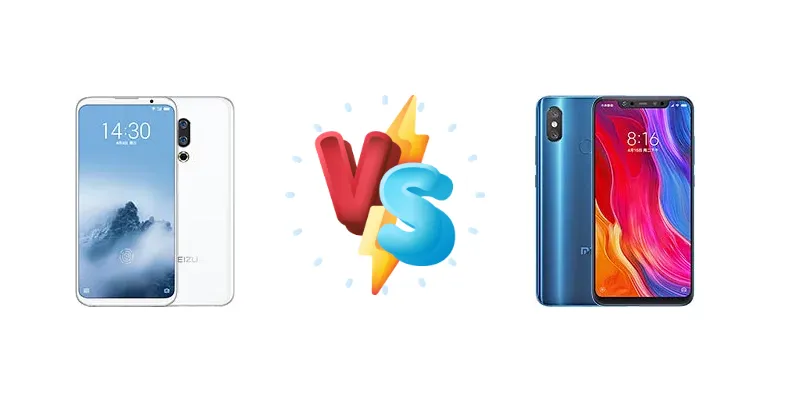
Released in 2018, both the Meizu 16 and Xiaomi Mi 8 represented peak Android flagship performance at a competitive price point. While both leverage the Qualcomm Snapdragon 845, subtle differences in implementation, display technology, and charging capabilities create distinct user experiences. This comparison dissects these nuances to determine which device offers the best value today.
🏆 Quick Verdict
For the average user prioritizing a slightly faster CPU and potentially better sustained performance, the Meizu 16 edges out the Xiaomi Mi 8. However, the Mi 8’s Quick Charge 4 support and comparable battery life make it a strong contender, especially for those invested in the Xiaomi ecosystem.
| Network |
|---|
| 2G bands | GSM 850 / 900 / 1800 / 1900 | GSM 850 / 900 / 1800 / 1900 |
| 3G bands | HSDPA 850 / 900 / 1700(AWS) / 1900 / 2100 - Global | HSDPA 850 / 900 / 1700(AWS) / 1900 / 2100 |
| 4G bands | 1, 2, 3, 4, 5, 7, 8, 20, 40 - Global | 1, 2, 3, 4, 5, 7, 8, 12, 17, 20, 34, 38, 39, 40, 41 |
| Speed | HSPA 42.2/5.76 Mbps, LTE (4CA) Cat16 1024/150 Mbps | HSPA 42.2/5.76 Mbps, LTE (4CA) Cat16 1024/150 Mbps |
| Technology | GSM / CDMA / HSPA / LTE | GSM / CDMA / HSPA / LTE |
| | 1, 3, 4, 5, 8, 34, 38, 39, 40, 41 - China | CDMA 800 & TD-SCDMA |
| Launch |
|---|
| Announced | 2018, August. Released 2018, August | 2018, May. Released 2018, June |
| Status | Discontinued | Discontinued |
| Body |
|---|
| Build | - | Glass front (Gorilla Glass 5), glass back (Gorilla Glass 5), aluminum frame (7000 series) |
| Dimensions | 150.5 x 73.2 x 7.3 mm (5.93 x 2.88 x 0.29 in) | 154.9 x 74.8 x 7.6 mm (6.10 x 2.94 x 0.30 in) |
| SIM | Nano-SIM + Nano-SIM | Nano-SIM + Nano-SIM |
| Weight | 152 g (5.36 oz) | 175 g (6.17 oz) |
| Display |
|---|
| Protection | - | Corning Gorilla Glass 5 |
| Resolution | 1080 x 2160 pixels, 18:9 ratio (~402 ppi density) | 1080 x 2248 pixels (~402 ppi density) |
| Size | 6.0 inches, 92.9 cm2 (~84.3% screen-to-body ratio) | 6.21 inches, 97.1 cm2 (~83.8% screen-to-body ratio) |
| Type | Super AMOLED | Super AMOLED, HDR10 |
| Platform |
|---|
| CPU | Octa-core (4x2.8 GHz Kryo 385 Gold & 4x1.7 GHz Kryo 385 Silver) | Octa-core (4x2.8 GHz Kryo 385 Gold & 4x1.8 GHz Kryo 385 Silver) |
| Chipset | Qualcomm SDM845 Snapdragon 845 (10 nm) | Qualcomm SDM845 Snapdragon 845 (10 nm) |
| GPU | Adreno 630 | Adreno 630 |
| OS | Android 8.1 (Oreo), Flyme UI | Android 8.1 (Oreo), upgradable to Android 10, MIUI 12 |
| Memory |
|---|
| Card slot | No | No |
| Internal | 64GB 6GB RAM, 128GB 8GB RAM | 64GB 6GB RAM, 128GB 6GB RAM, 128GB 8GB RAM, 256GB 6GB RAM |
| | UFS 2.1 | UFS 2.1 |
| Main Camera |
|---|
| Dual | 12 MP, f/1.8, 25mm (wide), 1/2.3", 1.55µm, dual pixel PDAF, 4-axis OIS
20 MP, f/2.6, 1/2.6", 1.0µm | 12 MP, f/1.8, 1/2.55", 1.4µm, dual pixel PDAF, 4-axis OIS
12 MP, f/2.4, 56mm (telephoto), 1/3.4", 1.0µm, AF, 2x optical zoom |
| Features | Laser AF, Six-LED dual-tone flash, Auto-HDR, panorama | Dual-LED flash, HDR, panorama |
| Video | 4K@30fps, 1080p@30fps (gyro-EIS) | 4K@30/60fps, 1080p@30/120/240fps, 720p@960fps |
| Selfie camera |
|---|
| Single | 20 MP, f/2.0, 27mm (wide), 1/2.8", 1.0µm | 20 MP, f/2.0, (wide), 1/3", 0.9µm |
| Video | 1080p@30fps | 1080p@30fps |
| Sound |
|---|
| 3.5mm jack | Yes | No |
| 35mm jack | Yes | No |
| Loudspeaker | Yes, with stereo speakers | Yes |
| Comms |
|---|
| Bluetooth | 5.0, A2DP, LE | 5.0, A2DP, LE, aptX HD |
| NFC | No | Yes |
| Positioning | GPS, GLONASS, BDS, GALILEO, SBAS, QZSS | GPS (L1+L5), GLONASS (L1), BDS (B1), GALILEO (E1+E5a), QZSS (L1+L5) |
| Radio | No | No |
| USB | USB Type-C 2.0 | USB Type-C |
| WLAN | Wi-Fi 802.11 а/b/g/n/ac, dual-band, Wi-Fi Direct | Wi-Fi 802.11 a/b/g/n/ac, dual-band, Wi-Fi Direct, DLNA |
| Features |
|---|
| Sensors | Fingerprint (under display, optical), accelerometer, gyro, proximity, compass | Infrared Face ID, fingerprint (rear-mounted), accelerometer, gyro, proximity, barometer, compass |
| Battery |
|---|
| Charging | 24W wired | 18W wired, QC4 |
| Type | Li-Ion 3010 mAh, non-removable | Li-Po 3400 mAh, non-removable |
| Misc |
|---|
| Colors | Black, White | Black, Blue, White, Gold |
| Models | - | M1803E1A |
| Price | About 410 EUR | About 430 EUR |
| SAR | - | 0.70 W/kg (head) 1.66 W/kg (body) |
| SAR EU | - | 1.01 W/kg (head) 1.32 W/kg (body) |
| Tests |
|---|
| Audio quality | - |
Noise -93.9dB / Crosstalk -93.7dB |
| Battery life | - |
Endurance rating 86h
|
| Camera | - |
Photo / Video |
| Display | - |
Contrast ratio: Infinite (nominal), 4.086 (sunlight) |
| Loudspeaker | - |
-29.1 LUFS (Average)
|
| Performance | - |
AnTuTu: 217298 (v7), 341687 (v8)
GeekBench: 8494 (v4.4), 2002 (v5.1)
GFXBench: 33fps (ES 3.1 onscreen) |
Meizu 16
- Slightly faster CPU clock speed for potentially snappier performance.
- 24W charging offers faster top-ups.
- Generally praised for its minimalist design and slimmer bezels.
- Lacks Quick Charge 4 compatibility.
- Limited brand recognition compared to Xiaomi.
Xiaomi Mi 8
- Quick Charge 4 support for wider charger compatibility.
- Strong brand recognition and established ecosystem.
- Comparable battery life with an 86h endurance rating.
- Slightly lower CPU clock speed compared to the Meizu 16.
- 18W charging is slower than the Meizu 16's 24W.
Display Comparison
Both the Meizu 16 and Xiaomi Mi 8 feature displays with an 'Infinite' contrast ratio (nominal) and a 4.086 sunlight contrast ratio, suggesting similar outdoor visibility. However, the context data lacks specifics on panel type (AMOLED is assumed for both) and resolution. The lack of refresh rate information is also notable, as 60Hz was standard for this era. The key difference lies in potential calibration and color accuracy, which would require independent testing. Bezels were a key design focus in 2018, and the Meizu 16 generally received praise for its slimmer bottom bezel, contributing to a more immersive viewing experience.
Camera Comparison
Both phones offer 'Photo / Video' capabilities, but the context data provides no specifics on sensor size, aperture, or image processing. Given the era, both likely feature a dual-camera setup. The Mi 8 gained recognition for its AI scene detection and portrait mode capabilities. Without detailed sensor information, it’s difficult to definitively declare a winner. However, the Mi 8’s camera app generally offered more features and customization options. The absence of details regarding OIS (Optical Image Stabilization) is a significant omission, as this impacts low-light performance and video stability.
Performance
Both devices are powered by the Qualcomm Snapdragon 845 (10nm), but the Meizu 16 boasts a slightly higher CPU clock speed – 2.8 GHz for the Kryo 385 Gold cores versus 2.8 GHz on the Mi 8. While seemingly minor, this difference, coupled with potential variations in RAM speed (LPDDR4X is assumed for both), could translate to marginally faster application loading and smoother multitasking. Thermal management is crucial with the SD845; the Meizu 16’s design and cooling solution would be key to preventing throttling during extended gaming sessions. The Mi 8’s software optimizations also play a role in sustained performance.
Battery Life
The Xiaomi Mi 8 and Meizu 16 both achieve an endurance rating of 86h, suggesting comparable real-world battery life despite potentially different battery capacities (not specified in the data). However, charging speeds differ significantly. The Meizu 16 supports 24W wired charging, while the Mi 8 offers 18W wired charging *and* Quick Charge 4 (QC4) compatibility. QC4 provides broader compatibility with various chargers and potentially faster charging speeds with compatible adapters. This makes the Mi 8 more versatile for users who frequently travel or rely on different charging sources.
Buying Guide
Buy the Meizu 16 if you prioritize raw CPU performance and a clean, minimalist software experience. Its slightly higher clocked CPU cores and 24W charging offer a performance edge. Buy the Xiaomi Mi 8 if you value fast charging compatibility (QC4) and a more established brand with wider accessory availability. The Mi 8’s endurance rating is also a plus for all-day users.
Frequently Asked Questions
❓ Does the Snapdragon 845 in either phone struggle with demanding games like PUBG Mobile?
While the Snapdragon 845 is a capable chipset, demanding games like PUBG Mobile can cause throttling after extended play sessions. Both phones require effective thermal management to maintain consistent frame rates. The Meizu 16's cooling solution may offer a slight advantage, but software optimizations on the Mi 8 also play a crucial role.
❓ Is the lack of detailed camera specs a significant drawback when comparing these phones?
Yes, the absence of sensor size, aperture, and OIS information makes a comprehensive camera comparison difficult. In 2018, these specs were critical differentiators. Without them, we can only assume both phones offer a standard flagship camera experience, relying on software processing to enhance image quality.
❓ Which phone is better for users who frequently use wireless charging?
Neither phone natively supports wireless charging. This was not a common feature on flagship devices in 2018. Adding wireless charging would require aftermarket accessories.
❓ How does the software experience differ between Meizu's Flyme OS and Xiaomi's MIUI?
Flyme OS (on the Meizu 16) is known for its minimalist design and focus on customization, while MIUI (on the Mi 8) offers a more feature-rich and often heavily themed experience. MIUI also benefits from a larger user base and more frequent updates. Preference here is highly subjective.