
Meizu 16 vs. Samsung Galaxy S22 5G: A Detailed Comparison of Two Android Flagships
| Phones Images | |||||
|---|---|---|---|---|---|
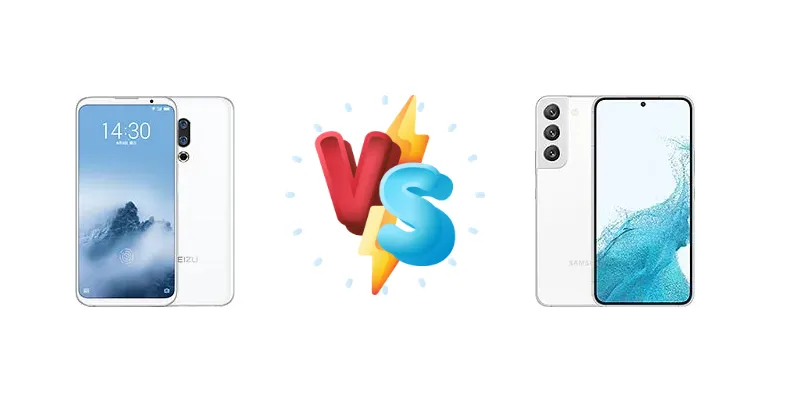
|
🏆 Quick Verdict
For most users, the Samsung Galaxy S22 5G is the better choice. Its newer Exynos 2200 (or Snapdragon 8 Gen 1) chipset, significantly improved camera system, and modern features like wireless charging outweigh the Meizu 16's strengths. However, the Meizu 16 remains a compelling option for those prioritizing a compact form factor and a clean software experience at a significantly lower price point.
| PHONES | ||
|---|---|---|
| Phone Names | Meizu 16 | Samsung Galaxy S22 5G |
| Network | ||
|---|---|---|
| 2G bands | GSM 850 / 900 / 1800 / 1900 | GSM 850 / 900 / 1800 / 1900 |
| 3G bands | HSDPA 850 / 900 / 1700(AWS) / 1900 / 2100 - Global | HSDPA 850 / 900 / 1700(AWS) / 1900 / 2100 |
| 4G bands | 1, 2, 3, 4, 5, 7, 8, 20, 40 - Global | 1, 2, 3, 4, 5, 7, 8, 12, 13, 17, 18, 19, 20, 25, 26, 28, 32, 38, 39, 40, 41, 66 - International |
| 5G bands | - | 1, 2, 3, 5, 7, 8, 12, 20, 25, 28, 38, 40, 41, 66, 75, 77, 78 SA/NSA/Sub6 - International |
| Speed | HSPA 42.2/5.76 Mbps, LTE (4CA) Cat16 1024/150 Mbps | HSPA 42.2/5.76 Mbps, LTE (7CA) Cat20 2000/200 Mbps, 5G (5+ Gbps DL) |
| Technology | GSM / CDMA / HSPA / LTE | GSM / CDMA / HSPA / EVDO / LTE / 5G |
| 1, 3, 4, 5, 8, 34, 38, 39, 40, 41 - China | 1, 3, 5, 7, 8, 20, 28, 38, 41, 66, 71, 260, 261 SA/NSA/Sub6/mmWave - USA | |
| Launch | ||
|---|---|---|
| Announced | 2018, August. Released 2018, August | 2022, February 09 |
| Status | Discontinued | Available. Released 2022, February 25 |
| Body | ||
|---|---|---|
| Build | - | Glass front (Gorilla Glass Victus+), glass back (Gorilla Glass Victus+), aluminum frame |
| Dimensions | 150.5 x 73.2 x 7.3 mm (5.93 x 2.88 x 0.29 in) | 146 x 70.6 x 7.6 mm (5.75 x 2.78 x 0.30 in) |
| SIM | Nano-SIM + Nano-SIM | Nano-SIM + eSIM· Nano-SIM + Nano-SIM + eSIM (max 2 at a time) |
| Weight | 152 g (5.36 oz) | 167 g / 168 g (mmWave) (5.89 oz) |
| - | IP68 dust/water resistant (up to 1.5m for 30 min) Armor aluminum frame with tougher drop and scratch resistance (advertised) | |
| Display | ||
|---|---|---|
| Protection | - | Corning Gorilla Glass Victus+ |
| Resolution | 1080 x 2160 pixels, 18:9 ratio (~402 ppi density) | 1080 x 2340 pixels, 19.5:9 ratio (~425 ppi density) |
| Size | 6.0 inches, 92.9 cm2 (~84.3% screen-to-body ratio) | 6.1 inches, 90.1 cm2 (~87.4% screen-to-body ratio) |
| Type | Super AMOLED | Dynamic AMOLED 2X, 120Hz, HDR10+, 1300 nits (peak) |
| - | Always-on display | |
| Platform | ||
|---|---|---|
| CPU | Octa-core (4x2.8 GHz Kryo 385 Gold & 4x1.7 GHz Kryo 385 Silver) | Octa-core (1x2.8 GHz Cortex-X2 & 3x2.50 GHz Cortex-A710 & 4x1.8 GHz Cortex-A510) - EuropeOcta-core (1x3.00 GHz Cortex-X2 & 3x2.50 GHz Cortex-A710 & 4x1.80 GHz Cortex-A510) - ROW |
| Chipset | Qualcomm SDM845 Snapdragon 845 (10 nm) | Exynos 2200 (4 nm) - EuropeQualcomm SM8450 Snapdragon 8 Gen 1 (4 nm) - ROW |
| GPU | Adreno 630 | Xclipse 920 - EuropeAdreno 730 - ROW |
| OS | Android 8.1 (Oreo), Flyme UI | Android 12, up to 4 major Android upgrades, One UI 8 |
| Memory | ||
|---|---|---|
| Card slot | No | No |
| Internal | 64GB 6GB RAM, 128GB 8GB RAM | 128GB 8GB RAM, 256GB 8GB RAM |
| UFS 2.1 | UFS 3.1 | |
| Main Camera | ||
|---|---|---|
| Dual | 12 MP, f/1.8, 25mm (wide), 1/2.3", 1.55µm, dual pixel PDAF, 4-axis OIS 20 MP, f/2.6, 1/2.6", 1.0µm | - |
| Features | Laser AF, Six-LED dual-tone flash, Auto-HDR, panorama | LED flash, auto-HDR, panorama |
| Single | - | 10 MP, f/2.2, 26mm (wide), 1/3.24", 1.22µm, Dual Pixel PDAF |
| Triple | - | 50 MP, f/1.8, 23mm (wide), 1/1.56", 1.0µm, dual pixel PDAF, OIS 10 MP, f/2.4, 70mm (telephoto), 1/3.94", 1.0µm, PDAF, OIS, 3x optical zoom 12 MP, f/2.2, 13mm, 120˚ (ultrawide), 1/2.55" 1.4µm, Super Steady video |
| Video | 4K@30fps, 1080p@30fps (gyro-EIS) | 8K@24fps, 4K@30/60fps, 1080p@30/60/120/240fps, HDR10+, stereo sound rec., gyro-EIS |
| Selfie camera | ||
|---|---|---|
| Features | - | HDR |
| Single | 20 MP, f/2.0, 27mm (wide), 1/2.8", 1.0µm | 10 MP, f/2.2, 26mm (wide), 1/3.24", 1.22µm, dual pixel PDAF |
| Video | 1080p@30fps | 4K@30/60fps, 1080p@30fps |
| Sound | ||
|---|---|---|
| 3.5mm jack | Yes | No |
| 35mm jack | Yes | No |
| Loudspeaker | Yes, with stereo speakers | Yes, with stereo speakers |
| - | 32-bit/384kHz audio Tuned by AKG | |
| Comms | ||
|---|---|---|
| Bluetooth | 5.0, A2DP, LE | 5.2, A2DP, LE |
| NFC | No | Yes |
| Positioning | GPS, GLONASS, BDS, GALILEO, SBAS, QZSS | GPS, GLONASS, BDS, GALILEO |
| Radio | No | No |
| USB | USB Type-C 2.0 | USB Type-C 3.2, OTG |
| WLAN | Wi-Fi 802.11 а/b/g/n/ac, dual-band, Wi-Fi Direct | Wi-Fi 802.11 a/b/g/n/ac/6, dual-band, Wi-Fi Direct |
| Features | ||
|---|---|---|
| Sensors | Fingerprint (under display, optical), accelerometer, gyro, proximity, compass | Fingerprint (under display, ultrasonic), accelerometer, gyro, proximity, compass, barometer |
| - | Samsung DeX, Samsung Wireless DeX (desktop experience support) Bixby natural language commands and dictation Samsung Pay (Visa, MasterCard certified) | |
| Battery | ||
|---|---|---|
| Charging | 24W wired | 25W wired, PD3.0 15W wireless (Qi) 4.5W reverse wireless |
| Type | Li-Ion 3010 mAh, non-removable | Li-Ion 3700 mAh |
| Misc | ||
|---|---|---|
| Colors | Black, White | Phantom Black, White, Pink Gold, Green, Graphite, Sky Blue, Violet, Cream, Bora Purple |
| Models | - | SM-S901B, SM-S901B/DS, SM-S901U, SM-S901U1, SM-S901W, SM-S901N, SM-S9010, SM-S901E, SM-S901E/DS |
| Price | About 410 EUR | $ 172.63 / C$ 304.00 / £ 186.11 / € 198.01 |
| SAR | - | 1.03 W/kg (head) 1.15 W/kg (body) |
| SAR EU | - | 1.21 W/kg (head) 1.59 W/kg (body) |
| Tests | ||
|---|---|---|
| Battery life | - | Endurance rating 85h |
| Camera | - | Photo / Video |
| Display | - | Contrast ratio: Infinite (nominal) |
| Loudspeaker | - | -26.4 LUFS (Good) |
| Performance | - | AnTuTu: 745496 (v8), 881428 (v9) GeekBench: 3682 (v5.1) GFXBench: 69fps (ES 3.1 onscreen) |
Meizu 16
- Compact and lightweight design
- Clean and minimalist software experience
- Potentially lower price point
- Outdated chipset and slower performance
- Inferior camera system
- Limited battery features (no wireless charging)
Samsung Galaxy S22 5G
- Powerful and efficient processor (Exynos 2200 or Snapdragon 8 Gen 1)
- Versatile and high-quality camera system
- Modern features like wireless and reverse wireless charging
- Larger size and weight
- Potentially higher price
- Exynos variant may experience thermal throttling
Display Comparison
The Samsung Galaxy S22 5G boasts a significantly brighter display, reaching a measured 982 nits, compared to the Meizu 16’s unspecified peak brightness. This translates to better visibility outdoors. While the Meizu 16’s display quality is likely good for its time, the S22’s panel benefits from modern advancements in color accuracy and contrast, with an 'Infinite' (nominal) contrast ratio. The S22’s smaller size (6.1” vs. 6.08”) doesn’t offer a huge difference in hand feel, but the S22’s Dynamic AMOLED 2X panel is a clear upgrade.
Camera Comparison
The Galaxy S22 5G’s camera system is a significant leap forward. While both phones offer photo and video capabilities, the S22 benefits from more advanced image processing, larger sensors, and features like optical image stabilization (OIS). The Meizu 16’s camera specs are not detailed enough to make a direct comparison, but it’s unlikely to match the S22’s low-light performance or dynamic range. The S22’s camera is designed for versatility, offering multiple lenses and shooting modes, while the Meizu 16 likely focuses on a more straightforward photography experience.
Performance
The core difference lies in the chipsets. The Meizu 16 utilizes the Qualcomm Snapdragon 845, a 10nm processor, while the Galaxy S22 5G features either the Exynos 2200 (4nm, Europe) or Snapdragon 8 Gen 1 (4nm, ROW). The 4nm process node of the S22’s chips offers superior power efficiency and thermal performance, reducing throttling during sustained workloads. The S22’s CPU, with its Cortex-X2 core, provides a substantial performance uplift over the Snapdragon 845’s Kryo 385 cores. While both are octa-core, the architectural improvements in the S22’s CPU and GPU translate to faster app loading, smoother multitasking, and better gaming performance.
Battery Life
Both phones have an endurance rating of 85h, but this doesn't tell the whole story. The Galaxy S22 5G offers 25W wired charging with PD3.0, 15W wireless charging (Qi), and 4.5W reverse wireless charging – features absent on the Meizu 16, which is limited to 24W wired charging. The S22’s more efficient chipset and optimized software contribute to comparable battery life despite potentially similar battery capacities. The addition of wireless charging provides convenience, and reverse wireless charging can be useful for topping up accessories.
Buying Guide
Buy the Meizu 16 if you prioritize a smaller, more manageable phone size, appreciate a minimalist software experience, and are on a tight budget. You'll sacrifice camera quality and processing power. Buy the Samsung Galaxy S22 5G if you demand a versatile camera system, the latest performance, 5G connectivity, and features like wireless charging, even if it means a larger device and a higher price tag.