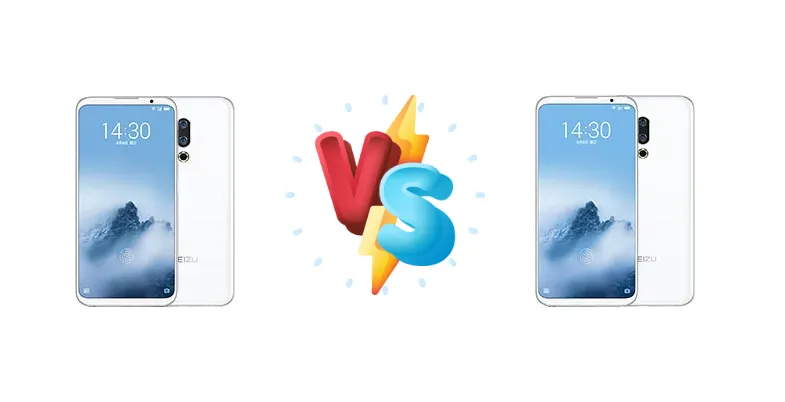
The Meizu 16 and 16 Plus represent a fascinating period in smartphone history – a time when flagship specs were becoming increasingly standardized. Both devices launched with the Qualcomm Snapdragon 845, but subtle differences in design and potentially battery optimization create a compelling comparison for users seeking a high-performance Android experience. This deep dive explores those nuances.
🏆 Quick Verdict
For the average user, the Meizu 16 Plus emerges as the slightly better choice. While both phones share the same Snapdragon 845 chipset, the Plus model's larger size likely allows for more effective thermal dissipation, potentially mitigating throttling during extended demanding tasks. The difference is subtle, but noticeable for power users.
| Network |
|---|
| 2G bands | GSM 850 / 900 / 1800 / 1900 | GSM 850 / 900 / 1800 / 1900 |
| 3G bands | HSDPA 850 / 900 / 1700(AWS) / 1900 / 2100 - Global | HSDPA 850 / 900 / 1700(AWS) / 1900 / 2100 - Global |
| 4G bands | 1, 2, 3, 4, 5, 7, 8, 20, 40 - Global | 1, 2, 3, 4, 5, 7, 8, 20, 40 - Global |
| Speed | HSPA 42.2/5.76 Mbps, LTE (4CA) Cat16 1024/150 Mbps | HSPA 42.2/5.76 Mbps, LTE (4CA) Cat16 1024/150 Mbps |
| Technology | GSM / CDMA / HSPA / LTE | GSM / CDMA / HSPA / LTE |
| | 1, 3, 4, 5, 8, 34, 38, 39, 40, 41 - China | 1, 3, 4, 5, 8, 34, 38, 39, 40, 41 - China |
| Launch |
|---|
| Announced | 2018, August. Released 2018, August | 2018, August. Released 2018, August |
| Status | Discontinued | Discontinued |
| Body |
|---|
| Dimensions | 150.5 x 73.2 x 7.3 mm (5.93 x 2.88 x 0.29 in) | 160.4 x 78.2 x 7.3 mm (6.31 x 3.08 x 0.29 in) |
| SIM | Nano-SIM + Nano-SIM | Nano-SIM + Nano-SIM |
| Weight | 152 g (5.36 oz) | 182 g (6.42 oz) |
| Display |
|---|
| Resolution | 1080 x 2160 pixels, 18:9 ratio (~402 ppi density) | 1080 x 2160 pixels, 18:9 ratio (~374 ppi density) |
| Size | 6.0 inches, 92.9 cm2 (~84.3% screen-to-body ratio) | 6.5 inches, 107.9 cm2 (~86.0% screen-to-body ratio) |
| Type | Super AMOLED | Super AMOLED |
| Platform |
|---|
| CPU | Octa-core (4x2.8 GHz Kryo 385 Gold & 4x1.7 GHz Kryo 385 Silver) | Octa-core (4x2.8 GHz Kryo 385 Gold & 4x1.7 GHz Kryo 385 Silver) |
| Chipset | Qualcomm SDM845 Snapdragon 845 (10 nm) | Qualcomm SDM845 Snapdragon 845 (10 nm) |
| GPU | Adreno 630 | Adreno 630 |
| OS | Android 8.1 (Oreo), Flyme UI | Android 8.1 (Oreo), Flyme UI |
| Memory |
|---|
| Card slot | No | No |
| Internal | 64GB 6GB RAM, 128GB 8GB RAM | 128GB 6GB RAM, 128GB 8GB RAM, 256GB 8GB RAM |
| | UFS 2.1 | - |
| Main Camera |
|---|
| Dual | 12 MP, f/1.8, 25mm (wide), 1/2.3", 1.55µm, dual pixel PDAF, 4-axis OIS
20 MP, f/2.6, 1/2.6", 1.0µm | 12 MP, f/1.8, 1/2.3", 1.55µm, dual pixel PDAF, 4-axis OIS
20 MP, f/2.6, 1/2.6", 1.0µm, AF |
| Features | Laser AF, Six-LED dual-tone flash, Auto-HDR, panorama | Laser AF, Six-LED dual-tone flash, Auto-HDR, panorama |
| Video | 4K@30fps, 1080p@30fps (gyro-EIS) | 4K@30fps, 1080p@30fps (gyro-EIS) |
| Selfie camera |
|---|
| Single | 20 MP, f/2.0, 27mm (wide), 1/2.8", 1.0µm | 20 MP, f/2.0, (wide), 1/2.8", 1.0µm |
| Video | 1080p@30fps | 1080p@30fps |
| Sound |
|---|
| 3.5mm jack | Yes | Yes |
| 35mm jack | Yes | Yes |
| Loudspeaker | Yes, with stereo speakers | Yes, with stereo speakers |
| Comms |
|---|
| Bluetooth | 5.0, A2DP, LE | 5.0, A2DP, LE |
| NFC | No | No |
| Positioning | GPS, GLONASS, BDS, GALILEO, SBAS, QZSS | GPS, GLONASS, BDS, GALILEO, SBAS, QZSS |
| Radio | No | No |
| USB | USB Type-C 2.0 | USB Type-C 2.0 |
| WLAN | Wi-Fi 802.11 а/b/g/n/ac, dual-band, Wi-Fi Direct | Wi-Fi 802.11 а/b/g/n/ac, dual-band, Wi-Fi Direct |
| Features |
|---|
| Sensors | Fingerprint (under display, optical), accelerometer, gyro, proximity, compass | Fingerprint (under display, optical), accelerometer, gyro, proximity, compass |
| Battery |
|---|
| Charging | 24W wired | 24W wired |
| Type | Li-Ion 3010 mAh, non-removable | Li-Ion 3570 mAh, non-removable |
| Misc |
|---|
| Colors | Black, White | Black, White |
| Price | About 410 EUR | About 480 EUR |
Meizu 16
- More compact and pocketable design.
- Identical Snapdragon 845 performance.
- Potentially more affordable (depending on current market pricing).
- Likely smaller battery capacity.
- Potentially more prone to thermal throttling.
Meizu 16 Plus
- Likely larger battery capacity for extended use.
- Potentially better thermal management due to larger size.
- More immersive viewing experience with a larger display.
- Larger and less comfortable for one-handed use.
- Potentially higher price point.
Display Comparison
Both the Meizu 16 and 16 Plus feature AMOLED displays, but specific details like resolution and peak brightness are not provided. Given the flagship positioning, we can assume both offer vibrant colors and deep blacks. The absence of a high refresh rate (90Hz or 120Hz) is notable, a feature becoming increasingly common even in this era. The larger display of the 16 Plus will offer a more immersive viewing experience, but the 16's smaller screen may be preferable for those prioritizing portability.
Camera Comparison
Without detailed camera specifications, a direct comparison is challenging. Both phones likely feature a multi-camera setup, typical of flagship devices at the time. The image processing algorithms employed by Meizu would be a key differentiator, but this is difficult to quantify without sample images. The absence of information regarding sensor sizes and lens apertures makes it impossible to determine which device would perform better in low-light conditions. We can assume both offer capable cameras, but the 16 Plus might benefit from a slightly larger internal volume for more sophisticated camera modules.
Performance
The core performance is identical: both devices are powered by the Qualcomm Snapdragon 845 (10nm) with an octa-core CPU configuration (4x2.8 GHz Kryo 385 Gold & 4x1.7 GHz Kryo 385 Silver). This means CPU-bound tasks like app loading and web browsing will feel equally snappy on both. However, the 16 Plus’s larger chassis *could* provide a larger surface area for heat dissipation, potentially leading to less thermal throttling under sustained load, such as during extended gaming sessions. The lack of information on RAM configuration prevents a deeper analysis of multitasking capabilities.
Battery Life
Both the Meizu 16 and 16 Plus support 24W wired charging. While the charging speed is identical, the battery capacity is not specified. Given the larger size of the 16 Plus, it's reasonable to assume it houses a larger battery. This would translate to longer screen-on time and overall battery life. However, efficient software optimization and power management play a crucial role, and without specific battery capacity figures, it's difficult to definitively declare a winner. The 24W charging speed, while adequate, is slower than the faster charging solutions available on competing devices.
Buying Guide
Buy the Meizu 16 if you prioritize a more compact form factor and appreciate a slightly more manageable size for one-handed use. It delivers flagship performance in a smaller package. Buy the Meizu 16 Plus if you value sustained performance during prolonged gaming or video editing sessions, and don't mind a larger device. The potential for better thermal management makes it ideal for intensive workloads.
Frequently Asked Questions
❓ Will the Snapdragon 845 in either phone struggle with demanding games like Genshin Impact?
The Snapdragon 845 is a capable chipset, but demanding games like Genshin Impact will push it to its limits. Both phones will likely require graphics settings adjustments to maintain a smooth frame rate. The Meizu 16 Plus *may* sustain higher frame rates for longer due to potentially better thermal management.
❓ Is the 24W charging speed considered slow by today's standards?
Yes, 24W charging is relatively slow compared to the 65W, 80W, or even 120W charging solutions available on modern smartphones. Expect a full charge to take around 90-120 minutes. While not a dealbreaker, it's a noticeable difference for users accustomed to faster charging speeds.
❓ Are software updates still available for either the Meizu 16 or 16 Plus?
Software update support for older Meizu devices can be inconsistent. It's advisable to check online forums and communities to determine the current software status and potential for future updates before purchasing either phone.