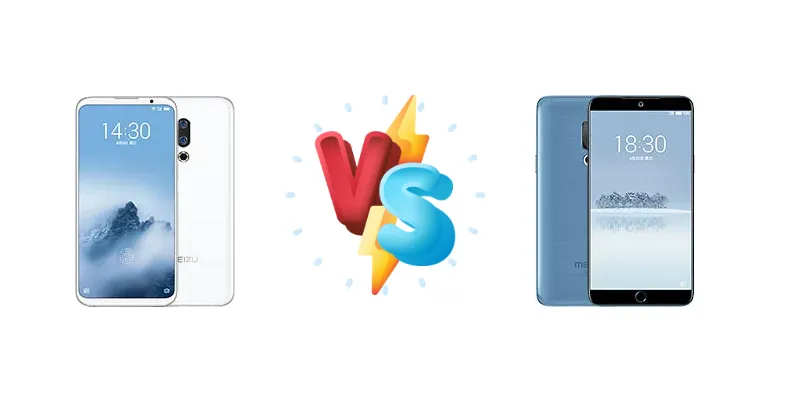
The Meizu 16 and 15 represent distinct points in the company’s flagship strategy. The Meizu 15 aimed for a classic aesthetic with solid mid-range performance, while the Meizu 16 aggressively pursued a modern, near-bezeless design paired with top-tier processing power. This comparison dissects the key differences to help you determine which device best suits your needs.
🏆 Quick Verdict
For most users, the Meizu 16 is the clear winner. The Snapdragon 845 delivers a substantially faster experience for gaming, multitasking, and demanding applications. While the Meizu 15 offers comparable battery endurance, the performance gap is too significant to ignore for power users.
| Network |
|---|
| 2G bands | GSM 850 / 900 / 1800 / 1900 | GSM 850 / 900 / 1800 / 1900 |
| 3G bands | HSDPA 850 / 900 / 1700(AWS) / 1900 / 2100 - Global | HSDPA 850 / 900 / 1900 / 2100 |
| 4G bands | 1, 2, 3, 4, 5, 7, 8, 20, 40 - Global | 1, 3, 4, 5, 7, 8, 34, 38, 39, 40, 41 |
| Speed | HSPA 42.2/5.76 Mbps, LTE (4CA) Cat16 1024/150 Mbps | HSPA 42.2/5.76 Mbps, LTE (2CA) Cat6 300/50 Mbps |
| Technology | GSM / CDMA / HSPA / LTE | GSM / CDMA / HSPA / LTE |
| | 1, 3, 4, 5, 8, 34, 38, 39, 40, 41 - China | 1, 3, 5, 8, 34, 38, 39, 40, 41 |
| Launch |
|---|
| Announced | 2018, August. Released 2018, August | 2018, April. Released 2018, April |
| Status | Discontinued | Discontinued |
| Body |
|---|
| Dimensions | 150.5 x 73.2 x 7.3 mm (5.93 x 2.88 x 0.29 in) | 143 x 72 x 7.3 mm (5.63 x 2.83 x 0.29 in) |
| SIM | Nano-SIM + Nano-SIM | Nano-SIM + Nano-SIM |
| Weight | 152 g (5.36 oz) | 152 g (5.36 oz) |
| Display |
|---|
| Resolution | 1080 x 2160 pixels, 18:9 ratio (~402 ppi density) | 1080 x 1920 pixels, 16:9 ratio (~403 ppi density) |
| Size | 6.0 inches, 92.9 cm2 (~84.3% screen-to-body ratio) | 5.46 inches, 82.2 cm2 (~79.8% screen-to-body ratio) |
| Type | Super AMOLED | Super AMOLED |
| Platform |
|---|
| CPU | Octa-core (4x2.8 GHz Kryo 385 Gold & 4x1.7 GHz Kryo 385 Silver) | Octa-core (4x2.2 GHz Kryo 260 Gold & 4x1.8 GHz Kryo 260 Silver) |
| Chipset | Qualcomm SDM845 Snapdragon 845 (10 nm) | Qualcomm SDM660 Snapdragon 660 (14 nm) |
| GPU | Adreno 630 | Adreno 512 |
| OS | Android 8.1 (Oreo), Flyme UI | Android 7.1.2 (Nougat), Flyme 7.3 |
| Memory |
|---|
| Card slot | No | No |
| Internal | 64GB 6GB RAM, 128GB 8GB RAM | 64GB 4GB RAM, 128GB 4GB RAM |
| | UFS 2.1 | eMMC 5.1 |
| Main Camera |
|---|
| Dual | 12 MP, f/1.8, 25mm (wide), 1/2.3", 1.55µm, dual pixel PDAF, 4-axis OIS
20 MP, f/2.6, 1/2.6", 1.0µm | 12 MP, f/1.8, 1/2.3", 1.55 µm, dual pixel PDAF, 4-axis OIS
20 MP, 1/2.8", 1.0 µm, AF, portraits only |
| Features | Laser AF, Six-LED dual-tone flash, Auto-HDR, panorama | Laser AF, Six-LED dual-tone flash, HDR, panorama |
| Video | 4K@30fps, 1080p@30fps (gyro-EIS) | 4K@30fps, 1080p@30fps |
| Selfie camera |
|---|
| Single | 20 MP, f/2.0, 27mm (wide), 1/2.8", 1.0µm | 20 MP, f/2.0, (wide), 1/2.8", 1.0µm |
| Video | 1080p@30fps | 1080p@30fps |
| Sound |
|---|
| 3.5mm jack | Yes | Yes |
| 35mm jack | Yes | Yes |
| Loudspeaker | Yes, with stereo speakers | Yes, with stereo speakers |
| Comms |
|---|
| Bluetooth | 5.0, A2DP, LE | 4.2, A2DP, LE |
| NFC | No | No |
| Positioning | GPS, GLONASS, BDS, GALILEO, SBAS, QZSS | GPS, GLONASS, BDS |
| Radio | No | No |
| USB | USB Type-C 2.0 | USB Type-C 2.0 |
| WLAN | Wi-Fi 802.11 а/b/g/n/ac, dual-band, Wi-Fi Direct | Wi-Fi 802.11 b/g/n/ac, dual-band, Wi-Fi Direct |
| Features |
|---|
| Sensors | Fingerprint (under display, optical), accelerometer, gyro, proximity, compass | Fingerprint (front-mounted), accelerometer, gyro, proximity, compass, barometer |
| Battery |
|---|
| Charging | 24W wired | 24W wired |
| Type | Li-Ion 3010 mAh, non-removable | Li-Ion 3000 mAh, non-removable |
| Misc |
|---|
| Colors | Black, White | Ink, Yakin, Indigo, White |
| Price | About 410 EUR | About 400 EUR |
| Tests |
|---|
| Audio quality | - |
Noise -93.2dB / Crosstalk -93.9dB |
| Battery life | - |
Endurance rating 77h
|
| Camera | - |
Photo / Video |
| Display | - |
Contrast ratio: Infinite (nominal), 4.082 (sunlight) |
| Loudspeaker | - |
Voice 77dB / Noise 74dB / Ring 80dB
|
| Performance | - |
AnTuTu: 128680 (v7)
GeekBench: 5770 (v4.4)
GFXBench: 9.2fps (ES 3.1 onscreen) |
Meizu 16
- Significantly faster processor (Snapdragon 845)
- Improved thermal efficiency for sustained performance
- More immersive display due to minimized bezels
- Potentially higher power consumption under heavy load
- May be harder to find/more expensive due to age
Meizu 15
- Excellent battery endurance (77h rating)
- Comparable charging speed (24W)
- Potentially lower price point
- Substantially slower processor (Snapdragon 660)
- Less capable for demanding games and applications
- Older chipset with limited software support
Display Comparison
Both the Meizu 16 and 15 share an 'Infinite' contrast ratio (nominal) and a 4.082 sunlight contrast ratio, suggesting similar display quality in outdoor visibility. However, the context data lacks specifics on panel technology (AMOLED vs IPS) or resolution. Given Meizu’s history with AMOLED displays, it’s likely both utilize this technology. The Meizu 16’s focus on minimizing bezels likely results in a more immersive viewing experience, even if the core display characteristics are similar.
Camera Comparison
Both devices are listed with 'Photo / Video' capabilities, but lack specific details regarding sensor size, aperture, or image processing. Without this information, a direct comparison is difficult. However, flagship devices like the Meizu 16 typically feature more advanced camera systems with larger sensors and improved image stabilization. The 660’s ISP in the Meizu 15 is less capable than the 845’s, impacting image quality, especially in low-light conditions. The absence of details suggests neither phone boasts a standout camera system.
Performance
The performance disparity is the most significant difference. The Meizu 16’s Qualcomm SDM845 Snapdragon 845 (10nm) is a generational leap over the Meizu 15’s SDM660 Snapdragon 660 (14nm). The 845 features Kryo 385 cores clocked up to 2.8 GHz, compared to the 660’s Kryo 260 cores peaking at 2.2 GHz. The smaller 10nm process node of the 845 also translates to improved thermal efficiency, reducing the likelihood of performance throttling during sustained workloads. This means the Meizu 16 will handle graphically intensive games and applications with significantly greater ease.
Battery Life
Interestingly, both the Meizu 16 and 15 are reported to have an endurance rating of 77 hours and support 24W wired charging. This suggests that despite the more powerful processor in the Meizu 16, software optimization and battery management are comparable. While the Meizu 16’s 845 will consume more power under load, the 77-hour endurance rating indicates that typical daily usage will yield similar battery life on both devices. The 24W charging ensures relatively quick top-ups for both.
Buying Guide
Buy the Meizu 16 if you prioritize performance and future-proofing, frequently play demanding games, or require a snappy user experience. Buy the Meizu 15 if you value battery life above all else, prefer a more understated design, and primarily use your phone for basic tasks like calling, texting, and social media.
Frequently Asked Questions
❓ Will the Snapdragon 660 in the Meizu 15 struggle with modern apps and games?
Yes, the Snapdragon 660 is a mid-range processor that will likely exhibit noticeable lag and slowdowns when running demanding applications or graphically intensive games. While it can handle basic tasks, it won't provide a smooth experience for power users.
❓ Is the 24W charging speed sufficient for both devices, considering their battery sizes are unknown?
Yes, 24W is a respectable charging speed for both phones. Given their similar endurance ratings, it suggests that the charging circuitry and software optimization are comparable, allowing for relatively quick top-ups despite potential differences in battery capacity.
❓ How does the thermal management differ between the Snapdragon 845 and 660?
The Snapdragon 845, built on a 10nm process, is significantly more thermally efficient than the 14nm Snapdragon 660. This means the Meizu 16 is less likely to overheat and experience performance throttling during prolonged gaming or demanding tasks.
❓ Given the age of both devices, what is the current software support situation?
Software support for both devices is likely limited. Meizu's update track record has been inconsistent, and these models are several years old. Expect limited or no further major Android updates, and potentially diminishing security patches.