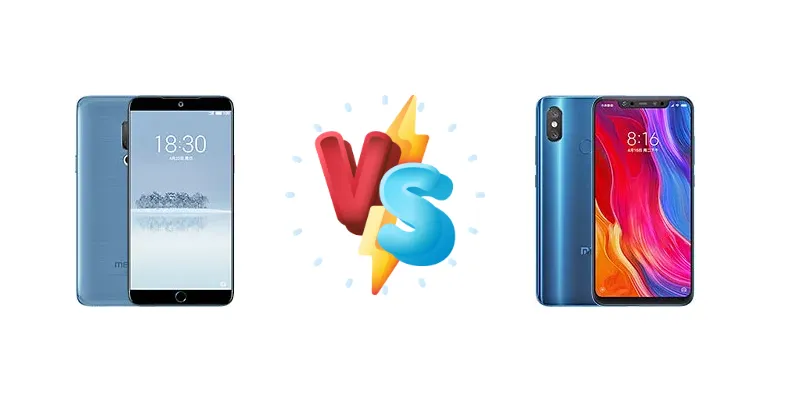
Released in 2018, the Meizu 15 and Xiaomi Mi 8 represented compelling flagship options, but catered to slightly different priorities. The Meizu 15 aimed for a refined, premium experience, while the Mi 8 aggressively pursued top-tier performance. Now, with both devices available at significantly reduced prices, the question of which offers better value is more relevant than ever.
🏆 Quick Verdict
For the average user in 2024, the Xiaomi Mi 8 is the stronger choice. Its Snapdragon 845 chipset delivers significantly faster performance, making it better suited for demanding tasks and future-proofing. While the Meizu 15 offers respectable battery life, the Mi 8’s superior processing power and Quick Charge 4 support provide a more compelling overall package.
| Network |
|---|
| 2G bands | GSM 850 / 900 / 1800 / 1900 | GSM 850 / 900 / 1800 / 1900 |
| 3G bands | HSDPA 850 / 900 / 1900 / 2100 | HSDPA 850 / 900 / 1700(AWS) / 1900 / 2100 |
| 4G bands | 1, 3, 4, 5, 7, 8, 34, 38, 39, 40, 41 | 1, 2, 3, 4, 5, 7, 8, 12, 17, 20, 34, 38, 39, 40, 41 |
| Speed | HSPA 42.2/5.76 Mbps, LTE (2CA) Cat6 300/50 Mbps | HSPA 42.2/5.76 Mbps, LTE (4CA) Cat16 1024/150 Mbps |
| Technology | GSM / CDMA / HSPA / LTE | GSM / CDMA / HSPA / LTE |
| | 1, 3, 5, 8, 34, 38, 39, 40, 41 | CDMA 800 & TD-SCDMA |
| Launch |
|---|
| Announced | 2018, April. Released 2018, April | 2018, May. Released 2018, June |
| Status | Discontinued | Discontinued |
| Body |
|---|
| Build | - | Glass front (Gorilla Glass 5), glass back (Gorilla Glass 5), aluminum frame (7000 series) |
| Dimensions | 143 x 72 x 7.3 mm (5.63 x 2.83 x 0.29 in) | 154.9 x 74.8 x 7.6 mm (6.10 x 2.94 x 0.30 in) |
| SIM | Nano-SIM + Nano-SIM | Nano-SIM + Nano-SIM |
| Weight | 152 g (5.36 oz) | 175 g (6.17 oz) |
| Display |
|---|
| Protection | - | Corning Gorilla Glass 5 |
| Resolution | 1080 x 1920 pixels, 16:9 ratio (~403 ppi density) | 1080 x 2248 pixels (~402 ppi density) |
| Size | 5.46 inches, 82.2 cm2 (~79.8% screen-to-body ratio) | 6.21 inches, 97.1 cm2 (~83.8% screen-to-body ratio) |
| Type | Super AMOLED | Super AMOLED, HDR10 |
| Platform |
|---|
| CPU | Octa-core (4x2.2 GHz Kryo 260 Gold & 4x1.8 GHz Kryo 260 Silver) | Octa-core (4x2.8 GHz Kryo 385 Gold & 4x1.8 GHz Kryo 385 Silver) |
| Chipset | Qualcomm SDM660 Snapdragon 660 (14 nm) | Qualcomm SDM845 Snapdragon 845 (10 nm) |
| GPU | Adreno 512 | Adreno 630 |
| OS | Android 7.1.2 (Nougat), Flyme 7.3 | Android 8.1 (Oreo), upgradable to Android 10, MIUI 12 |
| Memory |
|---|
| Card slot | No | No |
| Internal | 64GB 4GB RAM, 128GB 4GB RAM | 64GB 6GB RAM, 128GB 6GB RAM, 128GB 8GB RAM, 256GB 6GB RAM |
| | eMMC 5.1 | UFS 2.1 |
| Main Camera |
|---|
| Dual | 12 MP, f/1.8, 1/2.3", 1.55 µm, dual pixel PDAF, 4-axis OIS
20 MP, 1/2.8", 1.0 µm, AF, portraits only | 12 MP, f/1.8, 1/2.55", 1.4µm, dual pixel PDAF, 4-axis OIS
12 MP, f/2.4, 56mm (telephoto), 1/3.4", 1.0µm, AF, 2x optical zoom |
| Features | Laser AF, Six-LED dual-tone flash, HDR, panorama | Dual-LED flash, HDR, panorama |
| Video | 4K@30fps, 1080p@30fps | 4K@30/60fps, 1080p@30/120/240fps, 720p@960fps |
| Selfie camera |
|---|
| Single | 20 MP, f/2.0, (wide), 1/2.8", 1.0µm | 20 MP, f/2.0, (wide), 1/3", 0.9µm |
| Video | 1080p@30fps | 1080p@30fps |
| Sound |
|---|
| 3.5mm jack | Yes | No |
| 35mm jack | Yes | No |
| Loudspeaker | Yes, with stereo speakers | Yes |
| Comms |
|---|
| Bluetooth | 4.2, A2DP, LE | 5.0, A2DP, LE, aptX HD |
| NFC | No | Yes |
| Positioning | GPS, GLONASS, BDS | GPS (L1+L5), GLONASS (L1), BDS (B1), GALILEO (E1+E5a), QZSS (L1+L5) |
| Radio | No | No |
| USB | USB Type-C 2.0 | USB Type-C |
| WLAN | Wi-Fi 802.11 b/g/n/ac, dual-band, Wi-Fi Direct | Wi-Fi 802.11 a/b/g/n/ac, dual-band, Wi-Fi Direct, DLNA |
| Features |
|---|
| Sensors | Fingerprint (front-mounted), accelerometer, gyro, proximity, compass, barometer | Infrared Face ID, fingerprint (rear-mounted), accelerometer, gyro, proximity, barometer, compass |
| Battery |
|---|
| Charging | 24W wired | 18W wired, QC4 |
| Type | Li-Ion 3000 mAh, non-removable | Li-Po 3400 mAh, non-removable |
| Misc |
|---|
| Colors | Ink, Yakin, Indigo, White | Black, Blue, White, Gold |
| Models | - | M1803E1A |
| Price | About 400 EUR | About 430 EUR |
| SAR | - | 0.70 W/kg (head) 1.66 W/kg (body) |
| SAR EU | - | 1.01 W/kg (head) 1.32 W/kg (body) |
| Tests |
|---|
| Audio quality |
Noise -93.2dB / Crosstalk -93.9dB |
Noise -93.9dB / Crosstalk -93.7dB |
| Battery life |
Endurance rating 77h
|
Endurance rating 86h
|
| Camera |
Photo / Video |
Photo / Video |
| Display |
Contrast ratio: Infinite (nominal), 4.082 (sunlight) |
Contrast ratio: Infinite (nominal), 4.086 (sunlight) |
| Loudspeaker |
Voice 77dB / Noise 74dB / Ring 80dB
|
-29.1 LUFS (Average)
|
| Performance |
AnTuTu: 128680 (v7)
GeekBench: 5770 (v4.4)
GFXBench: 9.2fps (ES 3.1 onscreen) |
AnTuTu: 217298 (v7), 341687 (v8)
GeekBench: 8494 (v4.4), 2002 (v5.1)
GFXBench: 33fps (ES 3.1 onscreen) |
Meizu 15
- Potentially more refined software experience with Flyme OS.
- Respectable battery endurance for everyday use.
- Premium build quality (based on Meizu’s brand reputation).
- Significantly slower performance compared to the Mi 8.
- Less efficient Snapdragon 660 chipset.
- Lacks Quick Charge 4 support for faster charging.
Xiaomi Mi 8
- Superior performance with the Snapdragon 845.
- More efficient 10nm process for better battery life and thermal management.
- Faster charging with Quick Charge 4 support.
- MIUI software can be resource intensive.
- Potential for software bloatware.
- May not receive as many software updates as newer devices.
Display Comparison
Both the Meizu 15 and Xiaomi Mi 8 feature displays with an 'Infinite' (nominal) contrast ratio, suggesting excellent black levels. However, the Mi 8 edges out the Meizu 15 with a sunlight contrast ratio of 4.086 compared to the Meizu 15’s 4.082. While the difference is minimal, it indicates slightly better visibility under direct sunlight on the Mi 8. Both likely utilize AMOLED panels, common for the era, offering vibrant colors and deep blacks. Detailed color accuracy data is unavailable, but both would have been competitive for flagship displays in 2018.
Camera Comparison
Both phones are listed as having Photo/Video capabilities, but specific details regarding sensor size, aperture, or image processing are absent. Given the Mi 8’s positioning as a flagship, it likely featured a more advanced camera system. The Snapdragon 845’s image signal processor (ISP) is significantly more capable than the one found in the Snapdragon 660, enabling better dynamic range, noise reduction, and overall image quality. Without further data, it’s reasonable to assume the Mi 8 delivers superior camera performance, particularly in challenging lighting conditions.
Performance
The core difference between these two phones lies in their chipsets. The Xiaomi Mi 8 boasts the Qualcomm Snapdragon 845 (10nm process), featuring an octa-core CPU clocked up to 2.8 GHz. This is a substantial upgrade over the Meizu 15’s Snapdragon 660 (14nm process) with its 2.2 GHz Kryo 260 Gold cores. The 10nm fabrication process of the SD845 provides superior power efficiency and thermal performance, meaning the Mi 8 can sustain peak performance for longer periods without throttling. This translates to smoother gaming, faster app loading times, and a more responsive user experience for the Mi 8.
Battery Life
The Xiaomi Mi 8 claims an endurance rating of 86 hours, while the Meizu 15 achieves 77 hours. This suggests the Mi 8 offers better battery life despite having a similar battery capacity (not specified in the data). This advantage is likely due to the Snapdragon 845’s more efficient 10nm process. Furthermore, the Mi 8 supports 18W wired charging with Quick Charge 4 (QC4), allowing for significantly faster charging speeds compared to the Meizu 15’s 24W wired charging, which lacks QC4 support. The QC4 standard optimizes charging voltage and current for faster and safer charging.
Buying Guide
Buy the Meizu 15 if you prioritize a potentially more refined software experience (based on Meizu’s Flyme OS) and are content with mid-range performance for everyday tasks. Buy the Xiaomi Mi 8 if you demand faster processing speeds for gaming, multitasking, or demanding applications, and appreciate the benefits of Qualcomm’s Quick Charge 4 technology for faster charging.
Frequently Asked Questions
❓ Does the Snapdragon 660 in the Meizu 15 struggle with modern app demands?
Yes, the Snapdragon 660, while capable for its time, will show its age with demanding modern applications and games. Expect longer loading times, occasional stuttering, and reduced graphical settings in games compared to the Snapdragon 845-powered Mi 8.
❓ Is the difference in charging speed between the Meizu 15 and Mi 8 noticeable in real-world use?
Absolutely. The Mi 8’s Quick Charge 4 support allows it to charge significantly faster than the Meizu 15. You can expect a much quicker top-up, reducing downtime and making it more convenient for users who frequently need to recharge their phones.
❓ How does the software experience differ between Flyme OS (Meizu 15) and MIUI (Xiaomi Mi 8)?
Flyme OS, historically, offered a more minimalist and refined aesthetic, though update support has been inconsistent. MIUI is feature-rich and highly customizable, but can sometimes feel bloated with pre-installed apps and services. User preference plays a large role here.