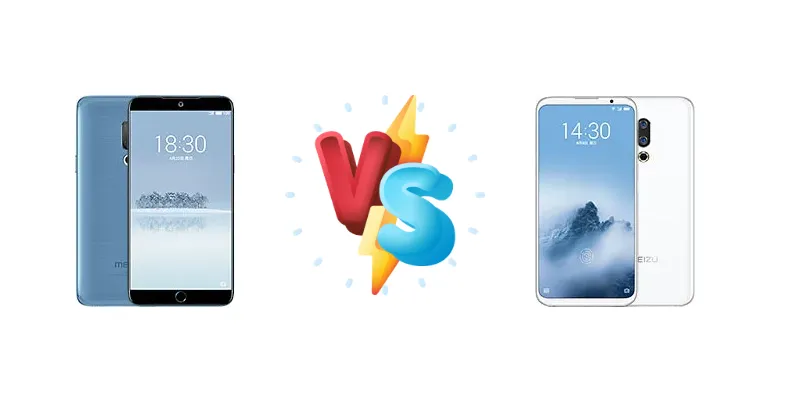
The Meizu 15 and 16 represent a fascinating period for the brand – a transition from a focus on refined design to a more aggressive pursuit of flagship-level performance. While both phones share a similar aesthetic, the core difference lies under the hood. This comparison will dissect the key upgrades in the Meizu 16, specifically the move from the Snapdragon 660 to the Snapdragon 845, and determine if that leap justifies the price difference for potential buyers.
🏆 Quick Verdict
For the average user prioritizing smooth daily performance and occasional gaming, the Meizu 16 is the clear winner. The Snapdragon 845 provides a substantial performance uplift over the 660, making demanding tasks and future-proofing a reality. However, the Meizu 15 remains a viable option for budget-conscious users who don't need the absolute fastest processing speeds.
| Network |
|---|
| 2G bands | GSM 850 / 900 / 1800 / 1900 | GSM 850 / 900 / 1800 / 1900 |
| 3G bands | HSDPA 850 / 900 / 1900 / 2100 | HSDPA 850 / 900 / 1700(AWS) / 1900 / 2100 - Global |
| 4G bands | 1, 3, 4, 5, 7, 8, 34, 38, 39, 40, 41 | 1, 2, 3, 4, 5, 7, 8, 20, 40 - Global |
| Speed | HSPA 42.2/5.76 Mbps, LTE (2CA) Cat6 300/50 Mbps | HSPA 42.2/5.76 Mbps, LTE (4CA) Cat16 1024/150 Mbps |
| Technology | GSM / CDMA / HSPA / LTE | GSM / CDMA / HSPA / LTE |
| | 1, 3, 5, 8, 34, 38, 39, 40, 41 | 1, 3, 4, 5, 8, 34, 38, 39, 40, 41 - China |
| Launch |
|---|
| Announced | 2018, April. Released 2018, April | 2018, August. Released 2018, August |
| Status | Discontinued | Discontinued |
| Body |
|---|
| Dimensions | 143 x 72 x 7.3 mm (5.63 x 2.83 x 0.29 in) | 150.5 x 73.2 x 7.3 mm (5.93 x 2.88 x 0.29 in) |
| SIM | Nano-SIM + Nano-SIM | Nano-SIM + Nano-SIM |
| Weight | 152 g (5.36 oz) | 152 g (5.36 oz) |
| Display |
|---|
| Resolution | 1080 x 1920 pixels, 16:9 ratio (~403 ppi density) | 1080 x 2160 pixels, 18:9 ratio (~402 ppi density) |
| Size | 5.46 inches, 82.2 cm2 (~79.8% screen-to-body ratio) | 6.0 inches, 92.9 cm2 (~84.3% screen-to-body ratio) |
| Type | Super AMOLED | Super AMOLED |
| Platform |
|---|
| CPU | Octa-core (4x2.2 GHz Kryo 260 Gold & 4x1.8 GHz Kryo 260 Silver) | Octa-core (4x2.8 GHz Kryo 385 Gold & 4x1.7 GHz Kryo 385 Silver) |
| Chipset | Qualcomm SDM660 Snapdragon 660 (14 nm) | Qualcomm SDM845 Snapdragon 845 (10 nm) |
| GPU | Adreno 512 | Adreno 630 |
| OS | Android 7.1.2 (Nougat), Flyme 7.3 | Android 8.1 (Oreo), Flyme UI |
| Memory |
|---|
| Card slot | No | No |
| Internal | 64GB 4GB RAM, 128GB 4GB RAM | 64GB 6GB RAM, 128GB 8GB RAM |
| | eMMC 5.1 | UFS 2.1 |
| Main Camera |
|---|
| Dual | 12 MP, f/1.8, 1/2.3", 1.55 µm, dual pixel PDAF, 4-axis OIS
20 MP, 1/2.8", 1.0 µm, AF, portraits only | 12 MP, f/1.8, 25mm (wide), 1/2.3", 1.55µm, dual pixel PDAF, 4-axis OIS
20 MP, f/2.6, 1/2.6", 1.0µm |
| Features | Laser AF, Six-LED dual-tone flash, HDR, panorama | Laser AF, Six-LED dual-tone flash, Auto-HDR, panorama |
| Video | 4K@30fps, 1080p@30fps | 4K@30fps, 1080p@30fps (gyro-EIS) |
| Selfie camera |
|---|
| Single | 20 MP, f/2.0, (wide), 1/2.8", 1.0µm | 20 MP, f/2.0, 27mm (wide), 1/2.8", 1.0µm |
| Video | 1080p@30fps | 1080p@30fps |
| Sound |
|---|
| 3.5mm jack | Yes | Yes |
| 35mm jack | Yes | Yes |
| Loudspeaker | Yes, with stereo speakers | Yes, with stereo speakers |
| Comms |
|---|
| Bluetooth | 4.2, A2DP, LE | 5.0, A2DP, LE |
| NFC | No | No |
| Positioning | GPS, GLONASS, BDS | GPS, GLONASS, BDS, GALILEO, SBAS, QZSS |
| Radio | No | No |
| USB | USB Type-C 2.0 | USB Type-C 2.0 |
| WLAN | Wi-Fi 802.11 b/g/n/ac, dual-band, Wi-Fi Direct | Wi-Fi 802.11 а/b/g/n/ac, dual-band, Wi-Fi Direct |
| Features |
|---|
| Sensors | Fingerprint (front-mounted), accelerometer, gyro, proximity, compass, barometer | Fingerprint (under display, optical), accelerometer, gyro, proximity, compass |
| Battery |
|---|
| Charging | 24W wired | 24W wired |
| Type | Li-Ion 3000 mAh, non-removable | Li-Ion 3010 mAh, non-removable |
| Misc |
|---|
| Colors | Ink, Yakin, Indigo, White | Black, White |
| Price | About 400 EUR | About 410 EUR |
| Tests |
|---|
| Audio quality |
Noise -93.2dB / Crosstalk -93.9dB | - |
| Battery life |
Endurance rating 77h
| - |
| Camera |
Photo / Video | - |
| Display |
Contrast ratio: Infinite (nominal), 4.082 (sunlight) | - |
| Loudspeaker |
Voice 77dB / Noise 74dB / Ring 80dB
| - |
| Performance |
AnTuTu: 128680 (v7)
GeekBench: 5770 (v4.4)
GFXBench: 9.2fps (ES 3.1 onscreen) | - |
Meizu 15
- Excellent battery endurance (77h)
- More affordable price point
- Sufficient performance for everyday tasks
- Less powerful processor for demanding applications
- May struggle with graphically intensive games
Meizu 16
- Significantly faster Snapdragon 845 processor
- Improved performance for gaming and multitasking
- More future-proofed for demanding applications
- Potentially shorter battery life
- Higher price tag
Display Comparison
Both the Meizu 15 and 16 share an 'Infinite' (nominal) contrast ratio, suggesting excellent black levels. However, the 4.082 sunlight contrast ratio indicates similar performance in direct sunlight. Without specific brightness (nit) data, it's difficult to definitively say which display is superior. The lack of information regarding panel technology (e.g., AMOLED, LCD) and refresh rate limits a deeper analysis. The focus on contrast suggests Meizu prioritized image quality in varying lighting conditions, but further details are needed for a complete picture.
Camera Comparison
Both phones are listed with 'Photo / Video' capabilities, but lack specific details regarding sensor size, aperture, or features like Optical Image Stabilization (OIS). Without this information, a meaningful camera comparison is impossible. It's reasonable to assume the Meizu 16, being the higher-end model, likely features a more capable camera system, but this is speculation. The absence of details regarding megapixel count or lens specifications makes it difficult to assess the quality of images and videos produced by either device.
Performance
The core difference between these devices is the chipset. The Meizu 16’s Snapdragon 845 (10nm) represents a significant upgrade over the Meizu 15’s Snapdragon 660 (14nm). The 845 features Kryo 385 cores clocked up to 2.8 GHz, compared to the 660’s Kryo 260 cores peaking at 2.2 GHz. This translates to a substantial performance increase in CPU-intensive tasks and a more powerful GPU for gaming. The 10nm process node of the 845 also offers improved thermal efficiency, potentially leading to less throttling during sustained workloads. Users who play graphically demanding games or frequently edit videos will see a dramatic improvement with the Meizu 16.
Battery Life
The Meizu 15 boasts an endurance rating of 77 hours, a strong indicator of battery life. The Meizu 16’s battery life is not specified, but the more powerful Snapdragon 845 is likely to consume more power. Both phones support 24W wired charging, suggesting similar charging speeds. While the Meizu 16’s increased processing power may lead to faster battery drain during intensive use, the efficiency gains from the 10nm process could partially offset this. The 77-hour endurance of the Meizu 15 provides a baseline for comparison, and users prioritizing battery life may lean towards the older model.
Buying Guide
Buy the Meizu 15 if you prioritize battery endurance and a lower price point, and your usage primarily revolves around everyday tasks like browsing, social media, and light photography. You'll appreciate the 77-hour endurance rating and the cost savings. Buy the Meizu 16 if you demand a significantly faster processor for gaming, multitasking, and demanding applications, and are willing to accept potentially slightly reduced battery life in exchange for a flagship-level experience.
Frequently Asked Questions
❓ Will the Snapdragon 660 in the Meizu 15 struggle with modern mobile games like Genshin Impact?
The Snapdragon 660 is capable of running many mobile games, but demanding titles like Genshin Impact will likely require significant graphics settings reductions and may still experience frame rate drops. The Meizu 16’s Snapdragon 845 is far better equipped to handle these games at higher settings.
❓ Does the Meizu 16's faster processor translate to noticeably quicker app loading times compared to the Meizu 15?
Yes, the Snapdragon 845’s increased processing power and faster memory speeds will result in noticeably quicker app loading times, especially for larger and more complex applications. This difference will be most apparent when switching between multiple apps.
❓ Is the 24W charging speed on both phones sufficient for quick top-ups throughout the day?
24W charging is a respectable speed, but not the fastest available. It should provide a reasonable top-up during a short break, but a full charge will still take a significant amount of time. The difference in charging speed between the two phones is likely negligible.