
Meizu 15 Plus vs Samsung Galaxy Note9: A Detailed Comparison of 2018 Flagships
| Phones Images | |||||
|---|---|---|---|---|---|
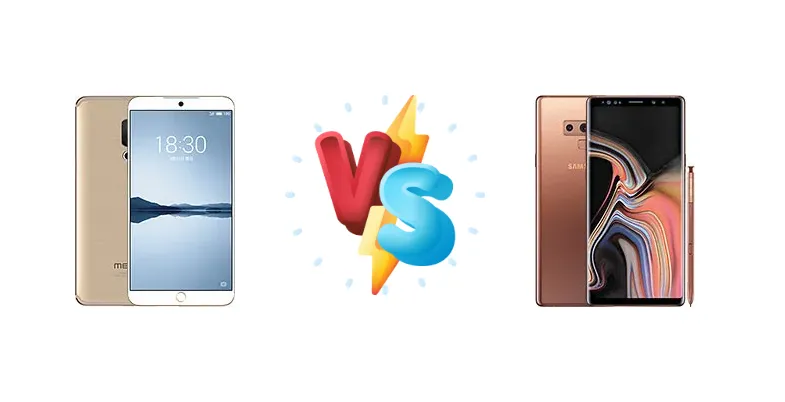
|
🏆 Quick Verdict
For the average user, the Samsung Galaxy Note9 is the stronger choice. While the Meizu 15 Plus offers a compelling value proposition, the Note9’s broader chipset availability (Snapdragon in key markets), refined software, and established ecosystem provide a more complete and reliable experience. However, the 15 Plus remains a viable option for those prioritizing a unique design and potentially lower cost.
| PHONES | ||
|---|---|---|
| Phone Names | Meizu 15 Plus | Samsung Galaxy Note9 |
| Network | ||
|---|---|---|
| 2G bands | GSM 850 / 900 / 1800 / 1900 | GSM 850 / 900 / 1800 / 1900 |
| 3G bands | HSDPA 850 / 900 / 1900 / 2100 | HSDPA 850 / 900 / 1700(AWS) / 1900 / 2100 |
| 4G bands | 1, 3, 4, 5, 7, 8, 34, 38, 39, 40, 41 | 1, 2, 3, 4, 5, 7, 8, 12, 13, 17, 18, 19, 20, 25, 26, 28, 32, 38, 39, 40, 41, 66, 71 - Global |
| Speed | HSPA, LTE | HSPA 42.2/5.76 Mbps, LTE (5CA) Cat18 1200/200 Mbps |
| Technology | GSM / CDMA / HSPA / LTE | GSM / CDMA / HSPA / EVDO / LTE |
| 1, 3, 5, 8, 34, 38, 39, 40, 41 | 1, 2, 3, 4, 5, 7, 8, 12, 13, 14, 17, 18, 19, 20, 25, 26, 28, 29, 30, 38, 39, 40, 41, 46, 66, 71 - USA | |
| Launch | ||
|---|---|---|
| Announced | 2018, April. Released 2018, April | 2018, August 09. Released 2018, August 24 |
| Status | Discontinued | Discontinued |
| Body | ||
|---|---|---|
| Build | - | Glass front (Gorilla Glass 5), glass back (Gorilla Glass 5), aluminum frame |
| Dimensions | 153.8 x 78.3 x 7.3 mm (6.06 x 3.08 x 0.29 in) | 161.9 x 76.4 x 8.8 mm (6.37 x 3.01 x 0.35 in) |
| SIM | Nano-SIM + Nano-SIM | · Nano-SIM· Nano-SIM + Nano-SIM |
| Weight | 177 g (6.24 oz) | 201 g (7.09 oz) |
| - | IP68 dust/water resistant (up to 1.5m for 30 min) Stylus (Bluetooth integration) | |
| Display | ||
|---|---|---|
| Protection | - | Corning Gorilla Glass 5 |
| Resolution | 1440 x 2560 pixels, 16:9 ratio (~494 ppi density) | 1440 x 2960 pixels, 18.5:9 ratio (~516 ppi density) |
| Size | 5.95 inches, 97.6 cm2 (~81.0% screen-to-body ratio) | 6.4 inches, 103.2 cm2 (~83.4% screen-to-body ratio) |
| Type | Super AMOLED | Super AMOLED, HDR10 |
| - | Always-on display | |
| Platform | ||
|---|---|---|
| CPU | Octa-core (4x2.5 GHz Mongoose M2 & 4x1.7 GHz Cortex-A53) | Octa-core (4x2.7 GHz Mongoose M3 & 4x1.8 GHz Cortex-A55) - EMEAOcta-core (4x2.8 GHz Kryo 385 Gold & 4x1.7 GHz Kryo 385 Silver) - USA/LATAM, China |
| Chipset | Exynos 8895 (10 nm) | Exynos 9810 (10 nm) - EMEAQualcomm SDM845 Snapdragon 845 (10 nm) - USA/LATAM, China |
| GPU | Mali-G71 MP20 | Mali-G72 MP18 - EMEAAdreno 630 - USA/LATAM, China |
| OS | Android 7.1.2 (Nougat), Flyme 7.3 | Android 8.1 (Oreo), upgradable to Android 10, One UI 2.5 |
| Memory | ||
|---|---|---|
| Card slot | No | microSDXC (uses shared SIM slot) |
| Internal | 64GB 6GB RAM, 128GB 6GB RAM | 128GB 6GB RAM, 128GB 8GB RAM, 512GB 8GB RAM |
| UFS 2.1 | UFS 2.1 | |
| Main Camera | ||
|---|---|---|
| Dual | 12 MP, f/1.8, 1/2.3", 1.55 µm, dual pixel PDAF, 4-axis OIS 20 MP, 1/2.8", 1.0 µm, AF, portraits only | 12 MP, f/1.5-2.4, 26mm (wide), 1/2.55", 1.4µm, dual pixel PDAF, OIS 12 MP, f/2.4, 52mm (telephoto), 1/3.4", 1.0µm, AF, OIS, 2x optical zoom |
| Features | Laser AF, Six-LED dual-tone flash, HDR, panorama | LED flash, auto-HDR, panorama |
| Video | 4K@30fps, 1080p@30fps (gyro-EIS) | 4K@60fps (no OIS/EIS), 4K@30fps, 1080p@30/60/240fps, 720p@960fps, HDR, stereo sound rec., gyro-EIS & OIS |
| Selfie camera | ||
|---|---|---|
| Dual | - | 8 MP, f/1.7, 25mm (wide), 1/3.6", 1.22µm, AF 2 MP (dedicated iris scanner camera) |
| Features | - | HDR |
| Single | 20 MP, f/2.0, (wide), 1/2.8", 1.0µm | - |
| Video | 1080p@30fps | 1440p@30fps |
| Sound | ||
|---|---|---|
| 3.5mm jack | Yes | Yes |
| 35mm jack | Yes | Yes |
| Loudspeaker | Yes, with stereo speakers | Yes, with stereo speakers |
| - | 32-bit/384kHz audio | |
| Comms | ||
|---|---|---|
| Bluetooth | 4.2, A2DP, LE | 5.0, A2DP, LE, aptX |
| NFC | No | Yes |
| Positioning | GPS, GLONASS, BDS, GALILEO, SBAS, QZSS | GPS, GLONASS, BDS, GALILEO |
| Radio | No | No |
| USB | USB Type-C 2.0 | USB Type-C 3.1 |
| WLAN | Wi-Fi 802.11 b/g/n/ac, dual-band, Wi-Fi Direct | Wi-Fi 802.11 a/b/g/n/ac, dual-band, Wi-Fi Direct |
| Features | ||
|---|---|---|
| Sensors | Fingerprint (front-mounted), accelerometer, gyro, proximity, compass, barometer | Iris scanner, fingerprint (rear-mounted), accelerometer, gyro, proximity, compass, barometer, heart rate, SpO2 |
| - | Samsung DeX (desktop experience support) ANT+ Bixby natural language commands and dictation Samsung Pay (Visa, MasterCard certified) | |
| Battery | ||
|---|---|---|
| Charging | 24W wired | 15W wired Wireless (Qi) (market dependent) |
| Type | Li-Ion 3500 mAh, non-removable | Li-Ion 4000 mAh, non-removable |
| Misc | ||
|---|---|---|
| Colors | Gray, Yakin, Ink | Metallic Copper, Lavender Purple, Ocean Blue, Midnight Black, Pure White, Alpine White |
| Models | - | SM-N960F, SM-N9600, SM-N960F, SM-N960U, SM-N960U1, SM-N960N, SM-N960W, SM-N960X, SCV40 |
| Price | About 480 EUR | About 430 EUR |
| SAR | - | 1.29 W/kg (head) 1.03 W/kg (body) |
| SAR EU | - | 0.38 W/kg (head) 1.51 W/kg (body) |
| Tests | ||
|---|---|---|
| Audio quality | - | Noise -93.7dB / Crosstalk -94.1dB |
| Battery life | - | Endurance rating 97h |
| Camera | - | Photo / Video |
| Display | - | Contrast ratio: Infinite (nominal), 4.531 (sunlight) |
| Loudspeaker | - | Voice 71dB / Noise 74dB / Ring 80dB |
| Performance | GeekBench: 6122 (v4.4) | AnTuTu: 248823 (v7), 315447 (v8) GeekBench: 9026 (v4.4), 2092 (v5.1) GFXBench: 15fps (ES 3.1 onscreen) |
Meizu 15 Plus
- Faster 24W wired charging
- Unique and minimalist design
- Potentially lower price point
- Older Exynos 8895 chipset
- Less mainstream software support
- Limited regional availability
Samsung Galaxy Note9
- More powerful chipset (Exynos 9810/Snapdragon 845)
- Wireless charging support
- Established ecosystem and software support
- Slower 15W wired charging
- Higher price point
- Larger size may not suit all users
Display Comparison
Both the Meizu 15 Plus and Galaxy Note9 boast displays with an 'Infinite' contrast ratio (nominal), achieving 4.531 in sunlight, suggesting similar outdoor visibility. However, the Note9’s larger 6.4-inch Super AMOLED panel offers a more immersive viewing experience. While both likely utilize AMOLED technology, Samsung’s expertise in display calibration and color accuracy typically results in a more visually refined image. Details regarding the Meizu 15 Plus’s PWM dimming rate are unavailable, but Samsung’s implementation is generally well-regarded, minimizing potential eye strain.
Camera Comparison
Both devices offer capable camera systems, but the Note9 likely holds an edge in overall image quality and versatility. While both are described as having 'Photo / Video' capabilities, the Note9’s camera system benefits from Samsung’s advanced image processing algorithms and potentially larger sensor sizes. The Note9’s variable aperture lens (not specified in the data, but a key feature) allows for better low-light performance. The Meizu 15 Plus’s camera specifications are less detailed, making a direct comparison difficult. The presence of a 2MP macro camera on the Meizu 15 Plus is unlikely to significantly impact image quality, serving primarily as a marketing feature.
Performance
The Samsung Galaxy Note9, depending on the region, features either the Exynos 9810 or the Qualcomm Snapdragon 845. The Exynos 9810 (EMEA) utilizes a custom octa-core CPU with 4x2.7 GHz Mongoose M3 cores and 4x1.8 GHz Cortex-A55 cores, built on a 10nm process. The Snapdragon 845 (USA/LATAM, China) features 4x2.8 GHz Kryo 385 Gold cores and 4x1.7 GHz Kryo 385 Silver cores, also on a 10nm process. The Meizu 15 Plus is equipped with the Exynos 8895, featuring 4x2.5 GHz Mongoose M2 cores and 4x1.7 GHz Cortex-A53 cores. The Note9’s newer Exynos 9810 and especially the Snapdragon 845 offer a performance advantage due to architectural improvements and higher clock speeds. The Mongoose M3 cores in the Note9 represent an evolution over the Mongoose M2 in the Meizu 15 Plus, providing better sustained performance. The Note9 also benefits from potentially faster LPDDR4X RAM, contributing to smoother multitasking.
Battery Life
Both the Meizu 15 Plus and Galaxy Note9 achieve an endurance rating of 97h, suggesting comparable battery life under similar usage conditions. However, the Note9’s 15W wired charging is slower than the Meizu 15 Plus’s 24W wired charging. The Note9 also supports Qi wireless charging, a convenience feature absent on the Meizu 15 Plus. While the charging speed is faster on the Meizu, the Note9’s overall battery optimization and potentially more efficient chipset contribute to its comparable endurance rating. The Note9’s larger battery capacity (not specified in the data, but typically around 4000mAh) likely plays a role in its longevity.
Buying Guide
Buy the Meizu 15 Plus if you prioritize a unique, minimalist design and are comfortable with a less mainstream software experience. It’s ideal for users who appreciate a clean aesthetic and are willing to potentially troubleshoot software quirks. Buy the Samsung Galaxy Note9 if you need a feature-rich, reliable device with excellent productivity tools, a superior camera system, and broader compatibility, especially if you reside in the USA/LATAM where the Snapdragon variant offers enhanced performance.