
Meizu 15 Lite vs. Samsung Galaxy S22 5G: A Generational Divide
| Phones Images | |||||
|---|---|---|---|---|---|
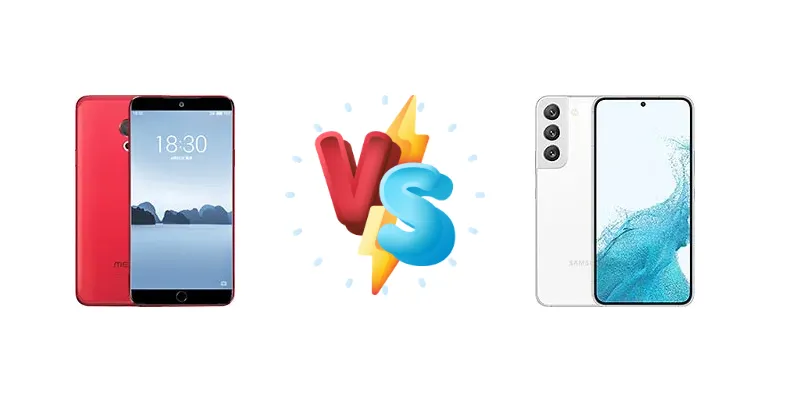
|
🏆 Quick Verdict
For the average user in 2024, the Samsung Galaxy S22 5G is the clear winner. Its vastly superior chipset, brighter display, and advanced camera capabilities justify the price difference. However, the Meizu 15 Lite remains a viable option for those on a strict budget prioritizing basic functionality.
| PHONES | ||
|---|---|---|
| Phone Names | Meizu 15 Lite | Samsung Galaxy S22 5G |
| Network | ||
|---|---|---|
| 2G bands | GSM 850 / 900 / 1800 / 1900 | GSM 850 / 900 / 1800 / 1900 |
| 3G bands | HSDPA 850 / 900 / 1900 / 2100 | HSDPA 850 / 900 / 1700(AWS) / 1900 / 2100 |
| 4G bands | 1, 3, 5, 8, 34, 38, 39, 40, 41 | 1, 2, 3, 4, 5, 7, 8, 12, 13, 17, 18, 19, 20, 25, 26, 28, 32, 38, 39, 40, 41, 66 - International |
| 5G bands | - | 1, 2, 3, 5, 7, 8, 12, 20, 25, 28, 38, 40, 41, 66, 75, 77, 78 SA/NSA/Sub6 - International |
| Speed | HSPA, LTE | HSPA 42.2/5.76 Mbps, LTE (7CA) Cat20 2000/200 Mbps, 5G (5+ Gbps DL) |
| Technology | GSM / CDMA / HSPA / LTE | GSM / CDMA / HSPA / EVDO / LTE / 5G |
| CDMA 800 & TD-SCDMA | 1, 3, 5, 7, 8, 20, 28, 38, 41, 66, 71, 260, 261 SA/NSA/Sub6/mmWave - USA | |
| Launch | ||
|---|---|---|
| Announced | 2018, April. Released 2018, May | 2022, February 09 |
| Status | Discontinued | Available. Released 2022, February 25 |
| Body | ||
|---|---|---|
| Build | - | Glass front (Gorilla Glass Victus+), glass back (Gorilla Glass Victus+), aluminum frame |
| Dimensions | 143.6 x 72.4 x 7.5 mm (5.65 x 2.85 x 0.30 in) | 146 x 70.6 x 7.6 mm (5.75 x 2.78 x 0.30 in) |
| SIM | Nano-SIM + Nano-SIM | Nano-SIM + eSIM· Nano-SIM + Nano-SIM + eSIM (max 2 at a time) |
| Weight | 145 g (5.11 oz) | 167 g / 168 g (mmWave) (5.89 oz) |
| - | IP68 dust/water resistant (up to 1.5m for 30 min) Armor aluminum frame with tougher drop and scratch resistance (advertised) | |
| Display | ||
|---|---|---|
| Protection | - | Corning Gorilla Glass Victus+ |
| Resolution | 1080 x 1920 pixels, 16:9 ratio (~403 ppi density) | 1080 x 2340 pixels, 19.5:9 ratio (~425 ppi density) |
| Size | 5.46 inches, 82.2 cm2 (~79.0% screen-to-body ratio) | 6.1 inches, 90.1 cm2 (~87.4% screen-to-body ratio) |
| Type | IPS LCD | Dynamic AMOLED 2X, 120Hz, HDR10+, 1300 nits (peak) |
| - | Always-on display | |
| Platform | ||
|---|---|---|
| CPU | Octa-core 2.2 GHz Cortex-A53 | Octa-core (1x2.8 GHz Cortex-X2 & 3x2.50 GHz Cortex-A710 & 4x1.8 GHz Cortex-A510) - EuropeOcta-core (1x3.00 GHz Cortex-X2 & 3x2.50 GHz Cortex-A710 & 4x1.80 GHz Cortex-A510) - ROW |
| Chipset | Qualcomm MSM8953-Pro Snapdragon 626 (14 nm) | Exynos 2200 (4 nm) - EuropeQualcomm SM8450 Snapdragon 8 Gen 1 (4 nm) - ROW |
| GPU | Adreno 506 | Xclipse 920 - EuropeAdreno 730 - ROW |
| OS | Android 7.1.2 (Nougat), Flyme 7 | Android 12, up to 4 major Android upgrades, One UI 8 |
| Memory | ||
|---|---|---|
| Card slot | microSDXC (uses shared SIM slot) | No |
| Internal | 64GB 4GB RAM | 128GB 8GB RAM, 256GB 8GB RAM |
| eMMC 5.1 | UFS 3.1 | |
| Main Camera | ||
|---|---|---|
| Features | Six-LED dual-tone flash, HDR, panorama | LED flash, auto-HDR, panorama |
| Single | 12 MP, f/1.9, 1.4 µm, dual pixel PDAF | 10 MP, f/2.2, 26mm (wide), 1/3.24", 1.22µm, Dual Pixel PDAF |
| Triple | - | 50 MP, f/1.8, 23mm (wide), 1/1.56", 1.0µm, dual pixel PDAF, OIS 10 MP, f/2.4, 70mm (telephoto), 1/3.94", 1.0µm, PDAF, OIS, 3x optical zoom 12 MP, f/2.2, 13mm, 120˚ (ultrawide), 1/2.55" 1.4µm, Super Steady video |
| Video | 1080p@30fps | 8K@24fps, 4K@30/60fps, 1080p@30/60/120/240fps, HDR10+, stereo sound rec., gyro-EIS |
| Selfie camera | ||
|---|---|---|
| Features | - | HDR |
| Single | 20 MP, f/2.0, (wide), 1/2.8", 1.0µm | 10 MP, f/2.2, 26mm (wide), 1/3.24", 1.22µm, dual pixel PDAF |
| Video | 1080p@30fps | 4K@30/60fps, 1080p@30fps |
| Sound | ||
|---|---|---|
| 3.5mm jack | Yes | No |
| 35mm jack | Yes | No |
| Loudspeaker | Yes | Yes, with stereo speakers |
| - | 32-bit/384kHz audio Tuned by AKG | |
| Comms | ||
|---|---|---|
| Bluetooth | 4.2, A2DP, LE | 5.2, A2DP, LE |
| NFC | No | Yes |
| Positioning | GPS, GLONASS, BDS | GPS, GLONASS, BDS, GALILEO |
| Radio | No | No |
| USB | USB Type-C 2.0 | USB Type-C 3.2, OTG |
| WLAN | Wi-Fi 802.11 a/b/g/n, Wi-Fi Direct | Wi-Fi 802.11 a/b/g/n/ac/6, dual-band, Wi-Fi Direct |
| Features | ||
|---|---|---|
| Sensors | Fingerprint (front-mounted), accelerometer, gyro, proximity, compass | Fingerprint (under display, ultrasonic), accelerometer, gyro, proximity, compass, barometer |
| - | Samsung DeX, Samsung Wireless DeX (desktop experience support) Bixby natural language commands and dictation Samsung Pay (Visa, MasterCard certified) | |
| Battery | ||
|---|---|---|
| Charging | 18W wired | 25W wired, PD3.0 15W wireless (Qi) 4.5W reverse wireless |
| Type | Li-Ion 3000 mAh, non-removable | Li-Ion 3700 mAh |
| Misc | ||
|---|---|---|
| Colors | Black, Gold, Red | Phantom Black, White, Pink Gold, Green, Graphite, Sky Blue, Violet, Cream, Bora Purple |
| Models | 15 Lite | SM-S901B, SM-S901B/DS, SM-S901U, SM-S901U1, SM-S901W, SM-S901N, SM-S9010, SM-S901E, SM-S901E/DS |
| Price | About 240 EUR | $ 172.63 / C$ 304.00 / £ 186.11 / € 198.01 |
| SAR | - | 1.03 W/kg (head) 1.15 W/kg (body) |
| SAR EU | - | 1.21 W/kg (head) 1.59 W/kg (body) |
| Tests | ||
|---|---|---|
| Battery life | - | Endurance rating 85h |
| Camera | - | Photo / Video |
| Display | - | Contrast ratio: Infinite (nominal) |
| Loudspeaker | - | -26.4 LUFS (Good) |
| Performance | GeekBench: 4464 (v4.4) | AnTuTu: 745496 (v8), 881428 (v9) GeekBench: 3682 (v5.1) GFXBench: 69fps (ES 3.1 onscreen) |
Meizu 15 Lite
- Significantly more affordable
- Compact and lightweight design
- Functional for basic smartphone tasks
- Outdated processor and limited performance
- Inferior camera quality
- Slower charging speeds
Samsung Galaxy S22 5G
- Exceptional performance with Snapdragon 8 Gen 1 or Exynos 2200
- Bright and vibrant display
- Advanced camera system with OIS
- Higher price point
- Potential for thermal throttling under heavy load (Exynos variant)
- Battery life could be better given the hardware
Display Comparison
The Samsung Galaxy S22 5G’s display dominates with a measured peak brightness of 982 nits, offering excellent visibility even in direct sunlight – a significant advantage over the Meizu 15 Lite, whose brightness is not specified but is expected to be considerably lower given its age and market positioning. While both displays offer an 'infinite' (nominal) contrast ratio, the S22 likely benefits from superior color accuracy and potentially LTPO technology for adaptive refresh rates, conserving battery life. The S22’s smaller size also contributes to a higher pixel density, resulting in a sharper image.
Camera Comparison
Both devices offer photo and video capabilities, but the S22’s camera system is far more advanced. While specific sensor details for the Meizu 15 Lite are unavailable, it’s reasonable to assume it lacks the sophisticated features of the S22. The S22 benefits from advanced image processing algorithms, optical image stabilization (OIS), and likely larger sensor sizes, resulting in superior low-light performance and dynamic range. The S22’s video recording capabilities are also significantly more robust, supporting higher resolutions and frame rates.
Performance
The performance gap is immense. The Meizu 15 Lite’s Qualcomm Snapdragon 626 (14nm) is an octa-core processor geared towards efficiency, with its 2.2 GHz Cortex-A53 cores. In contrast, the Samsung Galaxy S22 5G, depending on the region, features either the Exynos 2200 (4nm) or the Snapdragon 8 Gen 1 (4nm). These chips utilize a tri-cluster architecture with high-performance Cortex-X2 and A710 cores, delivering significantly faster processing speeds (up to 2.8/3.0 GHz) and improved multi-tasking capabilities. The 4nm process node used in the S22’s chipsets also provides superior thermal efficiency, reducing throttling during sustained workloads. The S22’s LPDDR5 RAM further enhances performance compared to the likely LPDDR3 or LPDDR4 used in the Meizu 15 Lite.
Battery Life
The Samsung Galaxy S22 5G boasts an endurance rating of 85 hours, indicating respectable battery life despite its powerful hardware. It supports 25W wired charging with PD3.0, 15W wireless charging (Qi), and even 4.5W reverse wireless charging. The Meizu 15 Lite, with its 18W wired charging, offers a slower charging experience. While the Meizu 15 Lite’s battery capacity isn’t specified, the S22’s combination of efficient chipset and optimized software likely translates to comparable or better real-world battery life, despite potentially having a smaller battery capacity.
Buying Guide
Buy the Meizu 15 Lite if you need a functional, affordable smartphone for essential tasks like calling, texting, and light social media use, and are willing to compromise on performance and features. Buy the Samsung Galaxy S22 5G if you prioritize a smooth, responsive experience for demanding apps, gaming, photography, and future-proofing with 5G connectivity and modern features like wireless charging.