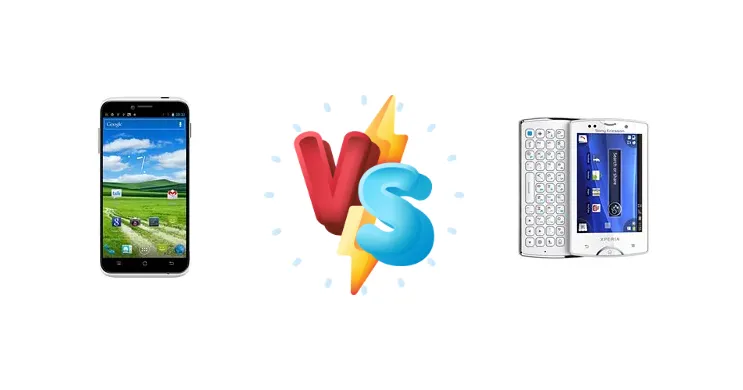
The Maxwest Orbit Z50 and Sony Ericsson Xperia mini pro represent distinct approaches to the budget Android market of their time. The Orbit Z50, leveraging the Qualcomm Snapdragon S4 Play, aimed for a performance boost, while the Xperia mini pro prioritized a compact, user-friendly experience with the Snapdragon S2. This comparison dissects their strengths and weaknesses to determine which device offers the best value today.
🏆 Quick Verdict
For users prioritizing performance in basic tasks and app responsiveness, the Maxwest Orbit Z50 is the better choice due to its quad-core processor and newer Snapdragon S4 Play chipset. However, the Sony Ericsson Xperia mini pro’s compact size and physical keyboard may appeal to those seeking portability and tactile input.
| Network |
|---|
| 2G bands | GSM 850 / 900 / 1800 / 1900 - SIM 1 & SIM 2 | GSM 850 / 900 / 1800 / 1900 |
| 3G bands | HSDPA 850 / 1900 - D570a | HSDPA 900 / 2100 |
| Speed | HSPA 7.2/5.76 Mbps | HSPA 7.2/5.76 Mbps |
| Technology | GSM / HSPA | GSM / HSPA |
| | - | HSDPA 850 / 1900 / 2100 |
| Launch |
|---|
| Announced | 2013, June. Released 2013, June | 2011, May. Released 2011, August |
| Status | Discontinued | Discontinued |
| Body |
|---|
| Dimensions | 143 x 72 x 8.9 mm (5.63 x 2.83 x 0.35 in) | 92 x 53 x 18 mm (3.62 x 2.09 x 0.71 in) |
| Keyboard | - | QWERTY |
| SIM | Dual SIM (Mini-SIM, dual stand-by) | Mini-SIM |
| Weight | 170 g (6.00 oz) | 136 g (4.80 oz) |
| Display |
|---|
| Protection | - | Scratch-resistant glass |
| Resolution | 540 x 960 pixels, 16:9 ratio (~220 ppi density) | 320 x 480 pixels, 3:2 ratio (~192 ppi density) |
| Size | 5.0 inches, 68.9 cm2 (~66.9% screen-to-body ratio) | 3.0 inches, 26.8 cm2 (~55.0% screen-to-body ratio) |
| Type | LED-backlit IPS LCD | LED-backlit LCD, |
| Platform |
|---|
| CPU | Quad-core 1.2 GHz Cortex-A5 | 1.0 GHz Scorpion |
| Chipset | Qualcomm MSM8225Q Snapdragon S4 Play | Qualcomm MSM8255 Snapdragon S2 |
| GPU | Adreno 203 | Adreno 205 |
| OS | Android 4.1.2 (Jelly Bean) | Android 2.3 (Gingerbread), 4.0 (Ice Cream Sandwich), not upgradable to 4.1 (Jelly Bean) |
| Memory |
|---|
| Card slot | microSDHC (dedicated slot) | microSDHC (dedicated slot), 2 GB included |
| Internal | 4GB 1GB RAM | 512MB RAM, 400MB |
| Main Camera |
|---|
| Features | Dual-LED flash | LED flash |
| Single | 8 MP, AF | 5 MP, AF |
| Video | 720p@30fps | 720p |
| Selfie camera |
|---|
| Single | 2 MP | VGA |
| Sound |
|---|
| 3.5mm jack | Yes | Yes |
| 35mm jack | Yes | Yes |
| Loudspeaker | Yes | Yes |
| Comms |
|---|
| Bluetooth | 3.0, A2DP | 2.1, A2DP |
| NFC | No | - |
| Positioning | GPS | GPS, A-GPS |
| Radio | Stereo FM radio | Stereo FM radio, RDS |
| USB | microUSB 2.0 | microUSB 2.0 |
| WLAN | Wi-Fi 802.11 b/g/n, Wi-Fi Direct, hotspot | Wi-Fi 802.11 b/g/n, DLNA, hotspot |
| Features |
|---|
| Browser | - | HTML, Adobe Flash |
| Sensors | Accelerometer, gyro, proximity, compass | Accelerometer, proximity, compass |
| | - | ANT+
MP4/H.264/WMV player
MP3/eAAC+/WMA/WAV player
TrackID music recognition
Document viewer
Voice memo
Predictive text input |
| Battery |
|---|
| Music play | - | Up to 29 h |
| Stand-by | Up to 900 h (2G) / Up to 750 h (3G) | Up to 331 h (2G) / Up to 340 h (3G) |
| Talk time | Up to 24 h (2G) / Up to 10 h (3G) | Up to 5 h 40 min (2G) / Up to 5 h 25 min (3G) |
| Type | Li-Ion 2000 mAh, removable | Removable Li-Ion 1200 mAh battery |
| Misc |
|---|
| Colors | Black, White, Pink | Black, White, Pink, Turquoise |
| Price | - | About 140 EUR |
| SAR EU | - | 0.46 W/kg (head) |
| Tests |
|---|
| Audio quality | - |
Noise -89.7dB / Crosstalk -91.0dB |
| Camera | - |
Photo / Video |
| Display | - |
Contrast ratio: 714:1 (nominal) |
| Loudspeaker | - |
Voice 70dB / Noise 62dB / Ring 70dB |
Maxwest Orbit Z50
- Faster quad-core processor for improved performance
- Newer Snapdragon S4 Play chipset offers architectural advantages
- Potentially larger battery capacity
- Likely more responsive user experience
- Larger size may not appeal to all users
- Display specifications are largely unknown
Sony Ericsson Xperia mini pro
- Extremely compact and pocketable design
- Physical QWERTY keyboard for tactile input
- Established brand reputation (Sony Ericsson)
- Potentially sharper display due to smaller screen size
- Significantly slower single-core processor
- Older Snapdragon S2 chipset
- Likely smaller battery capacity
- Limited software support
Display Comparison
Both devices share a nominal contrast ratio of 714:1, suggesting similar display quality in terms of black levels and color separation. However, the Orbit Z50’s display size is not specified, while the Xperia mini pro’s compact 3.0-inch screen caters to one-handed use. Given the era, neither display is expected to offer high brightness or wide color gamuts. The Xperia mini pro’s smaller size will likely result in a higher pixel density, potentially offering slightly sharper text, but the overall visual experience will be constrained by the technology of the time.
Camera Comparison
Both devices offer basic photo and video capabilities, but lack detailed specifications. Given the era, image quality will be limited by sensor size, lens quality, and image processing algorithms. The absence of specific megapixel counts or aperture information makes a direct comparison difficult. It’s reasonable to assume the Xperia mini pro, benefiting from Sony’s imaging expertise, might offer slightly better image processing, but the Z50’s potentially larger sensor (though unconfirmed) could compensate. Neither camera is expected to excel in low-light conditions.
Performance
The Maxwest Orbit Z50’s Qualcomm MSM8225Q Snapdragon S4 Play, featuring a quad-core 1.2 GHz Cortex-A5 CPU, represents a significant architectural leap over the Sony Ericsson Xperia mini pro’s Qualcomm MSM8255 Snapdragon S2 with its single-core 1.0 GHz Scorpion processor. The Cortex-A5 architecture, while still based on ARMv7, offers improved performance per clock cycle compared to the Scorpion. The quad-core configuration of the Z50 further amplifies this advantage, enabling smoother multitasking and faster application loading times. While both chipsets are dated, the Z50’s hardware will demonstrably outperform the mini pro in most scenarios.
Battery Life
Battery capacity for both devices is unspecified. However, the Xperia mini pro’s smaller form factor likely necessitates a smaller battery. The Orbit Z50, with its larger size, potentially accommodates a larger battery, offering longer runtime. Charging wattage is also unknown for both devices, but given the age, charging speeds will be relatively slow compared to modern smartphones. The Z50’s more efficient Snapdragon S4 Play could contribute to better battery life despite potentially higher power draw from the quad-core processor.
Buying Guide
Buy the Maxwest Orbit Z50 if you need a slightly more responsive experience for everyday tasks like browsing and social media, and aren't concerned about size. Buy the Sony Ericsson Xperia mini pro if you prioritize a truly pocketable form factor, a physical QWERTY keyboard for quick messaging, and a more established brand reputation from the era. Both phones are limited by their age and software support.
Frequently Asked Questions
❓ Is the Maxwest Orbit Z50 likely to receive software updates?
Given its age and the manufacturer's limited support history, it's highly unlikely the Maxwest Orbit Z50 will receive any further software updates. Users should expect to operate with the original version of Android it shipped with, which may lack modern security patches and features.
❓ How useful is the physical keyboard on the Sony Ericsson Xperia mini pro in 2024?
While a novelty today, the physical keyboard on the Xperia mini pro can be beneficial for users who frequently engage in text-heavy tasks like email or messaging. However, its small size and limited key travel may not provide the same typing experience as a modern smartphone keyboard.
❓ Will either of these phones run modern apps like WhatsApp or Facebook?
Running modern apps on either device is highly problematic. While some older versions of apps *might* function, compatibility is severely limited by the outdated Android versions and processor architectures. Expect frequent crashes and poor performance.