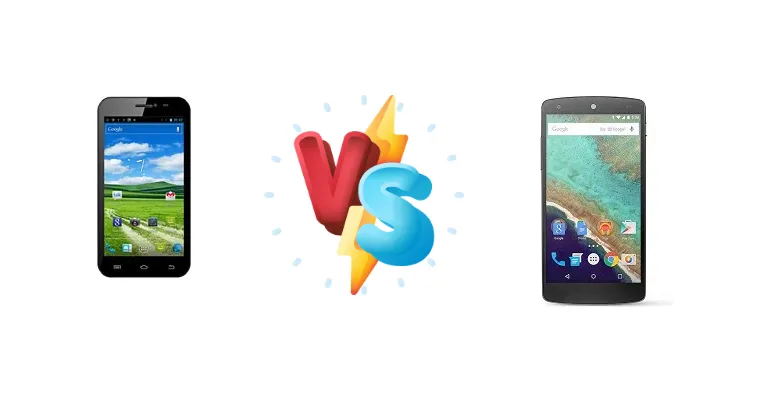
The LG Nexus 5, released in 2013, was a flagship that defined a generation of Android phones. Now, years later, it faces a new contender: the Maxwest Orbit 5400, a budget device aiming to deliver essential smartphone functionality. This comparison isn't about raw specs; it's about understanding how a mature, well-optimized platform stacks up against a newer, more constrained chipset in today's usage scenarios.
🏆 Quick Verdict
For the average user in 2024, the LG Nexus 5 remains the superior choice. While the Maxwest Orbit 5400 offers a newer device, the Snapdragon 800's significantly higher processing power and efficiency, coupled with the Nexus 5's wireless charging, outweigh the Orbit 5400's novelty.
| Network |
|---|
| 2G bands | GSM 850 / 900 / 1800 / 1900 - SIM 1 & SIM 2 | GSM 850 / 900 / 1800 / 1900 - all versions |
| 3G bands | HSDPA 850 / 1900 | HSDPA 800 / 850 / 1700 / 1900 / 2100 / 900 - North American version |
| 4G bands | - | 1, 2, 4, 5, 17, 19, 25, 26, 41 - North America |
| Speed | HSPA 7.2/5.76 Mbps | HSPA 42.2/5.76 Mbps, LTE Cat4 150/50 Mbps |
| Technology | GSM / HSPA | GSM / CDMA / HSPA / LTE |
| | - | 1, 3, 5, 7, 8, 20 |
| Launch |
|---|
| Announced | 2013, April. Released 2013, June | 2013, October. Released 2013, November |
| Status | Discontinued | Discontinued |
| Body |
|---|
| Build | - | Glass front (Gorilla Glass 3), plastic back, plastic frame |
| Dimensions | 143 x 74.2 x 9.6 mm (5.63 x 2.92 x 0.38 in) | 137.9 x 69.2 x 8.6 mm (5.43 x 2.72 x 0.34 in) |
| SIM | Dual SIM | Micro-SIM |
| Weight | 170 g (6.00 oz) | 130 g (4.59 oz) |
| Display |
|---|
| Protection | - | Corning Gorilla Glass 3 |
| Resolution | 540 x 960 pixels, 16:9 ratio (~220 ppi density) | 1080 x 1920 pixels, 16:9 ratio (~445 ppi density) |
| Size | 5.0 inches, 68.9 cm2 (~65.0% screen-to-body ratio) | 4.95 inches, 67.5 cm2 (~70.8% screen-to-body ratio) |
| Type | TFT | True HD IPS+ |
| Platform |
|---|
| CPU | Dual-core 1.0 GHz Cortex-A9 | Quad-core 2.3 GHz Krait 400 |
| Chipset | Mediatek MT6577 (40 nm) | Qualcomm MSM8974 Snapdragon 800 (28 nm) |
| GPU | PowerVR SGX531u | Adreno 330 |
| OS | Android 4.1.2 (Jelly Bean) | Android 4.4 (Ice Cream Sandwich), upgradable to 6.0 (Marshmallow) |
| Memory |
|---|
| Card slot | microSDHC (dedicated slot) | No |
| Internal | 4GB 512MB RAM | 16GB 2GB RAM, 32GB 2GB RAM |
| | - | eMMC 4.5 |
| Main Camera |
|---|
| Features | LED flash | LED flash, panorama, HDR |
| Single | 8 MP, AF | 8 MP, f/2.4, 30mm (standard), 1/3.2", 1.4µm, AF, OIS |
| Video | 1080p@30fps | 1080p@30fps |
| Selfie camera |
|---|
| Single | VGA | 1.3 MP, f/2.4, 1/6", 1.9µm |
| Sound |
|---|
| 3.5mm jack | Yes | Yes |
| 35mm jack | Yes | Yes |
| Loudspeaker | Yes | Yes |
| Comms |
|---|
| Bluetooth | 3.0, A2DP | 4.0, A2DP |
| NFC | No | Yes |
| Positioning | GPS | GPS, GLONASS |
| Radio | Stereo FM radio | No |
| USB | microUSB 2.0 | microUSB 2.0 (SlimPort), OTG |
| WLAN | Wi-Fi 802.11 b/g/n, Wi-Fi Direct, hotspot | Wi-Fi 802.11 a/b/g/n/ac, dual-band, Wi-Fi Direct, DLNA, hotspot |
| Features |
|---|
| Sensors | Accelerometer, proximity | Accelerometer, gyro, proximity, compass, barometer |
| Battery |
|---|
| Charging | - | Wireless (Qi) |
| Stand-by | Up to 900 h (2G) / Up to 750 h (3G) | Up to 300 h (3G) |
| Talk time | Up to 24 h (2G) / Up to 10 h (3G) | Up to 17 h (3G) |
| Type | Li-Ion 2000 mAh, removable | Li-Po 2300 mAh, non-removable |
| Misc |
|---|
| Colors | Black, Black/Red, White | Black, White, Red |
| Models | - | Nexus 5, D820, D821 |
| Price | - | About 260 EUR |
| SAR | - | 0.92 W/kg (head) 1.23 W/kg (body) |
| SAR EU | - | 0.49 W/kg (head) 0.48 W/kg (body) |
| Tests |
|---|
| Audio quality | - |
Noise -93.3dB / Crosstalk -94.3dB |
| Battery life | - |
Endurance rating 38h
|
| Camera | - |
Photo / Video |
| Display | - |
Contrast ratio: 967:1 (nominal) / 2.228:1 (sunlight) |
| Loudspeaker | - |
Voice 65dB / Noise 64dB / Ring 65dB
|
| Performance | - |
Basemark OS II 2.0: 1016Basemark X: 11638 |
Maxwest Orbit 5400
- Newer device with potential software support (though limited)
- Potentially lower price point
- May include features not found on the Nexus 5 (depending on software)
- Significantly weaker processor performance
- Less power-efficient chipset
- Limited information on display quality and camera capabilities
LG Nexus 5
- Powerful Snapdragon 800 processor
- Wireless charging (Qi)
- Mature and optimized software experience
- Older device with limited software updates
- Battery is aging and may have reduced capacity
- May show signs of wear and tear
Display Comparison
Both devices share a similar contrast ratio of 967:1 (nominal) and 2.228:1 (sunlight), suggesting comparable outdoor visibility. However, the Orbit 5400's display specifications are largely unknown, making a detailed comparison impossible. The Nexus 5's display, while aging, was praised for its color accuracy and clarity at the time of release. The lack of information regarding the Orbit 5400's panel type (IPS, TFT) and resolution impacts its potential image quality.
Camera Comparison
Both devices offer photo and video capabilities, but detailed camera specifications are limited for the Orbit 5400. The Nexus 5's camera was considered good for its time, but it's unlikely to compete with modern smartphone cameras. Without sensor size, aperture, or image processing details for the Orbit 5400, a meaningful comparison is difficult. The Nexus 5's image processing benefits from years of software optimization, potentially delivering more consistent results despite its older hardware.
Performance
The performance gap between the Qualcomm Snapdragon 800 (quad-core 2.3 GHz Krait 400) and the Mediatek MT6577 (dual-core 1.0 GHz Cortex-A9) is substantial. The Snapdragon 800, built on a 28nm process, offers significantly higher clock speeds and a more advanced architecture. This translates to faster app loading times, smoother multitasking, and a better gaming experience on the Nexus 5. The MT6577, fabricated on a 40nm node, is less power-efficient and will likely struggle with modern, resource-intensive applications. The Krait 400 architecture also provides a significant IPC (Instructions Per Clock) advantage over the Cortex-A9.
Battery Life
Both devices boast an endurance rating of 38 hours, suggesting similar battery life under comparable usage. However, the Snapdragon 800's superior power efficiency means the Nexus 5 is likely to achieve this endurance with more demanding tasks. The Nexus 5 also benefits from wireless charging (Qi), a feature absent on the Orbit 5400. While the Orbit 5400 may have a slightly larger battery capacity (unspecified), the Snapdragon 800's efficiency will likely offset any capacity difference.
Buying Guide
Buy the Maxwest Orbit 5400 if you need a very inexpensive, functional Android device for basic tasks like calls, texts, and light web browsing, and prioritize having a brand-new device. Buy the LG Nexus 5 if you value performance, a smoother user experience, wireless charging, and are comfortable with a device that's several years old but still capable of handling demanding applications and modern web browsing.
Frequently Asked Questions
❓ Is the LG Nexus 5 still secure in 2024, given its age and lack of official updates?
Security is a valid concern. While the Nexus 5 no longer receives official security updates from Google, the Android open-source community has created custom ROMs like LineageOS that provide ongoing security patches. However, using a custom ROM requires technical expertise and carries inherent risks.
❓ Will the Mediatek MT6577 in the Maxwest Orbit 5400 struggle with modern apps like Facebook or Instagram?
Yes, the MT6577 is likely to exhibit noticeable lag and slowdowns when running modern, resource-intensive apps like Facebook and Instagram. These apps have become significantly more demanding over the years, and the MT6577's limited processing power will struggle to keep up.
❓ Can I expect a smooth gaming experience on either of these devices?
Gaming performance will be limited on both devices, but the Nexus 5 offers a far superior experience. The Snapdragon 800 can handle older or less demanding games at reasonable settings. The MT6577 will struggle even with basic 2D games.
❓ What is the realistic lifespan of a used LG Nexus 5 battery in 2024?
A used Nexus 5 battery will likely have significantly reduced capacity. Expect significantly less than the original 38-hour endurance rating. Replacing the battery is possible, but requires technical skill and sourcing a compatible replacement.