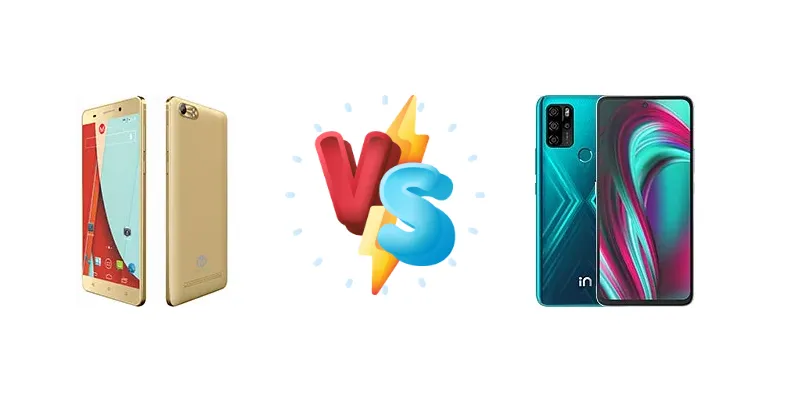
The sub-$150 smartphone market is fiercely competitive. We pit the Maxwest Gravity 5.5 LTE, a device relying on older silicon, against the Micromax In note 1, which leverages a more modern chipset. This comparison dives deep into the architectural differences and real-world implications for users seeking an affordable, functional smartphone.
🏆 Quick Verdict
For the average user, the Micromax In note 1 is the clear winner. Its Helio G85 chipset delivers significantly better performance than the Maxwest Gravity 5.5 LTE’s MT6735, offering a smoother experience for everyday tasks and even light gaming. The inclusion of 18W charging is a further advantage.
| Network |
|---|
| 2G bands | GSM 850 / 900 / 1800 / 1900 - SIM 1 & SIM 2 | GSM 850 / 900 / 1800 / 1900 |
| 3G bands | HSDPA 850 / 1700(AWS) / 1900 | HSDPA 850 / 900 / 2100 |
| 4G bands | 2, 4, 7, 17 | 1, 3, 5, 8, 40, 41 |
| Speed | HSPA 21.1/5.76 Mbps, LTE | HSPA 42.2/11.5 Mbps, LTE (2CA) Cat7 300/150 Mbps |
| Technology | GSM / HSPA / LTE | GSM / HSPA / LTE |
| Launch |
|---|
| Announced | 2015, June. Released 2015, September | 2020, November 03. Released 2020, November 24 |
| Status | Discontinued | Discontinued |
| Body |
|---|
| Dimensions | 155.5 x 78 x 7.5 mm (6.12 x 3.07 x 0.30 in) | 165.2 x 77 x 9 mm (6.50 x 3.03 x 0.35 in) |
| SIM | Dual SIM (Dual stand-by) | Nano-SIM + Nano-SIM |
| Weight | 165 g (5.82 oz) | 196 g (6.91 oz) |
| Display |
|---|
| Protection | Scratch-resistant glass | Oleophobic coating |
| Resolution | 720 x 1280 pixels, 16:9 ratio (~267 ppi density) | 1080 x 2400 pixels, 20:9 ratio (~395 ppi density) |
| Size | 5.5 inches, 83.4 cm2 (~68.8% screen-to-body ratio) | 6.67 inches, 107.4 cm2 (~84.4% screen-to-body ratio) |
| Type | IPS LCD | IPS LCD, 450 nits (peak) |
| Platform |
|---|
| CPU | Quad-core 1.0 GHz Cortex-A53 | Octa-core (2x2.0 GHz Cortex-A75 & 6x1.8 GHz Cortex-A55) |
| Chipset | Mediatek MT6735 (28 nm) | Mediatek MT6769Z Helio G85 (12 nm) |
| GPU | Mali-T720MP2 | Mali-G52 MC2 |
| OS | Android 5.1 (Lollipop) | Android 10 |
| Memory |
|---|
| Call records | 20 dialed, 20 received, 20 missed calls | - |
| Card slot | microSDHC | microSDXC (dedicated slot) |
| Internal | 8GB 1GB RAM | 64GB 4GB RAM, 128GB 4GB RAM |
| Phonebook | 1000 entries, Photocall | - |
| | - | eMMC 5.1 |
| Main Camera |
|---|
| Features | LED flash | LED flash, HDR |
| Quad | - | 48 MP, f/1.8, 26mm (wide), 1/2.0", 0.8µm, PDAF
5 MP, f/2.2, 115˚ (ultrawide), 1/5.0", 1.12µm
2 MP (macro)
Auxiliary lens |
| Single | 13 MP, AF | - |
| Video | 1080p@30fps | 1080p@30fps |
| Selfie camera |
|---|
| Single | 5 MP | 16 MP, f/2.0, 27mm (wide), 1/3.06", 1.0µm |
| Video | - | 1080p@30fps |
| Sound |
|---|
| 3.5mm jack | Yes | Yes |
| 35mm jack | Yes | Yes |
| Alert types | Vibration; Downloadable polyphonic, MP3, video ringtones ringtones | - |
| Loudspeaker | Yes | Yes |
| Comms |
|---|
| Bluetooth | 4.0, A2DP | 5.0, A2DP, LE |
| NFC | No | No |
| Positioning | GPS | GPS, GLONASS, GALILEO, BDS |
| Radio | Stereo FM radio | FM radio |
| USB | microUSB 2.0 | USB Type-C 2.0, OTG |
| WLAN | Wi-Fi 802.11 b/g/n, hotspot | Wi-Fi 802.11 a/b/g/n/ac, dual-band, Wi-Fi Direct |
| Features |
|---|
| Browser | WAP 2.0/xHTML, Adobe Flash Lite | - |
| Games | Yes + Downloadable | - |
| Java | Yes, MIDP 2.1 | - |
| Messaging | SMS, MMS, Email, IM | - |
| Sensors | Accelerometer, proximity | Fingerprint (rear-mounted), accelerometer, gyro, proximity, compass |
| Battery |
|---|
| Charging | - | 18W wired
2.5W reverse wired |
| Stand-by | Up to 350 h | - |
| Talk time | Up to 14 h | - |
| Type | Li-Ion 3000 mAh, non-removable | Li-Po 5000 mAh |
| Misc |
|---|
| Colors | Black, Gold, Silver | Green, White |
| Models | - | E7746 |
| Price | About 840 EUR | About 130 EUR |
| SAR | - | 0.57 W/kg (head) 0.96 W/kg (body) |
| Tests |
|---|
| Loudspeaker |
Voice 66dB / Noise 66dB / Ring 66dB
| - |
Maxwest Gravity 5.5 LTE
- Potentially lower price point (depending on availability)
- Basic functionality for essential tasks
- May have longer standby time due to less powerful processor
- Significantly slower performance
- Outdated chipset architecture
- Likely limited software support
- Poor gaming performance
Micromax In note 1
- Much faster performance with Helio G85
- 18W fast charging
- More efficient chipset for better battery life
- Better software support and updates
- 720p display resolution
- May be slightly more expensive than the Maxwest
- No dedicated low-light camera features
Display Comparison
Neither device boasts a standout display. The Maxwest Gravity 5.5 LTE’s display specifications are unavailable, but given its market positioning, it likely features a 720p panel. The Micromax In note 1 also utilizes a 720p display. The key difference lies in the processing power driving the display; the more capable GPU in the In note 1 will contribute to smoother animations and transitions. Without knowing the panel technology of the Maxwest, it's difficult to assess color accuracy or brightness, but it's unlikely to compete with more modern displays.
Camera Comparison
Camera details for the Maxwest Gravity 5.5 LTE are scarce. The Micromax In note 1’s camera setup is more defined, though details beyond the main sensor are limited. While the In note 1 likely includes standard auxiliary lenses, the Helio G85’s image signal processor (ISP) will deliver superior image processing compared to the MT6735. Expect better dynamic range and noise reduction on the Micromax device. The absence of OIS on either device means low-light performance will be limited.
Performance
The performance gap is substantial. The Maxwest Gravity 5.5 LTE’s Mediatek MT6735, built on a 28nm process, features a quad-core Cortex-A53 CPU clocked at 1.0 GHz. This is a relatively old architecture. Conversely, the Micromax In note 1’s Helio G85 (12nm) utilizes an octa-core configuration with a mix of Cortex-A75 (2x2.0 GHz) and Cortex-A55 (6x1.8 GHz) cores. The A75 cores provide a significant performance boost for demanding tasks, while the A55 cores offer efficiency. The 12nm process also contributes to better power efficiency. This translates to a noticeably faster and more responsive experience on the In note 1, especially when multitasking or running more complex applications.
Battery Life
Battery capacity for the Maxwest Gravity 5.5 LTE is unknown. The Micromax In note 1 offers 18W wired charging and 2.5W reverse wired charging. The older MT6735 chipset in the Maxwest is less power-efficient than the Helio G85. Even if the Maxwest has a larger battery capacity, the In note 1’s faster charging and more efficient chipset will likely result in comparable, or even better, real-world battery life. The 18W charging on the In note 1 will significantly reduce charging times compared to the likely 5W or 10W charging on the Maxwest.
Buying Guide
Buy the Maxwest Gravity 5.5 LTE if your primary need is a basic, functional smartphone for essential communication and you are on an extremely tight budget. It will handle calls, texts, and light app usage. Buy the Micromax In note 1 if you prioritize a more responsive user experience, enjoy occasional gaming, or value faster charging capabilities. The In note 1 offers a substantial performance upgrade for a minimal price increase.
Frequently Asked Questions
❓ Is the Micromax In note 1 capable of playing modern mobile games like PUBG or Call of Duty?
The Helio G85 in the Micromax In note 1 can handle PUBG and Call of Duty Mobile at medium settings with reasonable frame rates. However, demanding graphics settings and prolonged gaming sessions may lead to some frame drops. It's not a dedicated gaming phone, but it's capable of providing an enjoyable gaming experience.
❓ How does the Mediatek MT6735 in the Maxwest Gravity 5.5 LTE handle multitasking?
The MT6735 struggles with multitasking. Running multiple apps simultaneously will likely result in noticeable slowdowns and app crashes. It's best suited for running one app at a time.
❓ Does the Micromax In note 1 support VoLTE and VoWiFi?
Yes, the Micromax In note 1 supports both VoLTE (Voice over LTE) and VoWiFi (Voice over Wi-Fi), ensuring clear call quality and connectivity even in areas with poor cellular reception, provided your carrier supports these technologies.
❓ What type of charging port does the Maxwest Gravity 5.5 LTE use?
Given its age and market segment, the Maxwest Gravity 5.5 LTE likely uses a Micro-USB port for charging and data transfer. This is significantly slower and less convenient than the USB-C port found on the Micromax In note 1.