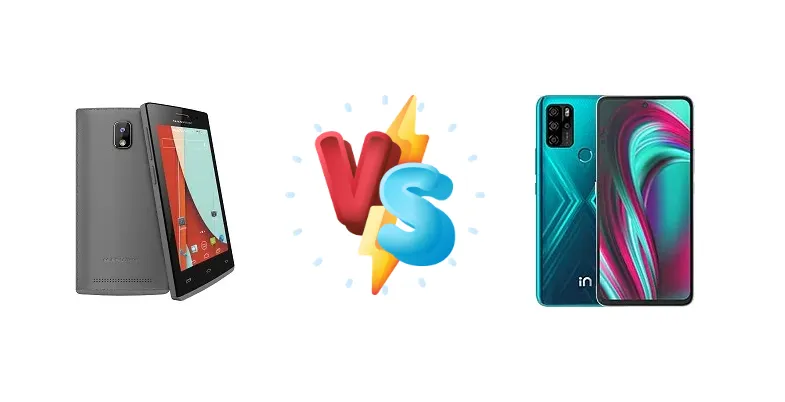
The Maxwest Astro 4.5 and Micromax In note 1 represent two ends of the entry-level smartphone spectrum. The Astro 4.5, likely an older model, focuses on basic functionality, while the In note 1 aims to deliver a more modern experience with a focus on gaming and faster charging. This comparison dissects their key differences to help you choose the right device for your needs.
🏆 Quick Verdict
For the average user, the Micromax In note 1 is the clear winner. Its Helio G85 chipset provides a substantial performance upgrade over the Astro 4.5’s aging MT6572M, making it significantly better for multitasking, gaming, and future-proofing. While the Astro 4.5 may be cheaper, the In note 1’s added features justify the price difference.
| Network |
|---|
| 2G bands | GSM 850 / 900 / 1800 / 1900 - SIM 1 & SIM 2 | GSM 850 / 900 / 1800 / 1900 |
| 3G bands | HSDPA 850 / 1900 / 2100 | HSDPA 850 / 900 / 2100 |
| 4G bands | - | 1, 3, 5, 8, 40, 41 |
| Speed | HSPA 21.1/5.76 Mbps | HSPA 42.2/11.5 Mbps, LTE (2CA) Cat7 300/150 Mbps |
| Technology | GSM / HSPA | GSM / HSPA / LTE |
| | HSDPA 850 / 1700 / 1900 | - |
| Launch |
|---|
| Announced | 2015, July. Released 2015, July | 2020, November 03. Released 2020, November 24 |
| Status | Discontinued | Discontinued |
| Body |
|---|
| Dimensions | 134.3 x 66.7 x 10 mm (5.29 x 2.63 x 0.39 in) | 165.2 x 77 x 9 mm (6.50 x 3.03 x 0.35 in) |
| SIM | Dual SIM (dual stand-by) | Nano-SIM + Nano-SIM |
| Weight | 131 g (4.62 oz) | 196 g (6.91 oz) |
| Display |
|---|
| Protection | - | Oleophobic coating |
| Resolution | 480 x 854 pixels, 16:9 ratio (~218 ppi density) | 1080 x 2400 pixels, 20:9 ratio (~395 ppi density) |
| Size | 4.5 inches, 55.8 cm2 (~62.3% screen-to-body ratio) | 6.67 inches, 107.4 cm2 (~84.4% screen-to-body ratio) |
| Type | TFT, 256K colors | IPS LCD, 450 nits (peak) |
| Platform |
|---|
| CPU | Dual-core 1.2 GHz Cortex-A7 | Octa-core (2x2.0 GHz Cortex-A75 & 6x1.8 GHz Cortex-A55) |
| Chipset | Mediatek MT6572M (28 nm) | Mediatek MT6769Z Helio G85 (12 nm) |
| GPU | Mali-400 | Mali-G52 MC2 |
| OS | Android 4.4.2 (KitKat) | Android 10 |
| Memory |
|---|
| Card slot | microSDHC | microSDXC (dedicated slot) |
| Internal | 4GB 512MB RAM | 64GB 4GB RAM, 128GB 4GB RAM |
| | - | eMMC 5.1 |
| Main Camera |
|---|
| Features | LED flash | LED flash, HDR |
| Quad | - | 48 MP, f/1.8, 26mm (wide), 1/2.0", 0.8µm, PDAF
5 MP, f/2.2, 115˚ (ultrawide), 1/5.0", 1.12µm
2 MP (macro)
Auxiliary lens |
| Single | 8 MP | - |
| Video | 720p | 1080p@30fps |
| Selfie camera |
|---|
| Single | VGA | 16 MP, f/2.0, 27mm (wide), 1/3.06", 1.0µm |
| Video | - | 1080p@30fps |
| Sound |
|---|
| 3.5mm jack | Yes | Yes |
| 35mm jack | Yes | Yes |
| Loudspeaker | Yes | Yes |
| Comms |
|---|
| Bluetooth | 4.0, A2DP | 5.0, A2DP, LE |
| NFC | No | No |
| Positioning | GPS | GPS, GLONASS, GALILEO, BDS |
| Radio | Stereo FM radio | FM radio |
| USB | microUSB 2.0 | USB Type-C 2.0, OTG |
| WLAN | Wi-Fi 802.11 b/g/n, hotspot | Wi-Fi 802.11 a/b/g/n/ac, dual-band, Wi-Fi Direct |
| Features |
|---|
| Sensors | Accelerometer, proximity | Fingerprint (rear-mounted), accelerometer, gyro, proximity, compass |
| Battery |
|---|
| Charging | - | 18W wired
2.5W reverse wired |
| Stand-by | Up to 190 h (3G) | - |
| Talk time | Up to 5 h (3G) | - |
| Type | Li-Ion 1700 mAh, removable | Li-Po 5000 mAh |
| Misc |
|---|
| Colors | White, Black, Gold, Gray, Blue | Green, White |
| Models | - | E7746 |
| Price | - | About 130 EUR |
| SAR | - | 0.57 W/kg (head) 0.96 W/kg (body) |
Maxwest Astro 4.5
- Potentially lower price point
- Simple and easy to use for basic tasks
- May have longer standby time due to less demanding hardware
- Significantly slower performance
- Outdated chipset and software
- Likely inferior camera quality
- Slower charging speeds
Micromax In note 1
- Much faster performance with Helio G85
- 18W fast charging and 2.5W reverse charging
- More modern software experience
- Better camera capabilities (likely)
- Potentially higher price
- May have slightly shorter battery life due to more powerful processor
- Larger size and weight (potentially)
Display Comparison
Neither device’s display specifications are detailed in the provided data. However, given the Astro 4.5’s older chipset, it likely features a lower resolution and less color accuracy than the In note 1. The In note 1, being a more recent device, likely benefits from improved display technology, potentially offering better viewing angles and brightness. The absence of details prevents a precise comparison, but the In note 1 is expected to have a superior display experience.
Camera Comparison
Without specific camera sensor details, a direct comparison is limited. However, the In note 1’s more modern platform suggests a more advanced image signal processor (ISP), potentially leading to better image quality, even with similar sensor sizes. The Astro 4.5’s older chipset likely has a less capable ISP, resulting in less detailed photos and poorer low-light performance. It’s reasonable to assume the In note 1 offers superior camera capabilities, even if the megapixel counts are similar.
Performance
The performance gap between these two devices is substantial. The Maxwest Astro 4.5’s Mediatek MT6572M, a dual-core Cortex-A7 processor built on a 28nm process, is significantly outdated. The Micromax In note 1’s MediaTek Helio G85, with its octa-core configuration (2x2.0 GHz Cortex-A75 & 6x1.8 GHz Cortex-A55) built on a more efficient 12nm process, offers a massive leap in processing power. The Helio G85’s architecture, featuring more powerful Cortex-A75 cores, excels in both single-core and multi-core tasks, making the In note 1 far more responsive and capable of handling demanding applications and games. This translates to smoother multitasking, faster app loading times, and a better overall user experience for the In note 1.
Battery Life
Battery capacity isn’t specified for either device. However, the Micromax In note 1’s 18W wired charging and 2.5W reverse wired charging provide a significant advantage. The Astro 4.5 likely supports slower charging speeds, meaning longer times to reach a full charge. The In note 1’s reverse charging feature allows it to act as a power bank for other devices, a feature absent on the Astro 4.5. Even if the Astro 4.5 has a slightly larger battery capacity, the In note 1’s faster charging and reverse charging capabilities offer a more convenient user experience.
Buying Guide
Buy the Maxwest Astro 4.5 if you absolutely need the lowest possible price and only require a phone for basic tasks like calls, texts, and light web browsing. It’s a suitable option for first-time smartphone users or as a temporary device. Buy the Micromax In note 1 if you prioritize performance, enjoy mobile gaming, or want a phone that will remain usable for longer. The 18W charging and reverse charging capabilities also add significant convenience.
Frequently Asked Questions
❓ Is the Micromax In note 1’s Helio G85 capable of playing demanding games like PUBG or Call of Duty Mobile?
Yes, the MediaTek Helio G85 is specifically designed for gaming. While it won’t deliver flagship-level performance, it’s capable of running PUBG and Call of Duty Mobile at medium to high settings with playable frame rates. The GPU within the Helio G85 provides a significant boost over the Astro 4.5’s integrated graphics.
❓ How much faster is the charging on the Micromax In note 1 compared to the Maxwest Astro 4.5?
The Micromax In note 1 supports 18W fast charging, while the Astro 4.5 likely supports significantly slower charging speeds (likely 5W or 10W). This means the In note 1 can charge from 0% to 100% much faster, potentially reducing charging times by over an hour depending on battery capacity. The reverse charging feature is also exclusive to the In note 1.
❓ Will the Maxwest Astro 4.5 receive software updates?
Given the age of the MT6572M chipset and the likely position of the Astro 4.5 as a budget device, it's unlikely to receive significant software updates. The Micromax In note 1, being a newer device, has a higher probability of receiving security patches and potentially even Android version updates.