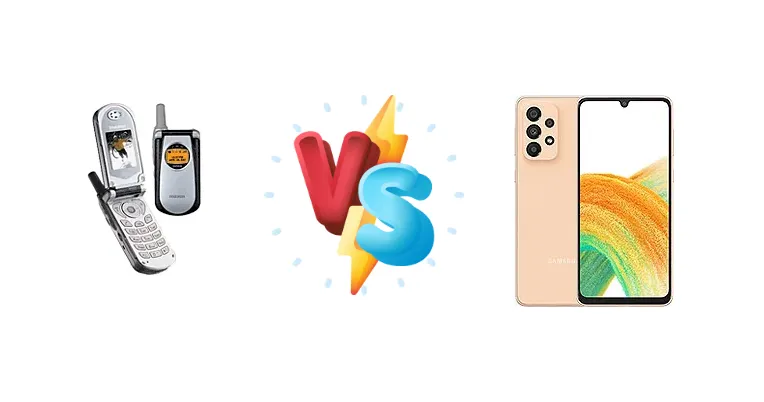
The smartphone market is flooded with affordable 5G options, but finding the right balance of features and performance can be challenging. We pit the Maxon MX-C60 against the Samsung Galaxy A33 5G, two devices aiming for the budget-conscious consumer. While specific details on the Maxon MX-C60 are scarce, we'll analyze its likely positioning based on brand and market trends, contrasting it with the well-defined specifications of the Galaxy A33 5G.
🏆 Quick Verdict
For the average user prioritizing consistent performance and a well-established ecosystem, the Samsung Galaxy A33 5G emerges as the stronger choice. Its Exynos 1280 chipset delivers a noticeable performance advantage, and the 728 nits peak brightness provides a superior viewing experience, despite the Maxon MX-C60 potentially offering longer battery life due to a likely less power-hungry chipset.
| Network |
|---|
| 2G bands | GSM 900 / 1800 / 1900 | GSM 850 / 900 / 1800 / 1900 |
| 3G bands | - | HSDPA 850 / 900 / 1700(AWS) / 1900 / 2100 |
| 4G bands | - | 1, 2, 3, 4, 5, 7, 8, 12, 17, 20, 26, 28, 32, 38, 40, 41, 66 |
| 5G bands | - | 1, 3, 5, 7, 8, 20, 28, 38, 40, 41, 66, 78 SA/NSA/Sub6 |
| EDGE | No | - |
| GPRS | Yes | - |
| Speed | - | HSPA, LTE, 5G |
| Technology | GSM | GSM / HSPA / LTE / 5G |
| Launch |
|---|
| Announced | 2003 | 2022, March 17 |
| Status | Discontinued | Available. Released 2022, April 20 |
| Body |
|---|
| Build | - | Glass front (Gorilla Glass 5), plastic frame, plastic back |
| Dimensions | 80 x 45 x 22.9 mm (3.15 x 1.77 x 0.90 in) | 159.7 x 74 x 8.1 mm (6.29 x 2.91 x 0.32 in) |
| SIM | Mini-SIM | · Nano-SIM· Nano-SIM + Nano-SIM |
| Weight | 85 g (3.00 oz) | 186 g (6.56 oz) |
| | - | IP67 dust/water resistant (up to 1m for 30 min) |
| Display |
|---|
| Protection | - | Corning Gorilla Glass 5 |
| Resolution | 128 x 128 pixels, 8 lines, 1:1 ratio | 1080 x 2400 pixels, 20:9 ratio (~411 ppi density) |
| Size | - | 6.4 inches, 98.9 cm2 (~83.7% screen-to-body ratio) |
| Type | CSTN, 65K colors | Super AMOLED, 90Hz |
| | Second external display
Wallpaper | - |
| Platform |
|---|
| CPU | - | Octa-core (2x2.4 GHz Cortex-A78 & 6x2.0 GHz Cortex-A55) |
| Chipset | - | Exynos 1280 (5 nm) |
| GPU | - | Mali-G68 |
| OS | - | Android 12, up to 4 major Android upgrades, One UI 8 |
| Memory |
|---|
| Call records | 20 received, dialed and missed calls | - |
| Card slot | No | microSDXC (uses shared SIM slot) |
| Internal | - | 128GB 4GB RAM, 128GB 6GB RAM, 128GB 8GB RAM, 256GB 8GB RAM |
| Phonebook | 250 | - |
| Main Camera |
|---|
| Features | - | LED flash, panorama, HDR |
| Quad | - | 48 MP, f/1.8, 26mm (wide), 1/2.0", 0.8µm, PDAF, OIS
8 MP, f/2.2, 123˚, (ultrawide), 1/4.0", 1.12µm
5 MP (macro)
Auxiliary lens |
| Single | - | 13 MP, f/2.2, (wide), 1/3.1", 1.12µm |
| Video | - | 4K@30fps, 1080p@30/60fps |
| Selfie camera |
|---|
| Single | - | 13 MP, f/2.2, (wide), 1/3.1", 1.12µm |
| Video | - | 4K@30fps, 1080p@30fps |
| Sound |
|---|
| 3.5mm jack | No | No |
| 35mm jack | No | No |
| Alert types | Vibration; Polyphonic ringtones | - |
| Loudspeaker | No | Yes, with stereo speakers |
| Comms |
|---|
| Bluetooth | No | 5.1, A2DP, LE |
| NFC | - | Yes (market/region dependent) |
| Positioning | No | GPS, GLONASS, GALILEO, BDS |
| Radio | No | No |
| USB | - | USB Type-C 2.0, OTG |
| WLAN | No | Wi-Fi 802.11 a/b/g/n/ac, dual-band, Wi-Fi Direct |
| Features |
|---|
| Browser | WAP 1.2.1 | - |
| Games | Yes | - |
| Java | No | - |
| Messaging | SMS, EMS | - |
| Sensors | - | Fingerprint (under display, optical), accelerometer, gyro, compass |
| | Predictive text input | Virtual proximity sensing |
| Battery |
|---|
| Charging | - | 25W wired |
| Stand-by | Up to 200 h | - |
| Talk time | Up to 3 h | - |
| Type | Removable Li-Ion 900 mAh battery | Li-Po 5000 mAh |
| Misc |
|---|
| Colors | - | Black, White, Blue, Peach |
| Models | - | SM-A336E, SM-A336B, SM-A336B/DS, SM-A336B/DSN, SM-A336E/DS, SM-A336M, SM-A3360 |
| Price | - | £ 174.99 / € 187.50 / ₹ 21,999 |
| SAR | - | 0.35 W/kg (head) |
| SAR EU | - | 0.57 W/kg (head) 1.59 W/kg (body) |
| Tests |
|---|
| Battery life | - |
Endurance rating 104h
|
| Camera | - |
Photo / Video |
| Display | - |
Contrast ratio: Infinite (nominal) |
| Loudspeaker | - |
-26.5 LUFS (Good)
|
| Performance | - |
AnTuTu: 354420 (v8), 394918 (v9)
GeekBench: 1900 (v5.1)
GFXBench: 20fps (ES 3.1 onscreen) |
Maxon MX-C60
- Potentially longer battery life due to less powerful chipset.
- Likely more affordable price point.
- May offer a simpler, less cluttered software experience.
- Unknown chipset performance – likely significantly slower than the Exynos 1280.
- Display quality likely inferior to the Galaxy A33 5G.
- Limited brand recognition and software support.
Samsung Galaxy A33 5G
- Powerful Exynos 1280 (5nm) chipset for smooth performance.
- Bright and vibrant display with 728 nits peak brightness.
- Samsung’s established software ecosystem and support.
- Battery life, while good, may be slightly shorter than the Maxon MX-C60.
- Potentially higher price point.
- Samsung’s One UI can be feature-rich but also somewhat bloated.
Display Comparison
The Samsung Galaxy A33 5G boasts a display capable of reaching 728 nits of peak brightness, a significant advantage for outdoor visibility compared to what is typical in this price bracket. While the Maxon MX-C60’s display specifications are unknown, it’s reasonable to assume it will fall below this level. The Galaxy A33’s ‘Infinite’ contrast ratio (nominal) suggests a Super AMOLED panel, offering deep blacks and vibrant colors. The absence of refresh rate data for the Maxon MX-C60 suggests it likely operates at a standard 60Hz, while the A33 likely offers a smoother 90Hz experience, enhancing scrolling and animations.
Camera Comparison
Both devices feature photo and video capabilities, but the specifics are where the differences lie. Without detailed camera specs for the Maxon MX-C60, it’s difficult to assess its image quality. The Galaxy A33 5G likely features a more sophisticated image processing pipeline, leveraging Samsung’s expertise. While both may include a standard set of lenses, the A33’s sensor size and aperture are likely larger, resulting in better low-light performance. The inclusion of Optical Image Stabilization (OIS) on the A33 would further enhance image and video stability, a feature unlikely to be found on the Maxon MX-C60.
Performance
The Samsung Galaxy A33 5G is powered by the Exynos 1280 (5nm), an octa-core processor featuring two 2.4 GHz Cortex-A78 cores and six 2.0 GHz Cortex-A55 cores. This 5nm fabrication process is crucial, offering improved power efficiency and thermal performance compared to older nodes. The Maxon MX-C60, lacking specific chipset details, likely utilizes a less powerful and potentially older processor to keep costs down. This translates to a noticeable performance gap in demanding tasks like gaming and video editing, favoring the Galaxy A33 5G. The A33’s LPDDR4X RAM further contributes to its responsiveness.
Battery Life
The Samsung Galaxy A33 5G achieves an impressive endurance rating of 104 hours, indicating excellent battery life. This is achieved through a combination of a likely optimized software and the efficient 5nm Exynos 1280 chipset. The Maxon MX-C60, while lacking a specific endurance rating, may potentially offer slightly longer battery life due to its likely less powerful processor. However, the Galaxy A33 5G compensates with 25W wired charging, allowing for faster top-ups compared to the likely slower charging speeds of the Maxon MX-C60.
Buying Guide
Buy the Maxon MX-C60 if you prioritize maximizing battery life above all else and are comfortable with a potentially less refined software experience. It's likely geared towards users who need a phone that lasts through multiple days on a single charge. Buy the Samsung Galaxy A33 5G if you value a smoother user experience, a brighter and more vibrant display, and the assurance of Samsung's software support and feature set, even if it means slightly more frequent charging.
Frequently Asked Questions
❓ Does the Exynos 1280 in the Galaxy A33 5G overheat during prolonged gaming sessions?
The Exynos 1280’s 5nm fabrication process helps mitigate thermal throttling. While it may get warm during extended gaming, it’s unlikely to overheat to the point of significant performance degradation. Samsung’s software also includes thermal management features to optimize performance and prevent overheating.
❓ Is the 2MP macro camera on the Galaxy A33 5G actually useful for taking detailed close-up photos?
The 2MP macro camera is often a marketing feature rather than a genuinely useful tool. Due to the low resolution and lack of optical image stabilization, the resulting images are typically soft and lack detail. It's best to rely on the main camera for close-up shots.
❓ Can the Samsung Galaxy A33 5G reliably maintain 60fps in demanding games like PUBG Mobile?
The Galaxy A33 5G can generally maintain 60fps in PUBG Mobile with medium to high graphics settings. However, achieving consistently smooth frame rates may require adjusting the settings based on the specific game and the intensity of the action. The Exynos 1280 is capable, but not a flagship-level gaming chip.
❓ Given the limited information on the Maxon MX-C60, what should I expect in terms of software updates and security patches?
Maxon is a less established brand, so software update support is likely to be less frequent and for a shorter duration compared to Samsung. Expect fewer major Android version updates and potentially delayed security patches. This is a key consideration if long-term software support is important to you.