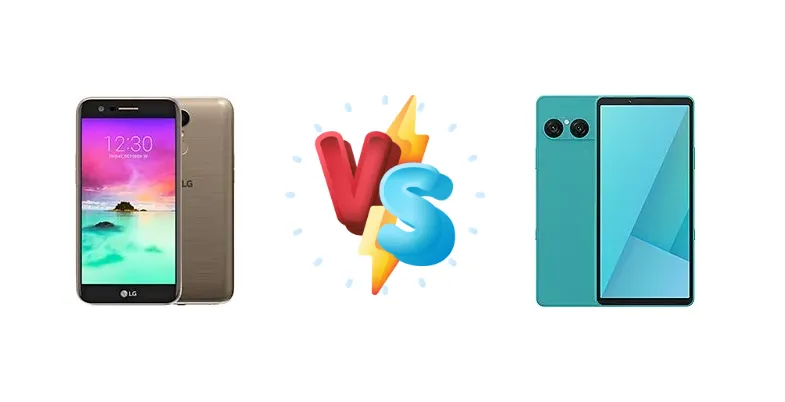
The LG X4+ represents a budget-focused approach from a brand once known for innovation, while the Sony Xperia 10 VII aims to deliver a refined experience in the mid-range. This comparison isn't about raw specs; it's about understanding where each phone excels and who benefits from its strengths, particularly given the significant architectural differences in their core processors.
🏆 Quick Verdict
For the average user prioritizing longevity and a smoother experience, the Sony Xperia 10 VII is the clear winner. Its Snapdragon 6 Gen 3 chipset and impressive 48:10h battery endurance significantly outperform the LG X4+'s aging Snapdragon 425, justifying the price difference.
| Network |
|---|
| 2G bands | GSM 850 / 900 / 1800 / 1900 | GSM 850 / 900 / 1800 / 1900 |
| 3G bands | HSDPA 850 / 900 / 1900 / 2100 | HSDPA 850 / 900 / 1700(AWS) / 2100 |
| 4G bands | 1, 3, 5, 7, 8, 28, 38 | 1, 3, 4, 5, 7, 8, 20, 28, 38, 39, 40, 41 |
| 5G bands | - | 1, 3, 5, 7, 8, 20, 28, 38, 40, 41, 77, 78, 79 SA/NSA/Sub6 |
| Speed | HSPA, LTE | HSPA, LTE, 5G |
| Technology | GSM / HSPA / LTE | GSM / HSPA / LTE / 5G |
| Launch |
|---|
| Announced | 2018, January. Released 2018, February | 2025, September 12 |
| Status | Discontinued | Available. Released 2025, September 19 |
| Body |
|---|
| Build | - | Glass front (Gorilla Glass Victus 2), plastic frame, plastic back |
| Dimensions | 148.6 x 75.1 x 8.6 mm (5.85 x 2.96 x 0.34 in) | 153 x 72 x 8.3 mm (6.02 x 2.83 x 0.33 in) |
| SIM | Nano-SIM + Nano-SIM | · Nano-SIM + eSIM· Nano-SIM + Nano-SIM |
| Weight | 172.3 g (6.07 oz) | 168 g (5.93 oz) |
| Display |
|---|
| Protection | - | Corning Gorilla Glass Victus 2, Mohs level 5 |
| Resolution | 720 x 1280 pixels, 16:9 ratio (~277 ppi density) | 1080 x 2340 pixels, 19.5:9 ratio (~422 ppi density) |
| Size | 5.3 inches, 77.4 cm2 (~69.4% screen-to-body ratio) | 6.1 inches, 91.3 cm2 (~82.9% screen-to-body ratio) |
| Type | IPS LCD | OLED, 1B colors, 120Hz, HDR |
| Platform |
|---|
| CPU | Quad-core 1.4 GHz Cortex-A53 | Octa-core (4x2.4 GHz Cortex-A78 & 4x1.8 GHz Cortex-A55) |
| Chipset | Qualcomm MSM8917 Snapdragon 425 (28 nm) | Qualcomm SM6475-AB Snapdragon 6 Gen 3 (4 nm) |
| GPU | Adreno 308 | Adreno 710 |
| OS | Android 7.0 (Nougat) | Android 15, upgradable to Android 16, up to 4 major Android upgrades |
| Memory |
|---|
| Card slot | microSDXC | microSDXC (uses shared SIM slot) |
| Internal | 32GB 2GB RAM | 128GB 8GB RAM |
| Main Camera |
|---|
| Dual | - | 50 MP, f/1.9, 24mm (wide), 1/1.56", PDAF, OIS
13 MP, f/2.4, 16mm, 123˚ (ultrawide), 1/3.0" |
| Features | LED flash, HDR | LED flash, HDR, panorama |
| Single | 13 MP, f/2.2, 1/3.1", 1.12µm, AF | - |
| Video | 1080p@30fps | 4K@30fps, 1080p@30/60/120fps, gyro-EIS, OIS |
| Selfie camera |
|---|
| Features | - | HDR |
| Single | 5 MP, f/2.4, 1/5.0", 1.12µm | 8 MP, f/2.0, 26mm (wide), 1/4.0", 1.12µm |
| Video | 1080p@30fps | 1080p@30fps |
| Sound |
|---|
| 35mm jack | Yes | Yes |
| Loudspeaker | Yes | Yes, with stereo speakers |
| Comms |
|---|
| Bluetooth | 4.2, A2DP, LE | 5.4, A2DP, LE |
| NFC | Yes | Yes |
| Positioning | GPS | GPS, GLONASS, GALILEO, BDS, QZSS |
| Radio | FM radio | No |
| USB | microUSB 2.0 | USB Type-C 2.0, OTG |
| WLAN | Wi-Fi 802.11 a/b/g/n, dual-band, Wi-Fi Direct | Wi-Fi 802.11 a/b/g/n/ac/6e, tri-band |
| Features |
|---|
| Sensors | Fingerprint (rear-mounted), accelerometer, proximity, compass | Fingerprint (side-mounted), accelerometer, gyro, proximity, compass |
| Battery |
|---|
| Charging | - | Wired, PD, QC |
| Type | Li-Ion 3000 mAh, non-removable | 5000 mAh |
| Misc |
|---|
| Colors | Lavender Violet, Moroccan Blue | White, Turquoise, Charcoal |
| Models | LM-X415L, LM-X410L, LM-X415S | XQ-FE54, XQZ-CBFE, xqfe54eukcl.gc, xqfe54eukcw.gc, xqfe54eukcb.gc |
| Price | About 200 EUR | $ 459.99 / £ 329.00 / € 379.00 |
| EU LABEL |
|---|
| Battery | - | 48:10h endurance, 1400 cycles |
| Energy | - | Class B |
| Free fall | - | Class C (90 falls) |
| Repairability | - | Class D |
LG X4+
- Extremely affordable price point
- Functional for basic smartphone tasks
- Compact and lightweight design (likely)
- Outdated processor and architecture
- Poor performance with demanding apps
- Limited battery life
- Likely slow software updates
Sony Xperia 10 VII
- Excellent battery life and endurance
- Modern and efficient Snapdragon 6 Gen 3 chipset
- Bright and clear display
- Fast charging support (PD, QC)
- Higher price compared to the LG X4+
- May not compete with flagship camera performance
- Software experience may not appeal to all users
Display Comparison
The Sony Xperia 10 VII boasts a significantly brighter display, reaching a measured 1064 nits. This is a substantial improvement over what the LG X4+ likely offers (estimated under 400 nits based on its market segment), making the Xperia 10 VII far more usable outdoors. While the X4+'s resolution is likely 720p, the Xperia 10 VII's panel benefits from higher brightness and likely better color accuracy, enhancing media consumption. We lack specific panel technology details for the X4+, but the Xperia 10 VII's display is a clear advantage for visual clarity.
Camera Comparison
Without detailed camera specs for the LG X4+, it's difficult to make a direct comparison. However, given its price point, it likely features a basic camera setup. The Xperia 10 VII, while not a camera powerhouse, benefits from a more modern image signal processor (ISP) within the Snapdragon 6 Gen 3. This translates to better image processing, improved low-light performance, and potentially more accurate colors. We can assume the Xperia 10 VII will offer a more consistent and reliable camera experience, even without flagship-level sensor sizes.
Performance
The core difference lies in the chipsets. The LG X4+'s Qualcomm MSM8917 Snapdragon 425, built on a 28nm process, features a quad-core Cortex-A53 CPU. This is a dated architecture, designed for basic tasks. Conversely, the Sony Xperia 10 VII utilizes the Snapdragon 6 Gen 3 (4nm), an octa-core processor with a mix of Cortex-A78 and A55 cores. The 4nm fabrication process delivers significantly improved power efficiency and performance. The A78 cores provide a substantial boost in single-core performance, resulting in snappier app launches and smoother multitasking. The Xperia 10 VII will handle demanding apps and light gaming with ease, while the X4+ will struggle with anything beyond basic usage.
Battery Life
The Sony Xperia 10 VII truly shines in battery life. Its reported 48:10h endurance and 1400 cycles demonstrate exceptional longevity. The active use score of 12:57h further reinforces this. The Snapdragon 6 Gen 3's 4nm process contributes significantly to this efficiency. The LG X4+'s battery life, while adequate for basic use, will be considerably shorter due to the less efficient Snapdragon 425. The Xperia 10 VII also supports PD and QC charging, offering faster replenishment compared to the X4+'s likely standard charging capabilities.
Buying Guide
Buy the LG X4+ if you need a functional smartphone on an extremely tight budget and are willing to compromise on performance and future-proofing. It's a viable option for basic tasks like calls, texts, and light social media. Buy the Sony Xperia 10 VII if you prioritize a responsive user experience, a brighter and more modern display, and significantly longer battery life, even if it means spending more upfront.
Frequently Asked Questions
❓ Will the Snapdragon 6 Gen 3 in the Xperia 10 VII handle modern mobile games like Genshin Impact?
While the Snapdragon 6 Gen 3 isn't a gaming powerhouse, it can handle Genshin Impact at lower settings (medium or low) with acceptable frame rates. Expect some compromises in graphical fidelity to maintain smooth gameplay. The LG X4+'s Snapdragon 425 would struggle significantly with this title.
❓ How does the 4nm process of the Snapdragon 6 Gen 3 impact the Xperia 10 VII's thermal performance?
The 4nm process is significantly more power-efficient than the 28nm process used in the Snapdragon 425. This translates to less heat generation during operation, reducing the likelihood of thermal throttling and maintaining consistent performance for longer periods. The Xperia 10 VII will remain cooler under load compared to the X4+.
❓ Is the difference in battery life between the two phones noticeable in everyday use?
Absolutely. The Xperia 10 VII's 48:10h endurance means you can realistically expect to go a day and a half, or even two days, on a single charge with moderate use. The LG X4+ will likely require daily charging, even with conservative usage. This difference is substantial and a key advantage for the Xperia 10 VII.