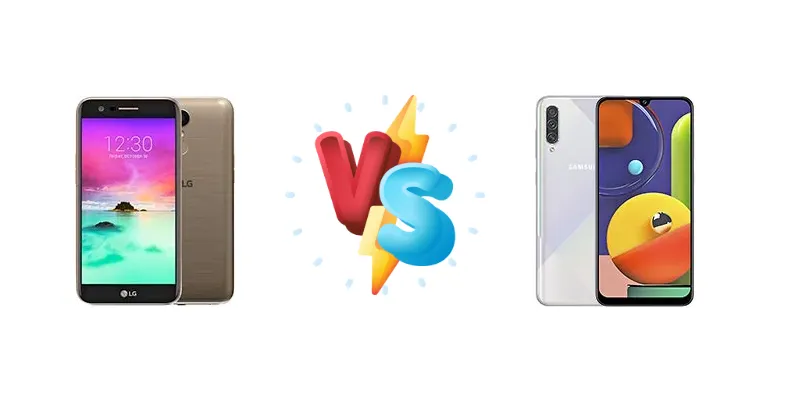
The LG X4+ and Samsung Galaxy A50s represent different approaches to the budget smartphone market. The X4+ aims for extreme affordability, while the A50s offers a more feature-rich experience at a slightly higher price point. This comparison dissects their core components to determine which device delivers the best value.
🏆 Quick Verdict
For most users, the Samsung Galaxy A50s is the superior choice. Its Exynos 9611 chipset provides significantly faster performance than the LG X4+'s Snapdragon 425, making it better suited for multitasking and demanding applications. While the X4+ is cheaper, the A50s' performance advantage justifies the price difference.
| Network |
|---|
| 2G bands | GSM 850 / 900 / 1800 / 1900 | GSM 850 / 900 / 1800 / 1900 |
| 3G bands | HSDPA 850 / 900 / 1900 / 2100 | HSDPA 850 / 900 / 1900 / 2100 |
| 4G bands | 1, 3, 5, 7, 8, 28, 38 | 1, 3, 5, 7, 8, 20, 28, 38, 40, 41 |
| Speed | HSPA, LTE | HSPA, LTE |
| Technology | GSM / HSPA / LTE | GSM / HSPA / LTE |
| Launch |
|---|
| Announced | 2018, January. Released 2018, February | 2019, August 22. Released 2019, September |
| Status | Discontinued | Discontinued |
| Body |
|---|
| Build | - | Glass front (Gorilla Glass 3), plastic back, plastic frame |
| Dimensions | 148.6 x 75.1 x 8.6 mm (5.85 x 2.96 x 0.34 in) | 158.5 x 74.5 x 7.7 mm (6.24 x 2.93 x 0.30 in) |
| SIM | Nano-SIM + Nano-SIM | · Nano-SIM· Nano-SIM + Nano-SIM |
| Weight | 172.3 g (6.07 oz) | 169 g (5.96 oz) |
| Display |
|---|
| Protection | - | Corning Gorilla Glass 3 |
| Resolution | 720 x 1280 pixels, 16:9 ratio (~277 ppi density) | 1080 x 2340 pixels, 19.5:9 ratio (~403 ppi density) |
| Size | 5.3 inches, 77.4 cm2 (~69.4% screen-to-body ratio) | 6.4 inches, 100.5 cm2 (~85.1% screen-to-body ratio) |
| Type | IPS LCD | Super AMOLED |
| Platform |
|---|
| CPU | Quad-core 1.4 GHz Cortex-A53 | Octa-core (4x2.3 GHz Cortex-A73 & 4x1.7 GHz Cortex-A53) |
| Chipset | Qualcomm MSM8917 Snapdragon 425 (28 nm) | Exynos 9611 (10 nm) |
| GPU | Adreno 308 | Mali-G72 MP3 |
| OS | Android 7.0 (Nougat) | Android 9.0 (Pie), upgradable to Android 11, One UI 3.1 |
| Memory |
|---|
| Card slot | microSDXC | microSDXC (dedicated slot) |
| Internal | 32GB 2GB RAM | 64GB 4GB RAM, 128GB 4GB RAM, 128GB 6GB RAM |
| | - | UFS 2.1 |
| Main Camera |
|---|
| Features | LED flash, HDR | LED flash, panorama, HDR |
| Single | 13 MP, f/2.2, 1/3.1", 1.12µm, AF | - |
| Triple | - | 48 MP, f/2.0, 26mm (wide), 1/2.0", 0.8µm, PDAF
8 MP, f/2.2, 13mm (ultrawide), 1/4.0", 1.12µm
Auxiliary lens |
| Video | 1080p@30fps | 4K@30fps, 1080p@30fps |
| Selfie camera |
|---|
| Features | - | HDR |
| Single | 5 MP, f/2.4, 1/5.0", 1.12µm | 32 MP, f/2.0, 25mm (wide), 1/2.8", 0.8µm |
| Video | 1080p@30fps | 4K@30fps, 1080p@30fps |
| Sound |
|---|
| 3.5mm jack | - | Yes |
| 35mm jack | Yes | Yes |
| Loudspeaker | Yes | Yes |
| Comms |
|---|
| Bluetooth | 4.2, A2DP, LE | 5.0, A2DP, LE |
| NFC | Yes | Yes (market/region dependent) |
| Positioning | GPS | GPS, GLONASS, GALILEO, BDS |
| Radio | FM radio | FM radio |
| USB | microUSB 2.0 | USB Type-C 2.0, OTG |
| WLAN | Wi-Fi 802.11 a/b/g/n, dual-band, Wi-Fi Direct | Wi-Fi 802.11 a/b/g/n/ac, dual-band, Wi-Fi Direct |
| Features |
|---|
| Sensors | Fingerprint (rear-mounted), accelerometer, proximity, compass | Fingerprint (under display, optical), accelerometer, gyro, proximity, compass |
| | - | ANT+ |
| Battery |
|---|
| Charging | - | 15W wired |
| Type | Li-Ion 3000 mAh, non-removable | Li-Po 4000 mAh, non-removable |
| Misc |
|---|
| Colors | Lavender Violet, Moroccan Blue | Prism Crush Black, Prism Crush White, Prism Crush Green, Prism Crush Violet2 |
| Models | LM-X415L, LM-X410L, LM-X415S | SM-A507F, SM-A507FN, SM-A5070 |
| Price | About 200 EUR | About 290 EUR |
| SAR EU | - | 0.43 W/kg (head) 1.55 W/kg (body) |
| Tests |
|---|
| Performance | - |
AnTuTu: 154761 (v7)
GeekBench: 5295 (v4.4)
GFXBench: 9.2fps (ES 3.1 onscreen) |
LG X4+
- Lowest possible price point
- Simple and easy to use
- Compact size (likely)
- Significantly slower performance
- Likely lower-quality display
- Basic camera capabilities
Samsung Galaxy A50s
- Much faster performance with Exynos 9611
- 15W fast charging
- Potentially better camera image processing
- Higher price than the LG X4+
- May not be as compact as the X4+
- Software updates may be limited
Display Comparison
Neither device is known for display excellence. Specifics regarding panel type (IPS, TFT) and resolution are missing for the X4+, but given its price point, it's likely a lower-resolution panel. The A50s, while not boasting cutting-edge tech, benefits from a larger screen size. The lack of detailed display specs on the X4+ suggests a focus on cost reduction over visual fidelity. Both likely feature standard 60Hz refresh rates.
Camera Comparison
Camera details beyond sensor count are scarce for both devices. However, the A50s likely benefits from Samsung’s image processing algorithms, which generally produce more vibrant and detailed photos. The X4+’s camera is likely a basic setup focused on functionality rather than quality. Without specific aperture or sensor size information, it’s difficult to make a definitive judgment, but the A50s’ more powerful chipset allows for more complex image processing, potentially resulting in superior image quality. The presence of a 15W charger on the A50s suggests a more complete user experience, potentially extending to camera features.
Performance
The performance gap is the most significant differentiator. The Samsung Galaxy A50s’ Exynos 9611, built on a 10nm process, features an octa-core configuration (4x2.3 GHz Cortex-A73 & 4x1.7 GHz Cortex-A53) offering substantially more processing power than the LG X4+'s quad-core 1.4 GHz Cortex-A53 Snapdragon 425, fabricated on a larger 28nm node. This translates to faster app loading times, smoother multitasking, and a more enjoyable gaming experience on the A50s. The A50s’ architecture, with its Cortex-A73 cores, is a generation ahead of the X4+'s Cortex-A53, providing a noticeable performance uplift. The 10nm process also contributes to better thermal efficiency, reducing the likelihood of throttling under sustained load.
Battery Life
Battery capacity is not specified for either device. However, the A50s’ 15W wired charging is a clear advantage over the X4+, which likely supports slower charging speeds. While a larger mAh rating doesn’t always equate to longer battery life (due to chipset efficiency), the A50s’ more efficient Exynos 9611 processor will likely result in comparable or better battery endurance despite potentially having a similar capacity. The faster charging speed on the A50s also minimizes downtime.
Buying Guide
Buy the LG X4+ if you absolutely need the lowest possible price and your smartphone usage is limited to basic tasks like calls, texts, and light web browsing. Buy the Samsung Galaxy A50s if you prioritize smoother performance, enjoy media consumption, or occasionally play mobile games – the Exynos 9611 offers a far more responsive experience.
Frequently Asked Questions
❓ Does the Exynos 9611 in the Samsung Galaxy A50s tend to overheat during prolonged gaming sessions?
While the Exynos 9611 isn't a flagship processor, its 10nm fabrication process and thermal design generally prevent significant overheating during typical gaming. However, demanding titles at maximum settings may cause some throttling to maintain safe operating temperatures. The Snapdragon 425 in the X4+ is less likely to overheat simply because it's less powerful, but it will also struggle to run those games smoothly.
❓ Is the 2MP macro camera on the Samsung Galaxy A50s actually useful for taking detailed close-up photos?
The 2MP macro camera on the A50s, like on many phones in this price range, is limited by its low resolution and lack of optical image stabilization. While it can capture close-up shots, the detail and clarity will be significantly lower than those taken with the main sensor. It's best used in well-lit conditions and for casual snapshots rather than serious photography.
❓ Can the Samsung Galaxy A50s handle popular games like PUBG Mobile at 60fps?
The Samsung Galaxy A50s can likely run PUBG Mobile, but achieving a consistent 60fps experience will depend on the graphics settings. Lowering the settings to medium or low is recommended for smoother gameplay. The LG X4+ will struggle to maintain a playable framerate even at the lowest settings.