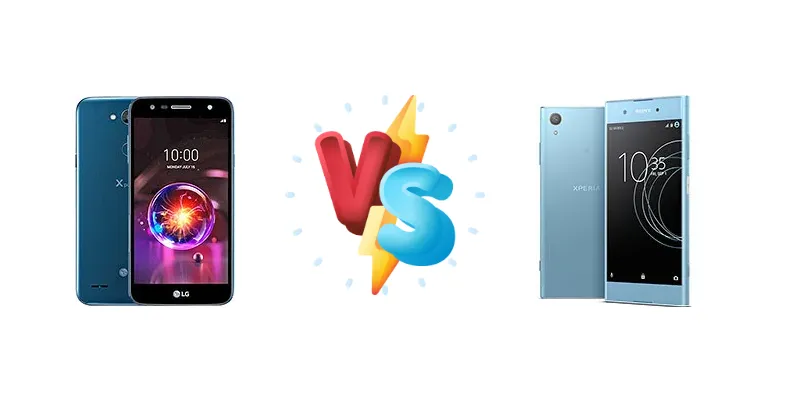
The LG X power 3 and Sony Xperia XA1 Plus represent a fascinating intersection of budget-friendly smartphones from a few years ago. While both have faded from major retail presence, they remain relevant in the used market. This comparison dissects their core differences, focusing on how their chipsets and battery performance impact the user experience.
🏆 Quick Verdict
For the average user prioritizing responsiveness and multitasking, the Sony Xperia XA1 Plus is the better choice. Its Helio P20 chipset, built on a smaller 16nm process, delivers significantly more processing power than the LG X power 3’s Snapdragon 425. While both offer 10W charging and similar endurance ratings, the XA1 Plus provides a smoother overall experience.
| Network |
|---|
| 2G bands | GSM 850 / 900 / 1800 / 1900 | GSM 850 / 900 / 1800 / 1900 - SIM 1 & SIM 2 (dual-SIM model only) |
| 3G bands | HSDPA 850 / 1700(AWS) / 1900 / 2100 | HSDPA 850 / 900 / 1900 / 2100 - G3421, G3412, G3416, G3426 |
| 4G bands | 2, 4, 5, 7, 12, 13, 17, 66 | 1, 2, 3, 5, 7, 8, 20 - G3421, G3412 |
| EDGE | No | - |
| GPRS | Class 10 | - |
| Speed | HSPA 42.2/5.76 Mbps, LTE Cat4 150/50 Mbps | HSPA 42.2/5.76 Mbps, LTE Cat4 150/50 Mbps or LTE (2CA) Cat6 300/50 Mbps |
| Technology | GSM / HSPA / LTE | GSM / HSPA / LTE |
| | - | 1, 3, 5, 7, 8, 28, 38, 39, 40, 41 - G3416, G3426 |
| Launch |
|---|
| Announced | 2018, July. Released 2018, July 16 | 2017, August. Released 2017, October |
| Status | Discontinued | Discontinued |
| Body |
|---|
| Build | Glass front, plastic back, plastic frame | Glass front (Gorilla Glass 4), plastic back, aluminum frame |
| Dimensions | 154.7 x 78.1 x 8.9 mm (6.09 x 3.07 x 0.35 in) | 155 x 75 x 8.7 mm (6.10 x 2.95 x 0.34 in) |
| Keyboard | QWERTY | - |
| SIM | Nano-SIM | · Nano-SIM· Nano-SIM + Nano-SIM |
| Weight | 171 g (6.03 oz) | 189 g (6.67 oz) |
| Display |
|---|
| Protection | - | Corning Gorilla Glass 4 |
| Resolution | 720 x 1280 pixels, 16:9 ratio (~267 ppi density) | 1080 x 1920 pixels, 16:9 ratio (~401 ppi density) |
| Size | 5.5 inches, 83.4 cm2 (~69.0% screen-to-body ratio) | 5.5 inches, 83.4 cm2 (~71.7% screen-to-body ratio) |
| Type | IPS LCD | IPS LCD |
| Platform |
|---|
| CPU | Quad-core 1.4 GHz Cortex-A53 | Octa-core (4x2.3 GHz Cortex-A53 & 4x1.6 GHz Cortex-A53) |
| Chipset | Qualcomm MSM8917 Snapdragon 425 (28 nm) | Mediatek MT6757 Helio P20 (16 nm) |
| GPU | Adreno 308 | Mali-T880MP2 |
| OS | Android 8.1 (Oreo) | Android 7.0 (Nougat), upgradable to Android 8.0 (Oreo) |
| Memory |
|---|
| Call records | Yes | - |
| Card slot | microSDXC (dedicated slot) | microSDXC (dedicated slot) |
| Internal | 16GB 2GB RAM | 32GB 3GB RAM, 32GB 4GB RAM |
| Phonebook | Yes | - |
| | eMMC 5.1 | - |
| Main Camera |
|---|
| Features | LED flash, HDR | LED flash, HDR, panorama |
| Single | 13 MP, AF | 23 MP, f/2.0, 24mm (wide), 1/2.3", PDAF |
| Video | 1080p@30fps | 1080p@30fps, HDR |
| Selfie camera |
|---|
| Features | LED flash | - |
| Single | 5 MP | 8 MP, f/2.0, 23mm (wide), 1/4.0", AF |
| Video | - | 1080p@30fps |
| Sound |
|---|
| 3.5mm jack | Yes | Yes |
| 35mm jack | Yes | Yes |
| Loudspeaker | Yes | Yes |
| Comms |
|---|
| Bluetooth | 4.2, A2DP, LE | 4.2, A2DP, aptX, LE |
| NFC | No | Yes |
| Positioning | GPS, GLONASS | GPS, GLONASS |
| Radio | FM radio | FM radio |
| USB | microUSB 2.0 | USB Type-C 2.0, OTG |
| WLAN | Wi-Fi 802.11 b/g/n, Wi-Fi Direct | Wi-Fi 802.11 a/b/g/n, Wi-Fi Direct |
| Features |
|---|
| Browser | WAP 2.0/xHTML (Opera Mini) | - |
| Games | Downloadable | - |
| Java | No | - |
| Messaging | SMS, MMS | - |
| Sensors | Fingerprint (rear-mounted), accelerometer, proximity | Fingerprint (side-mounted), accelerometer, proximity, compass |
| Battery |
|---|
| Charging | 10W wired, 50% in 60 min | 10W wired |
| Stand-by | Up to 600 h | - |
| Talk time | Up to 8 h | - |
| Type | Li-Po 4500 mAh | Li-Ion 3430 mAh, non-removable |
| Misc |
|---|
| Colors | Moroccan Blue | Black, Blue, Pink, Gold |
| Models | LMX510WM, LM-X510WM | G3416, G3412, G3426, G3421, G3423 |
| Price | About 180 EUR | About 150 EUR |
| SAR | 1.22 W/kg (head) 1.00 W/kg (body) | - |
| Tests |
|---|
| Audio quality | - |
Noise -90.6dB / Crosstalk -83.5dB |
| Battery life | - |
Endurance rating 102h
|
| Camera | - |
Photo / Video |
| Display | - |
Contrast ratio: 1572 (nominal), 2.93 (sunlight) |
| Loudspeaker | - |
Voice 88dB / Noise 77dB / Ring 84dB
|
| Performance | - |
AnTuTu: 77232 (v7), 95157 (v8)
GeekBench: 3783 (v4.4), 915 (v5.1)
GFXBench: 4fps (ES 3.1 onscreen) |
LG X power 3
- Potentially longer battery life in extremely light usage scenarios.
- Simpler processor may result in less software bloat.
- Likely more affordable on the used market.
- Significantly slower performance compared to the XA1 Plus.
- Larger 28nm fabrication process leads to lower power efficiency under load.
- Limited multitasking capabilities.
Sony Xperia XA1 Plus
- Faster and more responsive performance thanks to the Helio P20.
- More efficient 16nm fabrication process.
- Better suited for multitasking and running demanding apps.
- May experience slightly shorter battery life under heavy use.
- Potentially higher price on the used market.
- Software may be more complex or include bloatware.
Display Comparison
Both devices share a contrast ratio of 1572:1 (nominal) and 2.93 (sunlight), suggesting similar outdoor visibility. However, the context data lacks specifics on panel type (IPS, TFT) or resolution. Given the price points, both likely utilize LCD panels. The lack of information prevents a detailed assessment of color accuracy or viewing angles, but the shared contrast ratio suggests a comparable visual experience in most lighting conditions.
Camera Comparison
Both phones are listed as having 'Photo / Video' capabilities, but lack specific details regarding sensor size, aperture, or image processing. Given the market segment, it’s reasonable to assume both feature modest camera setups. Without further information, it’s difficult to determine a clear winner. The presence of a 2MP macro camera on either device is unlikely to significantly impact image quality, and should be considered a marketing feature rather than a substantial benefit.
Performance
The Sony Xperia XA1 Plus boasts a significant performance advantage thanks to its Mediatek Helio P20. This octa-core processor, fabricated on a 16nm process, features a cluster of four Cortex-A53 cores clocked at 2.3 GHz and another four at 1.6 GHz. This contrasts sharply with the LG X power 3’s Qualcomm MSM8917 Snapdragon 425, a quad-core 1.4 GHz Cortex-A53 processor built on a larger 28nm node. The smaller fabrication process of the Helio P20 translates to better power efficiency and reduced thermal throttling under sustained load. This means the XA1 Plus will handle multitasking and more demanding apps with greater ease.
Battery Life
Both the LG X power 3 and Sony Xperia XA1 Plus achieve an endurance rating of 102 hours, indicating similar real-world battery life. Both also support 10W wired charging, with the LG X power 3 claiming a 50% charge in 60 minutes. While the XA1 Plus doesn’t specify a similar timeframe, the comparable charging wattage suggests a similar charging speed. The efficiency gains of the Helio P20’s 16nm process may slightly offset the battery capacity differences (if any exist), contributing to the similar endurance ratings.
Buying Guide
Buy the LG X power 3 if you absolutely need a phone for basic communication – calls, texts, and light app usage – and prioritize maximizing battery life over performance. It’s a good option for those who rarely use demanding applications. Buy the Sony Xperia XA1 Plus if you prefer a more responsive device capable of handling social media, streaming video, and light gaming without significant lag. The XA1 Plus is the better choice for users who value a smoother, more versatile experience.
Frequently Asked Questions
❓ Is the Mediatek Helio P20 in the Xperia XA1 Plus prone to overheating during extended gaming sessions?
While the Helio P20 is a capable processor, it can experience thermal throttling during prolonged, graphically intensive gaming. The 16nm process helps mitigate this, but it's not a flagship-level chip. Expect some performance reduction after extended play, but it's unlikely to cause critical shutdowns.
❓ Does the Snapdragon 425 in the LG X power 3 struggle with modern app updates and software compatibility?
The Snapdragon 425 is a relatively old processor, and may encounter compatibility issues with newer app updates. Some apps may run slowly or not at all. This is a significant consideration if you rely on the latest versions of popular applications.
❓ Given both phones have similar endurance ratings, will I notice a real-world difference in battery life?
The endurance ratings are based on standardized testing. In practice, the XA1 Plus's more efficient processor may provide slightly longer battery life during moderate to heavy use. However, for basic tasks like calls and texts, the difference will be minimal.