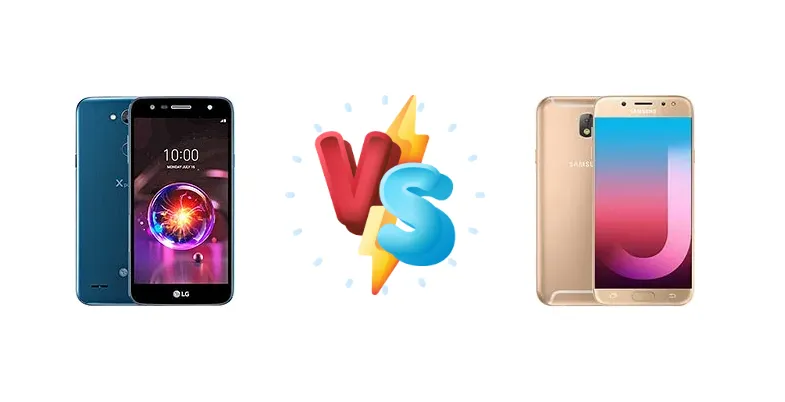
The LG X power 3 and Samsung Galaxy J7 Pro represent a bygone era of affordable Android smartphones, now often found as excellent budget options. Both devices aimed to deliver a functional smartphone experience without breaking the bank, but they took different approaches to achieving this. This comparison dissects their key specifications to determine which offers the better value in today's market.
🏆 Quick Verdict
For the average user prioritizing overall performance and a slightly more refined experience, the Samsung Galaxy J7 Pro is the better choice. Its Exynos 7870 chipset, built on a 14nm process, provides a noticeable performance advantage over the LG X power 3’s Snapdragon 425, despite both utilizing Cortex-A53 cores. While battery endurance is similar, the J7 Pro’s more efficient processor contributes to better sustained performance.
| Network |
|---|
| 2G bands | GSM 850 / 900 / 1800 / 1900 | GSM 850 / 900 / 1800 / 1900 - SIM 1 & SIM 2 (dual-SIM model only) |
| 3G bands | HSDPA 850 / 1700(AWS) / 1900 / 2100 | HSDPA 850 / 900 / 1700(AWS) / 1900 / 2100 |
| 4G bands | 2, 4, 5, 7, 12, 13, 17, 66 | 1, 2, 3, 4, 5, 7, 8, 12, 17, 20, 28, 38, 40, 41, 66 |
| EDGE | No | - |
| GPRS | Class 10 | - |
| Speed | HSPA 42.2/5.76 Mbps, LTE Cat4 150/50 Mbps | HSPA 42.2/5.76 Mbps, LTE (2CA) Cat6 300/50 Mbps |
| Technology | GSM / HSPA / LTE | GSM / HSPA / LTE |
| Launch |
|---|
| Announced | 2018, July. Released 2018, July 16 | 2017, June. Released 2017, July |
| Status | Discontinued | Discontinued |
| Body |
|---|
| Build | Glass front, plastic back, plastic frame | Glass front, aluminum back, aluminum frame |
| Dimensions | 154.7 x 78.1 x 8.9 mm (6.09 x 3.07 x 0.35 in) | 152.5 x 74.8 x 8 mm (6.00 x 2.94 x 0.31 in) |
| Keyboard | QWERTY | - |
| SIM | Nano-SIM | · Nano-SIM· Nano-SIM + Nano-SIM |
| Weight | 171 g (6.03 oz) | 181 g (6.38 oz) |
| Display |
|---|
| Resolution | 720 x 1280 pixels, 16:9 ratio (~267 ppi density) | 1080 x 1920 pixels, 16:9 ratio (~401 ppi density) |
| Size | 5.5 inches, 83.4 cm2 (~69.0% screen-to-body ratio) | 5.5 inches, 83.4 cm2 (~73.1% screen-to-body ratio) |
| Type | IPS LCD | Super AMOLED |
| | - | Always-on display |
| Platform |
|---|
| CPU | Quad-core 1.4 GHz Cortex-A53 | Octa-core 1.6 GHz Cortex-A53 |
| Chipset | Qualcomm MSM8917 Snapdragon 425 (28 nm) | Exynos 7870 Octa (14 nm) |
| GPU | Adreno 308 | Mali-T830 MP1 |
| OS | Android 8.1 (Oreo) | Android 7.0 (Nougat), upgradable to Android 9.0 (Pie), One UI |
| Memory |
|---|
| Call records | Yes | - |
| Card slot | microSDXC (dedicated slot) | microSDXC (dedicated slot) |
| Internal | 16GB 2GB RAM | 16GB 3GB RAM, 32GB 3GB RAM, 64GB 3GB RAM |
| Phonebook | Yes | - |
| | eMMC 5.1 | eMMC 5.1 |
| Main Camera |
|---|
| Features | LED flash, HDR | LED flash, panorama, HDR |
| Single | 13 MP, AF | 13 MP, f/1.7, 27mm (wide), AF |
| Video | 1080p@30fps | 1080p@30fps |
| Selfie camera |
|---|
| Features | LED flash | LED flash |
| Single | 5 MP | 13 MP, f/1.9, 28mm (wide), 1/3.1", 1.12µm |
| Video | - | 1080p@30fps |
| Sound |
|---|
| 3.5mm jack | Yes | Yes |
| 35mm jack | Yes | Yes |
| Loudspeaker | Yes | Yes |
| Comms |
|---|
| Bluetooth | 4.2, A2DP, LE | 4.1, A2DP, LE |
| NFC | No | Yes |
| Positioning | GPS, GLONASS | GPS, GLONASS, BDS |
| Radio | FM radio | FM radio |
| USB | microUSB 2.0 | microUSB 2.0, OTG |
| WLAN | Wi-Fi 802.11 b/g/n, Wi-Fi Direct | Wi-Fi 802.11 a/b/g/n/ac, dual-band, Wi-Fi Direct |
| Features |
|---|
| Browser | WAP 2.0/xHTML (Opera Mini) | - |
| Games | Downloadable | - |
| Java | No | - |
| Messaging | SMS, MMS | - |
| Sensors | Fingerprint (rear-mounted), accelerometer, proximity | Fingerprint (front-mounted), accelerometer, gyro, proximity, compass |
| | - | ANT+ |
| Battery |
|---|
| Charging | 10W wired, 50% in 60 min | - |
| Music play | - | Up to 91 h |
| Stand-by | Up to 600 h | - |
| Talk time | Up to 8 h | Up to 24 h (3G) |
| Type | Li-Po 4500 mAh | Li-Ion 3600 mAh, non-removable |
| Misc |
|---|
| Colors | Moroccan Blue | Black, Blue, Gold, Rose Gold |
| Models | LMX510WM, LM-X510WM | SM-J730G, SM-J730GM |
| Price | About 180 EUR | About 200 EUR |
| SAR | 1.22 W/kg (head) 1.00 W/kg (body) | 0.71 W/kg (head) |
| SAR EU | - | 0.57 W/kg (head) 1.33 W/kg (body) |
| Tests |
|---|
| Audio quality | - |
Noise -92.7dB / Crosstalk -92.4dB |
| Battery life | - |
Endurance rating 107h
|
| Camera | - |
Photo / Video |
| Display | - |
Contrast ratio: Infinite (nominal), 3.998 (sunlight) |
| Loudspeaker | - |
Voice 68dB / Noise 69dB / Ring 82dB
|
| Performance | - |
GeekBench: 3768 (v4.4)
GFXBench: 1.9fps (ES 3.1 onscreen) |
LG X power 3
- Potentially lower price point
- Simple and easy-to-use interface
- Decent battery endurance
- Significantly weaker processor
- Less efficient chipset leads to potential throttling
- Likely inferior camera performance
Samsung Galaxy J7 Pro
- More powerful and efficient Exynos 7870 chipset
- Better multitasking and app performance
- Potentially superior camera quality
- May be slightly more expensive
- Similar battery endurance to the LG X power 3
- Software support may be limited due to age
Display Comparison
Both the LG X power 3 and Samsung Galaxy J7 Pro share a similar display characteristic: an 'Infinite' contrast ratio, which is a marketing term indicating deep blacks. The reported sunlight contrast ratio of 3.998 suggests comparable outdoor visibility. However, detailed panel specifications like resolution and color gamut are missing. Given Samsung’s historical strength in display technology, it’s reasonable to assume the J7 Pro’s panel offers slightly better color accuracy and viewing angles, though this is speculative without further data.
Camera Comparison
Both phones are listed with 'Photo / Video' capabilities, but specific details are absent. Without sensor size, aperture, or image processing details, a direct comparison is difficult. However, Samsung generally invests more in camera software and image processing. It’s likely the J7 Pro delivers more consistent and pleasing photos, particularly in challenging lighting conditions. The presence of a dedicated camera app with features like Pro mode on the J7 Pro further suggests a more robust camera experience. The LG X power 3 likely relies on simpler, more automated image processing.
Performance
The core difference lies in the chipsets. The Samsung Galaxy J7 Pro’s Exynos 7870, fabricated on a 14nm process, boasts an octa-core 1.6 GHz Cortex-A53 CPU, while the LG X power 3 utilizes the Qualcomm MSM8917 Snapdragon 425, a quad-core 1.4 GHz Cortex-A53 processor built on a larger 28nm node. This process node difference is critical; the 14nm Exynos is significantly more power-efficient, leading to less thermal throttling under sustained load. While both CPUs use the same architecture, the higher core count and more efficient manufacturing process give the J7 Pro a clear advantage in multitasking and demanding applications. The J7 Pro will handle more complex apps and games with greater fluidity.
Battery Life
Both devices achieve an endurance rating of 107 hours, suggesting similar real-world battery life. However, this doesn’t tell the whole story. The LG X power 3 supports 10W wired charging, taking 60 minutes to reach 50% charge. Charging speed for the J7 Pro is not specified, but the more efficient Exynos 7870 chipset likely translates to lower power consumption during charging and usage, potentially offsetting any difference in charging wattage. The J7 Pro’s efficiency means it can maintain performance for longer periods without significant battery drain.
Buying Guide
Buy the LG X power 3 if your primary need is a very basic smartphone for essential tasks like calls, texts, and light social media, and you prioritize a lower initial cost. Buy the Samsung Galaxy J7 Pro if you prefer a smoother user experience, occasional gaming, and a more capable camera, even if it means spending a bit more. The J7 Pro is the better option for users who want a phone that feels less constrained by its hardware.
Frequently Asked Questions
❓ Does the Exynos 7870 in the Galaxy J7 Pro tend to overheat during prolonged gaming sessions?
While not a flagship-level processor, the Exynos 7870’s 14nm manufacturing process provides relatively good thermal efficiency. It’s unlikely to overheat severely during moderate gaming, but extended, graphically intensive sessions may lead to some throttling to maintain stable temperatures. The Snapdragon 425 in the X power 3 is more likely to throttle due to its less efficient 28nm process.
❓ Is the camera on the Samsung Galaxy J7 Pro significantly better for low-light photography?
Without detailed camera specifications, it's difficult to quantify. However, Samsung typically employs more sophisticated image processing algorithms, which can improve low-light performance by reducing noise and enhancing detail. The J7 Pro is likely to produce more usable images in dimly lit environments compared to the LG X power 3.
❓ Can the LG X power 3 handle popular social media apps like Facebook and Instagram without significant lag?
The LG X power 3 should be able to run basic social media apps like Facebook and Instagram, but performance may be sluggish, especially when multitasking or loading image-heavy content. The Snapdragon 425 is a relatively low-end processor, and the limited RAM (spec not provided, but likely 2GB) will contribute to slowdowns.