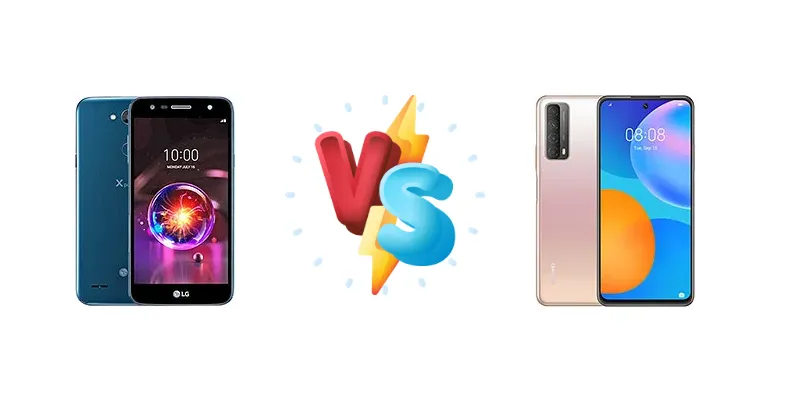
The LG X power 3 and Huawei P smart 2021 represent distinct approaches to the budget smartphone market. The LG prioritizes longevity with a large battery, while the Huawei aims for a more balanced experience with a more modern chipset and faster charging. This comparison dissects their key differences to help you choose the right device for your needs.
🏆 Quick Verdict
For most users, the Huawei P smart 2021 is the better choice. Its Kirin 710A chipset delivers significantly improved performance over the LG X power 3’s Snapdragon 425, and the 22.5W charging is a substantial upgrade. While both offer similar battery endurance ratings, the Huawei’s faster charging and overall responsiveness make it the more compelling option.
| Network |
|---|
| 2G bands | GSM 850 / 900 / 1800 / 1900 | GSM 900 / 1800 / 1900 |
| 3G bands | HSDPA 850 / 1700(AWS) / 1900 / 2100 | HSDPA 850 / 900 / 1700(AWS) / 1900 / 2100 |
| 4G bands | 2, 4, 5, 7, 12, 13, 17, 66 | 1, 3, 5, 7, 8, 20, 28, 38, 40, 41 |
| EDGE | No | - |
| GPRS | Class 10 | - |
| Speed | HSPA 42.2/5.76 Mbps, LTE Cat4 150/50 Mbps | HSPA, LTE |
| Technology | GSM / HSPA / LTE | GSM / HSPA / LTE |
| Launch |
|---|
| Announced | 2018, July. Released 2018, July 16 | 2020, September 28. Released 2020, September 28 |
| Status | Discontinued | Discontinued |
| Body |
|---|
| Build | Glass front, plastic back, plastic frame | - |
| Dimensions | 154.7 x 78.1 x 8.9 mm (6.09 x 3.07 x 0.35 in) | 165.7 x 76.9 x 9.3 mm (6.52 x 3.03 x 0.37 in) |
| Keyboard | QWERTY | - |
| SIM | Nano-SIM | Nano-SIM + Nano-SIM |
| Weight | 171 g (6.03 oz) | 206 g (7.27 oz) |
| Display |
|---|
| Resolution | 720 x 1280 pixels, 16:9 ratio (~267 ppi density) | 1080 x 2400 pixels, 20:9 ratio (~395 ppi density) |
| Size | 5.5 inches, 83.4 cm2 (~69.0% screen-to-body ratio) | 6.67 inches, 107.4 cm2 (~84.3% screen-to-body ratio) |
| Type | IPS LCD | IPS LCD |
| Platform |
|---|
| CPU | Quad-core 1.4 GHz Cortex-A53 | Octa-core (4x2.0 GHz Cortex-A73 & 4x1.7 GHz Cortex-A53) |
| Chipset | Qualcomm MSM8917 Snapdragon 425 (28 nm) | Kirin 710A (14 nm) |
| GPU | Adreno 308 | Mali-G51 MP4 |
| OS | Android 8.1 (Oreo) | Android 10, EMUI 10.1, no Google Play Services |
| Memory |
|---|
| Call records | Yes | - |
| Card slot | microSDXC (dedicated slot) | microSDXC (dedicated slot) |
| Internal | 16GB 2GB RAM | 64GB 4GB RAM, 128GB 4GB RAM |
| Phonebook | Yes | - |
| | eMMC 5.1 | - |
| Main Camera |
|---|
| Features | LED flash, HDR | LED flash, HDR, panorama |
| Quad | - | 48 MP, f/1.8, 26mm (wide), 1/2.0", 0.8µm, PDAF
8 MP, f/2.4, 120˚ (ultrawide), 1/4.0", 1.12µm
2 MP (macro)
Auxiliary lens |
| Single | 13 MP, AF | - |
| Video | 1080p@30fps | 1080p@30/60fps |
| Selfie camera |
|---|
| Features | LED flash | HDR |
| Single | 5 MP | 8 MP, f/2.0, (wide) |
| Video | - | 1080p@30fps |
| Sound |
|---|
| 3.5mm jack | Yes | Yes |
| 35mm jack | Yes | Yes |
| Loudspeaker | Yes | Yes |
| Comms |
|---|
| Bluetooth | 4.2, A2DP, LE | 5.1, A2DP, LE |
| NFC | No | No |
| Positioning | GPS, GLONASS | GPS, GLONASS, BDS |
| Radio | FM radio | FM radio, built-in antenna |
| USB | microUSB 2.0 | USB Type-C 2.0, OTG |
| WLAN | Wi-Fi 802.11 b/g/n, Wi-Fi Direct | Wi-Fi 802.11 b/g/n, Wi-Fi Direct |
| Features |
|---|
| Browser | WAP 2.0/xHTML (Opera Mini) | - |
| Games | Downloadable | - |
| Java | No | - |
| Messaging | SMS, MMS | - |
| Sensors | Fingerprint (rear-mounted), accelerometer, proximity | Fingerprint (side-mounted), accelerometer, proximity, compass |
| Battery |
|---|
| Charging | 10W wired, 50% in 60 min | 22.5W wired, 46% in 30 min |
| Stand-by | Up to 600 h | - |
| Talk time | Up to 8 h | - |
| Type | Li-Po 4500 mAh | Li-Po 5000 mAh |
| Misc |
|---|
| Colors | Moroccan Blue | Crush Green, Blush Gold, Midnight Black |
| Models | LMX510WM, LM-X510WM | PPA-LX1, PPA-LX2 |
| Price | About 180 EUR | About 230 EUR |
| SAR | 1.22 W/kg (head) 1.00 W/kg (body) | - |
| Tests |
|---|
| Battery life | - | Endurance rating 119h |
| Camera | - |
Photo / Video |
| Display | - |
Contrast ratio: 1252:1 (nominal) |
| Loudspeaker | - |
-28.8 LUFS (Average) |
| Performance | - |
AnTuTu: 169253 (v8)
GeekBench: 1334 (v5.1)
GFXBench: 7fps (ES 3.1 onscreen) |
LG X power 3
- Potentially longer standby time due to simpler chipset.
- May be more affordable depending on current pricing.
- Focus on core functionality for basic users.
- Significantly slower performance compared to the Huawei.
- Slow 10W charging.
- Limited display specifications.
Huawei P smart 2021
- Faster and more responsive performance with the Kirin 710A.
- Significantly faster 22.5W charging.
- Brighter display for better outdoor visibility.
- May have slightly shorter battery life under heavy use due to more powerful chipset.
- Potentially higher price point.
- Software experience may vary depending on region.
Display Comparison
The Huawei P smart 2021 boasts a noticeably brighter display, reaching 442 nits compared to an unspecified brightness for the LG X power 3. Both share a 1252:1 contrast ratio, suggesting similar color depth and black levels. However, the Huawei’s higher brightness translates to better visibility outdoors. The LG’s display specifications are limited, making a detailed comparison difficult, but the Huawei clearly has the edge in display quality.
Camera Comparison
Both devices feature 'Photo / Video' capabilities, but lack specific details. Without sensor size or aperture information, a direct comparison is impossible. However, given the Huawei P smart 2021’s positioning as a more feature-rich device, it’s reasonable to assume a more capable camera system. The LG X power 3 likely focuses on basic image capture, while the Huawei may offer features like scene recognition or improved low-light performance. The absence of detail makes this a difficult area to assess definitively.
Performance
The Kirin 710A in the Huawei P smart 2021 represents a significant leap in processing power over the Qualcomm Snapdragon 425 found in the LG X power 3. The Kirin 710A’s octa-core configuration (4x2.0 GHz Cortex-A73 & 4x1.7 GHz Cortex-A53) provides a substantial advantage in multi-tasking and app loading times compared to the LG’s quad-core 1.4 GHz Cortex-A53. Furthermore, the Kirin 710A is built on a 14nm process, offering better efficiency than the Snapdragon 425’s 28nm node, potentially leading to less heat generation under load.
Battery Life
Both the LG X power 3 and Huawei P smart 2021 achieve an endurance rating of 119 hours, suggesting comparable overall battery life. However, the charging speeds differ dramatically. The Huawei P smart 2021 supports 22.5W wired charging, achieving 46% charge in just 30 minutes, while the LG X power 3 is limited to 10W charging, taking 60 minutes to reach 50%. This faster charging capability gives the Huawei a significant advantage for users who need to quickly top up their battery.
Buying Guide
Buy the LG X power 3 if you absolutely prioritize maximizing battery life and are willing to sacrifice performance for it. This phone is ideal for users who primarily make calls, send texts, and occasionally browse the web. Buy the Huawei P smart 2021 if you want a more responsive and versatile smartphone experience, capable of handling social media, streaming video, and light gaming without significant lag. It’s the better choice for users who demand more from their device.
Frequently Asked Questions
❓ Is the Kirin 710A chipset in the Huawei P smart 2021 capable of running demanding games like PUBG Mobile?
While the Kirin 710A isn't a flagship-level processor, it's capable of running PUBG Mobile at medium settings with reasonable frame rates. Expect some occasional stuttering during intense firefights, but it's a playable experience. The LG X power 3’s Snapdragon 425 would struggle significantly with this title.
❓ How does the charging speed difference impact daily use between the LG X power 3 and Huawei P smart 2021?
The Huawei P smart 2021’s 22.5W charging is a game-changer. Getting 46% charge in 30 minutes means a quick top-up during a lunch break is sufficient to power through the afternoon. The LG X power 3’s 10W charging requires a much longer commitment to reach a similar charge level, making it less convenient for users on the go.
❓ Does the Huawei P smart 2021 support software updates and security patches?
Huawei’s software update situation has been complex. While the P smart 2021 launched with EMUI, it may not receive the same level of long-term support as some other brands. Check current software availability and Huawei’s update policy for your region before purchasing.