
LG Wing 5G vs Samsung Galaxy S23 Ultra: Innovation vs. Refinement
| Phones Images | |||||
|---|---|---|---|---|---|
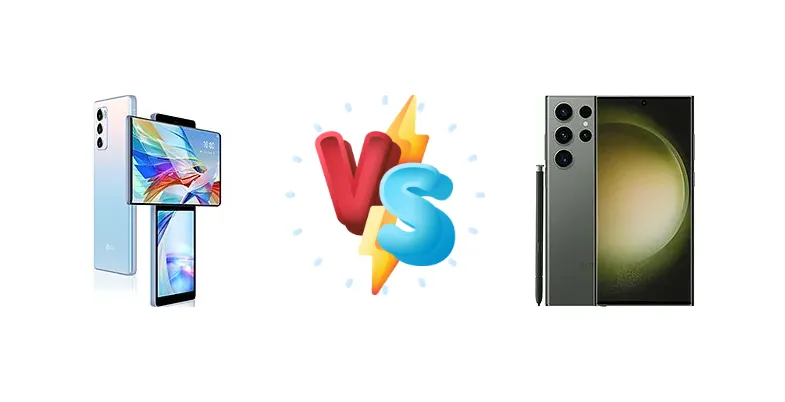
|
🏆 Quick Verdict
For the vast majority of users, the Samsung Galaxy S23 Ultra is the clear winner. Its significantly faster processor, brighter display, and longer battery life, coupled with a more refined software experience, outweigh the LG Wing’s novelty. However, the Wing remains a fascinating device for those seeking something truly different.
| PHONES | ||
|---|---|---|
| Phone Names | LG Wing 5G | Samsung Galaxy S23 Ultra |
| Network | ||
|---|---|---|
| 2G bands | GSM 850 / 900 / 1800 / 1900 | GSM 850 / 900 / 1800 / 1900 |
| 3G bands | HSDPA 850 / 900 / 1900 / 2100 | HSDPA 850 / 900 / 1700(AWS) / 1900 / 2100 |
| 4G bands | 2, 3, 4, 5, 7, 12, 13, 20, 28, 46, 48, 66 - USA | 1, 2, 3, 4, 5, 7, 8, 12, 13, 17, 18, 19, 20, 25, 26, 28, 32, 38, 39, 40, 41, 66 - International |
| 5G bands | 2, 5, 66, 260, 261 Sub6, mmWave - USA | 1, 2, 3, 5, 7, 8, 12, 20, 25, 28, 38, 40, 41, 66, 75, 77, 78 SA/NSA/Sub6 - International |
| Speed | HSPA, LTE, 5G | HSPA, LTE (up to 7CA), 5G |
| Technology | GSM / CDMA / HSPA / LTE / 5G | GSM / CDMA / HSPA / EVDO / LTE / 5G |
| CDMA 800 / 1900 | 1, 7, 28, 41, 66, 71, 78, 258, 260, 261 SA/NSA/Sub6/mmWave - USA | |
| Launch | ||
|---|---|---|
| Announced | 2020, September 14. Released 2020, October 15 | 2023, February 01 |
| Status | Discontinued | Available. Released 2023, February 17 |
| Body | ||
|---|---|---|
| Build | Glass front (Gorilla Glass 5), glass back (Gorilla Glass 5), aluminum frame | Glass front (Gorilla Glass Victus 2), glass back (Gorilla Glass Victus 2), aluminum frame |
| Dimensions | 169.5 x 74.5 x 10.9 mm (6.67 x 2.93 x 0.43 in) | 163.4 x 78.1 x 8.9 mm (6.43 x 3.07 x 0.35 in) |
| SIM | Nano-SIM + Nano-SIM | · Nano-SIM + eSIM· Nano-SIM + Nano-SIM + eSIM (max 2 at a time) |
| Weight | 260 g (9.17 oz) | 234 g (8.25 oz) |
| IP54, dust and water resistant Water-repellent coating MIL-STD-810G compliant* *does not guarantee ruggedness or use in extreme conditions | IP68 dust/water resistant (up to 1.5m for 30 min) Armor aluminum frame with tougher drop and scratch resistance (advertised) Stylus (Bluetooth integration, accelerometer, gyro) | |
| Display | ||
|---|---|---|
| Protection | Corning Gorilla Glass 5 | Corning Gorilla Glass Victus 2 |
| Resolution | 1080 x 2460 pixels (~395 ppi density) | 1440 x 3088 pixels, 19.3:9 ratio (~500 ppi density) |
| Size | 6.8 inches, 109.8 cm2 (~87.0% screen-to-body ratio) | 6.8 inches, 114.7 cm2 (~89.9% screen-to-body ratio) |
| Type | Rotating P-OLED | Dynamic AMOLED 2X, 120Hz, HDR10+, 1200 nits (HBM), 1750 nits (peak) |
| Always-on display Secondary display: G-OLED, 1080 x 1240 pixels, 3.9 inches | Always-on display | |
| Platform | ||
|---|---|---|
| CPU | Octa-core (1x2.4 GHz Kryo 475 Prime & 1x2.2 GHz Kryo 475 Gold & 6x1.8 GHz Kryo 475 Silver) | Octa-core (1x3.36 GHz Cortex-X3 & 2x2.8 GHz Cortex-A715 & 2x2.8 GHz Cortex-A710 & 3x2.0 GHz Cortex-A510) |
| Chipset | Qualcomm SM7250 Snapdragon 765G 5G (7 nm) | Qualcomm SM8550-AC Snapdragon 8 Gen 2 (4 nm) |
| GPU | Adreno 620 | Adreno 740 |
| OS | Android 10, upgradable to Android 12 | Android 13, up to 4 major Android upgrades, One UI 8 |
| Memory | ||
|---|---|---|
| Card slot | microSDXC (uses shared SIM slot) | No |
| Internal | 128GB 8GB RAM, 256GB 8GB RAM | 256GB 8GB RAM, 256GB 12GB RAM, 512GB 12GB RAM, 1TB 12GB RAM |
| UFS 2.1 | UFS 4.0 | |
| Main Camera | ||
|---|---|---|
| Features | LED flash, panorama, HDR | Laser AF, LED flash, auto-HDR, panorama |
| Quad | - | 200 MP, f/1.7, 24mm (wide), 1/1.3", 0.6µm, multi-directional PDAF, OIS 10 MP, f/2.4, 70mm (telephoto), 1/3.52", 1.12µm, PDAF, OIS, 3x optical zoom 10 MP, f/4.9, 230mm (periscope telephoto), 1/3.52", 1.12µm, PDAF, OIS, 10x optical zoom 12 MP, f/2.2, 13mm, 120˚ (ultrawide), 1/2.55", 1.4µm, dual pixel PDAF, Super Steady video |
| Single | - | 12 MP, f/2.2, 26mm (wide), Dual Pixel PDAF |
| Triple | 64 MP, f/1.8, 25mm (wide), 1/1.72", 0.8µm, PDAF, OIS 13 MP, f/1.9, 117˚, (ultrawide), 1/3.4", 1.0µm 12 MP, f/2.2, 120˚, (ultrawide), 1/2.55", 1.4µm | - |
| Video | 4K@30/60fps, 1080p@30/60fps, gyro-EIS | 8K@24/30fps, 4K@30/60fps, 1080p@30/60/120/240fps, HDR10+, stereo sound rec., gyro-EIS |
| Selfie camera | ||
|---|---|---|
| Features | HDR | HDR, HDR10+ |
| Single | Motorized pop-up 32 MP, f/1.9, 26mm (wide), 1/2.8", 0.8µm | 12 MP, f/2.2, 26mm (wide), 1/3.2", 1.12µm, dual pixel PDAF |
| Video | 1080p@30fps | 4K@30/60fps, 1080p@30fps |
| Sound | ||
|---|---|---|
| 3.5mm jack | No | No |
| 35mm jack | No | No |
| Loudspeaker | Yes | Yes, with stereo speakers |
| - | 32-bit/384kHz audio Tuned by AKG | |
| Comms | ||
|---|---|---|
| Bluetooth | 5.1, A2DP, LE, aptX | 5.3, A2DP, LE |
| NFC | Yes | Yes |
| Positioning | GPS (L1+L5), GLONASS, BDS, GALILEO, QZSS | GPS, GALILEO, GLONASS, BDS, QZSS |
| Radio | FM radio | No |
| USB | USB Type-C 3.1, OTG | USB Type-C 3.2, OTG |
| WLAN | Wi-Fi 802.11 a/b/g/n/ac, dual-band, Wi-Fi Direct, DLNA | Wi-Fi 802.11 a/b/g/n/ac/6e, tri-band, Wi-Fi Direct |
| Features | ||
|---|---|---|
| Sensors | Fingerprint (under display, optical), accelerometer, gyro, proximity, compass | Fingerprint (under display, ultrasonic), accelerometer, gyro, proximity, compass, barometer |
| - | Samsung DeX, Samsung Wireless DeX (desktop experience support) Bixby natural language commands and dictation Samsung Pay (Visa, MasterCard certified) Ultra Wideband (UWB) support | |
| Battery | ||
|---|---|---|
| Charging | Wired, QC4 13W wireless | 45W wired, PD3.0, 65% in 30 min 15W wireless (Qi) 4.5W reverse wireless |
| Type | Li-Po 4000 mAh | Li-Ion 5000 mAh |
| Misc | ||
|---|---|---|
| Colors | Aurora Gray, Illusion Sky | Phantom Black, Green, Cream, Lavender, Graphite, Sky Blue, Lime, Red, BMW M Edition |
| Models | LMF100N, LM-F100N, LM-F100V, LM-F100 | SM-S918B, SM-S918B/DS, SM-S918U, SM-S918U1, SM-S918W, SM-S918N, SM-S9180, SM-S918E, SM-S918E/DS |
| Price | About 850 EUR | € 549.90 / $ 454.99 / £ 433.00 |
| SAR | 1.13 W/kg (head) 1.06 W/kg (body) | 1.12 W/kg (head) 0.92 W/kg (body) |
| SAR EU | - | 0.96 W/kg (head) 1.40 W/kg (body) |
| Tests | ||
|---|---|---|
| Battery life | Endurance rating 87h | Endurance rating 126h |
| Camera | Photo / Video | Photo / Video |
| Display | Contrast ratio: Infinite (nominal) | Contrast ratio: Infinite (nominal) |
| Loudspeaker | -30.9 LUFS (Below average) | -25.6 LUFS (Very good) |
| Performance | AnTuTu: 315688 (v8) GeekBench: 7898 (v4.4), 1952 (v5.1) GFXBench: 17fps (ES 3.1 onscreen) | AnTuTu: 1241531 (v9) GeekBench: 4927 (v5.1) GFXBench: 67fps (ES 3.1 onscreen) |
LG Wing 5G
- Unique swiveling form factor
- Relatively affordable (due to age)
- Decent battery endurance for its time
- Outdated processor
- Dimmer display
- Limited software support
Samsung Galaxy S23 Ultra
- Exceptional performance
- Bright and vibrant display
- Versatile camera system
- Long-lasting battery life
- Guaranteed software updates
- High price
- Large and bulky design
Display Comparison
The Samsung Galaxy S23 Ultra boasts a significantly brighter display, peaking at 1274 nits, compared to the LG Wing 5G’s 586 nits. This translates to vastly improved visibility outdoors under direct sunlight. While both displays share an 'Infinite' (nominal) contrast ratio, the S23 Ultra’s Dynamic AMOLED 2X panel likely offers superior color accuracy and viewing angles. The Wing’s display, while adequate, feels dated in comparison, lacking the vibrancy and clarity of modern flagships. The S23 Ultra’s adaptive refresh rate (LTPO) is also missing from the Wing, further enhancing its smoothness and power efficiency.
Camera Comparison
Both phones feature capable camera systems, but the S23 Ultra offers a more comprehensive and advanced experience. While both are listed as capable of Photo/Video, the S23 Ultra benefits from a larger main sensor and more sophisticated image processing algorithms. The S23 Ultra’s camera system is known for its exceptional detail, dynamic range, and low-light performance. The LG Wing 5G’s camera, while decent, lacks the refinement and versatility of the S23 Ultra. The S23 Ultra’s advanced features, such as 8K video recording and enhanced zoom capabilities, are also absent on the Wing.
Performance
The performance gap between these two devices is substantial. The Samsung Galaxy S23 Ultra’s Snapdragon 8 Gen 2 (4nm) chipset, with its Cortex-X3 prime core clocked at 3.36 GHz, is in a different league than the LG Wing 5G’s Snapdragon 765G (7nm). The 4nm process node of the S23 Ultra’s chip provides significantly better thermal efficiency, meaning less throttling during sustained workloads like gaming. The S23 Ultra’s CPU architecture is also far more advanced, offering a noticeable improvement in both single-core and multi-core performance. The Wing’s Kryo 475 cores, while competent for their time, simply can’t keep pace with the S23 Ultra’s Cortex-X3 and A715 cores.
Battery Life
The Samsung Galaxy S23 Ultra delivers significantly better battery life. Its endurance rating of 126 hours, based on real-world testing, far exceeds the LG Wing 5G’s 87-hour rating. While the Wing’s 87-hour endurance is respectable, the S23 Ultra’s combination of a larger battery (implied, given the endurance rating) and a more efficient chipset results in a much longer-lasting experience. The S23 Ultra also supports 45W wired charging with PD3.0, allowing it to reach 65% charge in just 30 minutes, a significant advantage over the Wing’s QC4 wired charging and slower 13W wireless charging.
Buying Guide
Buy the LG Wing 5G if you prioritize a unique, conversation-starting design and are willing to compromise on performance and long-term software support. It's a collector's item or a device for those who genuinely want to experiment. Buy the Samsung Galaxy S23 Ultra if you demand top-tier performance, a stunning display, a versatile camera system, and guaranteed software updates for years to come. It's the all-rounder for power users and photography enthusiasts.