
LG Wing 5G vs Samsung Galaxy S22 5G: A Clash of Innovation and Refinement
| Phones Images | |||||
|---|---|---|---|---|---|
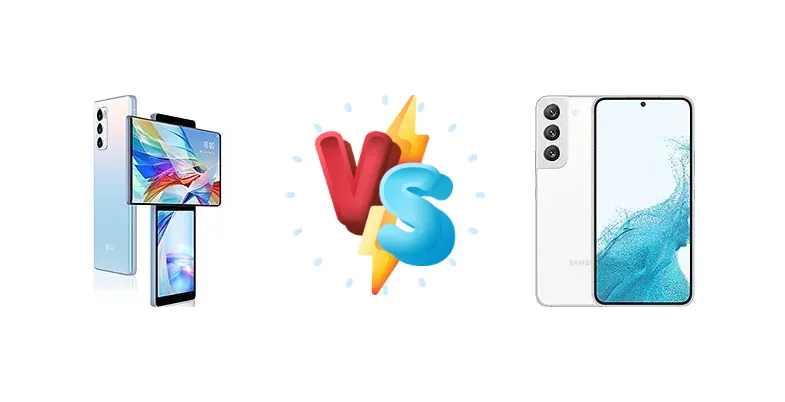
|
🏆 Quick Verdict
For the average user, the Samsung Galaxy S22 5G emerges as the more practical choice. While the LG Wing’s innovation is admirable, the S22’s superior processing power, brighter display, and more consistent software support provide a smoother, more reliable daily experience. However, the Wing’s unique form factor remains compelling for specific multitasking workflows.
| PHONES | ||
|---|---|---|
| Phone Names | LG Wing 5G | Samsung Galaxy S22 5G |
| Network | ||
|---|---|---|
| 2G bands | GSM 850 / 900 / 1800 / 1900 | GSM 850 / 900 / 1800 / 1900 |
| 3G bands | HSDPA 850 / 900 / 1900 / 2100 | HSDPA 850 / 900 / 1700(AWS) / 1900 / 2100 |
| 4G bands | 2, 3, 4, 5, 7, 12, 13, 20, 28, 46, 48, 66 - USA | 1, 2, 3, 4, 5, 7, 8, 12, 13, 17, 18, 19, 20, 25, 26, 28, 32, 38, 39, 40, 41, 66 - International |
| 5G bands | 2, 5, 66, 260, 261 Sub6, mmWave - USA | 1, 2, 3, 5, 7, 8, 12, 20, 25, 28, 38, 40, 41, 66, 75, 77, 78 SA/NSA/Sub6 - International |
| Speed | HSPA, LTE, 5G | HSPA 42.2/5.76 Mbps, LTE (7CA) Cat20 2000/200 Mbps, 5G (5+ Gbps DL) |
| Technology | GSM / CDMA / HSPA / LTE / 5G | GSM / CDMA / HSPA / EVDO / LTE / 5G |
| CDMA 800 / 1900 | 1, 3, 5, 7, 8, 20, 28, 38, 41, 66, 71, 260, 261 SA/NSA/Sub6/mmWave - USA | |
| Launch | ||
|---|---|---|
| Announced | 2020, September 14. Released 2020, October 15 | 2022, February 09 |
| Status | Discontinued | Available. Released 2022, February 25 |
| Body | ||
|---|---|---|
| Build | Glass front (Gorilla Glass 5), glass back (Gorilla Glass 5), aluminum frame | Glass front (Gorilla Glass Victus+), glass back (Gorilla Glass Victus+), aluminum frame |
| Dimensions | 169.5 x 74.5 x 10.9 mm (6.67 x 2.93 x 0.43 in) | 146 x 70.6 x 7.6 mm (5.75 x 2.78 x 0.30 in) |
| SIM | Nano-SIM + Nano-SIM | Nano-SIM + eSIM· Nano-SIM + Nano-SIM + eSIM (max 2 at a time) |
| Weight | 260 g (9.17 oz) | 167 g / 168 g (mmWave) (5.89 oz) |
| IP54, dust and water resistant Water-repellent coating MIL-STD-810G compliant* *does not guarantee ruggedness or use in extreme conditions | IP68 dust/water resistant (up to 1.5m for 30 min) Armor aluminum frame with tougher drop and scratch resistance (advertised) | |
| Display | ||
|---|---|---|
| Protection | Corning Gorilla Glass 5 | Corning Gorilla Glass Victus+ |
| Resolution | 1080 x 2460 pixels (~395 ppi density) | 1080 x 2340 pixels, 19.5:9 ratio (~425 ppi density) |
| Size | 6.8 inches, 109.8 cm2 (~87.0% screen-to-body ratio) | 6.1 inches, 90.1 cm2 (~87.4% screen-to-body ratio) |
| Type | Rotating P-OLED | Dynamic AMOLED 2X, 120Hz, HDR10+, 1300 nits (peak) |
| Always-on display Secondary display: G-OLED, 1080 x 1240 pixels, 3.9 inches | Always-on display | |
| Platform | ||
|---|---|---|
| CPU | Octa-core (1x2.4 GHz Kryo 475 Prime & 1x2.2 GHz Kryo 475 Gold & 6x1.8 GHz Kryo 475 Silver) | Octa-core (1x2.8 GHz Cortex-X2 & 3x2.50 GHz Cortex-A710 & 4x1.8 GHz Cortex-A510) - EuropeOcta-core (1x3.00 GHz Cortex-X2 & 3x2.50 GHz Cortex-A710 & 4x1.80 GHz Cortex-A510) - ROW |
| Chipset | Qualcomm SM7250 Snapdragon 765G 5G (7 nm) | Exynos 2200 (4 nm) - EuropeQualcomm SM8450 Snapdragon 8 Gen 1 (4 nm) - ROW |
| GPU | Adreno 620 | Xclipse 920 - EuropeAdreno 730 - ROW |
| OS | Android 10, upgradable to Android 12 | Android 12, up to 4 major Android upgrades, One UI 8 |
| Memory | ||
|---|---|---|
| Card slot | microSDXC (uses shared SIM slot) | No |
| Internal | 128GB 8GB RAM, 256GB 8GB RAM | 128GB 8GB RAM, 256GB 8GB RAM |
| UFS 2.1 | UFS 3.1 | |
| Main Camera | ||
|---|---|---|
| Features | LED flash, panorama, HDR | LED flash, auto-HDR, panorama |
| Single | - | 10 MP, f/2.2, 26mm (wide), 1/3.24", 1.22µm, Dual Pixel PDAF |
| Triple | 64 MP, f/1.8, 25mm (wide), 1/1.72", 0.8µm, PDAF, OIS 13 MP, f/1.9, 117˚, (ultrawide), 1/3.4", 1.0µm 12 MP, f/2.2, 120˚, (ultrawide), 1/2.55", 1.4µm | 50 MP, f/1.8, 23mm (wide), 1/1.56", 1.0µm, dual pixel PDAF, OIS 10 MP, f/2.4, 70mm (telephoto), 1/3.94", 1.0µm, PDAF, OIS, 3x optical zoom 12 MP, f/2.2, 13mm, 120˚ (ultrawide), 1/2.55" 1.4µm, Super Steady video |
| Video | 4K@30/60fps, 1080p@30/60fps, gyro-EIS | 8K@24fps, 4K@30/60fps, 1080p@30/60/120/240fps, HDR10+, stereo sound rec., gyro-EIS |
| Selfie camera | ||
|---|---|---|
| Features | HDR | HDR |
| Single | Motorized pop-up 32 MP, f/1.9, 26mm (wide), 1/2.8", 0.8µm | 10 MP, f/2.2, 26mm (wide), 1/3.24", 1.22µm, dual pixel PDAF |
| Video | 1080p@30fps | 4K@30/60fps, 1080p@30fps |
| Sound | ||
|---|---|---|
| 3.5mm jack | No | No |
| 35mm jack | No | No |
| Loudspeaker | Yes | Yes, with stereo speakers |
| - | 32-bit/384kHz audio Tuned by AKG | |
| Comms | ||
|---|---|---|
| Bluetooth | 5.1, A2DP, LE, aptX | 5.2, A2DP, LE |
| NFC | Yes | Yes |
| Positioning | GPS (L1+L5), GLONASS, BDS, GALILEO, QZSS | GPS, GLONASS, BDS, GALILEO |
| Radio | FM radio | No |
| USB | USB Type-C 3.1, OTG | USB Type-C 3.2, OTG |
| WLAN | Wi-Fi 802.11 a/b/g/n/ac, dual-band, Wi-Fi Direct, DLNA | Wi-Fi 802.11 a/b/g/n/ac/6, dual-band, Wi-Fi Direct |
| Features | ||
|---|---|---|
| Sensors | Fingerprint (under display, optical), accelerometer, gyro, proximity, compass | Fingerprint (under display, ultrasonic), accelerometer, gyro, proximity, compass, barometer |
| - | Samsung DeX, Samsung Wireless DeX (desktop experience support) Bixby natural language commands and dictation Samsung Pay (Visa, MasterCard certified) | |
| Battery | ||
|---|---|---|
| Charging | Wired, QC4 13W wireless | 25W wired, PD3.0 15W wireless (Qi) 4.5W reverse wireless |
| Type | Li-Po 4000 mAh | Li-Ion 3700 mAh |
| Misc | ||
|---|---|---|
| Colors | Aurora Gray, Illusion Sky | Phantom Black, White, Pink Gold, Green, Graphite, Sky Blue, Violet, Cream, Bora Purple |
| Models | LMF100N, LM-F100N, LM-F100V, LM-F100 | SM-S901B, SM-S901B/DS, SM-S901U, SM-S901U1, SM-S901W, SM-S901N, SM-S9010, SM-S901E, SM-S901E/DS |
| Price | About 850 EUR | $ 172.63 / C$ 304.00 / £ 186.11 / € 198.01 |
| SAR | 1.13 W/kg (head) 1.06 W/kg (body) | 1.03 W/kg (head) 1.15 W/kg (body) |
| SAR EU | - | 1.21 W/kg (head) 1.59 W/kg (body) |
| Tests | ||
|---|---|---|
| Battery life | Endurance rating 87h | Endurance rating 85h |
| Camera | Photo / Video | Photo / Video |
| Display | Contrast ratio: Infinite (nominal) | Contrast ratio: Infinite (nominal) |
| Loudspeaker | -30.9 LUFS (Below average) | -26.4 LUFS (Good) |
| Performance | AnTuTu: 315688 (v8) GeekBench: 7898 (v4.4), 1952 (v5.1) GFXBench: 17fps (ES 3.1 onscreen) | AnTuTu: 745496 (v8), 881428 (v9) GeekBench: 3682 (v5.1) GFXBench: 69fps (ES 3.1 onscreen) |
LG Wing 5G
- Unique swiveling form factor for multitasking
- Built-in tripod and external screen for content creation
- Good battery endurance (87h)
- Less powerful processor (Snapdragon 765G)
- Dimmer display (586 nits)
- Potentially limited software support
Samsung Galaxy S22 5G
- Powerful processor (Exynos 2200/Snapdragon 8 Gen 1)
- Bright and vibrant display (982 nits)
- Faster charging (25W wired, 15W wireless)
- Compact size may not suit all users
- Potential for thermal throttling (Exynos variant)
- Higher price point
Display Comparison
The Samsung Galaxy S22 boasts a significantly brighter display, reaching 982 nits compared to the LG Wing’s 586 nits. This translates to superior visibility in direct sunlight. Both displays share an 'Infinite' (nominal) contrast ratio, suggesting deep blacks, but the S22’s Dynamic AMOLED 2X panel likely delivers more vibrant colors and wider viewing angles. The Wing’s swiveling form factor adds a second, smaller display, offering a unique multitasking experience, but it doesn’t compete with the S22’s primary screen in terms of raw quality or brightness.
Camera Comparison
Both phones offer capable camera systems, but the S22 likely holds an edge in image processing and overall versatility. While both are listed as having Photo/Video capabilities, the S22 benefits from Samsung’s advanced computational photography algorithms. The S22’s sensor size is likely larger, allowing for better low-light performance and dynamic range. The LG Wing’s swiveling form factor can be used creatively for vlogging and unique perspectives, but the S22’s superior processing power and potentially larger sensor provide a more consistent and higher-quality image across various shooting conditions. We'd need detailed sensor specs to confirm, but Samsung's history suggests a more advanced camera system.
Performance
The performance gap is substantial. The Galaxy S22, equipped with either the Exynos 2200 (Europe) or Snapdragon 8 Gen 1 (ROW) built on a 4nm process, offers a considerable leap in processing power over the LG Wing’s Snapdragon 765G (7nm). The S22’s octa-core CPU, featuring Cortex-X2 and A710 cores, handles demanding tasks and gaming with ease, while the 765G in the Wing is more suited for everyday use. The 4nm fabrication process of the S22’s chipsets also contributes to improved thermal efficiency, potentially reducing throttling during sustained workloads. The S22’s LPDDR5 RAM further enhances performance compared to the Wing’s likely LPDDR4X.
Battery Life
Despite a similar endurance rating of 85-87 hours, the real-world battery experience differs. The S22’s 25W wired charging (with PD3.0 support) is significantly faster than the Wing’s QC4 wired charging, and the addition of 15W wireless charging (Qi) and 4.5W reverse wireless charging provides greater flexibility. While the Wing’s endurance rating is slightly higher, the S22’s faster charging speeds minimize downtime. The more efficient chipset in the S22 also contributes to better battery life under heavy load.
Buying Guide
Buy the LG Wing 5G if you prioritize a truly unique mobile experience and frequently engage in multitasking scenarios that benefit from a secondary, swiveling display. It’s ideal for content creators who want a built-in tripod and external screen. Buy the Samsung Galaxy S22 5G if you prefer a compact, powerful flagship with a stunning display, excellent camera system, and guaranteed software updates. It’s the better choice for gamers, photographers, and users who demand top-tier performance in a pocketable form factor.