
LG Wing 5G vs Samsung Galaxy Note20 Ultra: A Clash of Innovation and Productivity
| Phones Images | |||||
|---|---|---|---|---|---|
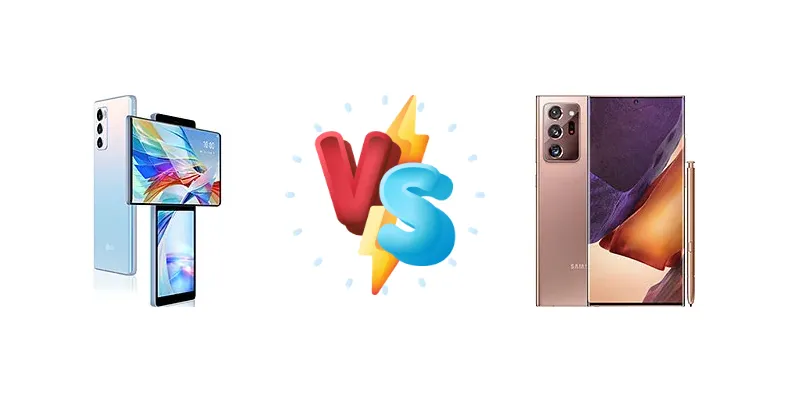
|
🏆 Quick Verdict
For the average user prioritizing productivity and a refined experience, the Samsung Galaxy Note20 Ultra 5G emerges as the stronger choice. Its brighter display, more powerful processor (particularly the Snapdragon variant), and integrated S Pen functionality outweigh the LG Wing 5G’s novelty swivel design. However, the Wing’s unique form factor and competitive battery life make it a compelling option for those seeking something different.
| PHONES | ||
|---|---|---|
| Phone Names | LG Wing 5G | Samsung Galaxy Note20 Ultra 5G |
| Network | ||
|---|---|---|
| 2G bands | GSM 850 / 900 / 1800 / 1900 | GSM 850 / 900 / 1800 / 1900 |
| 3G bands | HSDPA 850 / 900 / 1900 / 2100 | HSDPA 850 / 900 / 1700(AWS) / 1900 / 2100 |
| 4G bands | 2, 3, 4, 5, 7, 12, 13, 20, 28, 46, 48, 66 - USA | 1, 2, 3, 4, 5, 7, 8, 12, 13, 14, 18, 19, 20, 25, 26, 28, 29, 30, 38, 39, 40, 41, 46, 48, 66, 71 - SM-N986U |
| 5G bands | 2, 5, 66, 260, 261 Sub6, mmWave - USA | 2, 5, 41, 66, 71, 260, 261 SA/NSA/Sub6/mmWave - SM-N986U |
| Speed | HSPA, LTE, 5G | HSPA 42.2/5.76 Mbps, LTE (7CA) Cat20 2000/200 Mbps, 5G |
| Technology | GSM / CDMA / HSPA / LTE / 5G | GSM / CDMA / HSPA / EVDO / LTE / 5G |
| CDMA 800 / 1900 | 41, 66, 71 Sub6 - SM-N986W | |
| Launch | ||
|---|---|---|
| Announced | 2020, September 14. Released 2020, October 15 | 2020, August 05 |
| Status | Discontinued | Available. Released 2020, August 21 |
| Body | ||
|---|---|---|
| Build | Glass front (Gorilla Glass 5), glass back (Gorilla Glass 5), aluminum frame | Glass front (Gorilla Glass Victus), glass back (Gorilla Glass Victus), stainless steel frame |
| Dimensions | 169.5 x 74.5 x 10.9 mm (6.67 x 2.93 x 0.43 in) | 164.8 x 77.2 x 8.1 mm (6.49 x 3.04 x 0.32 in) |
| SIM | Nano-SIM + Nano-SIM | · Nano-SIM + eSIM· Nano-SIM + Nano-SIM |
| Weight | 260 g (9.17 oz) | 208 g (7.34 oz) |
| IP54, dust and water resistant Water-repellent coating MIL-STD-810G compliant* *does not guarantee ruggedness or use in extreme conditions | IP68 dust/water resistant (up to 1.5m for 30 min) Stylus, 9ms latency (Bluetooth integration, accelerometer, gyro) | |
| Display | ||
|---|---|---|
| Protection | Corning Gorilla Glass 5 | Corning Gorilla Glass Victus |
| Resolution | 1080 x 2460 pixels (~395 ppi density) | 1440 x 3088 pixels, 19.3:9 ratio (~496 ppi density) |
| Size | 6.8 inches, 109.8 cm2 (~87.0% screen-to-body ratio) | 6.9 inches, 116.7 cm2 (~91.7% screen-to-body ratio) |
| Type | Rotating P-OLED | Dynamic AMOLED 2X, 120Hz, HDR10+ |
| Always-on display Secondary display: G-OLED, 1080 x 1240 pixels, 3.9 inches | Always-on display 120Hz@FHD/60Hz@QHD refresh rate | |
| Platform | ||
|---|---|---|
| CPU | Octa-core (1x2.4 GHz Kryo 475 Prime & 1x2.2 GHz Kryo 475 Gold & 6x1.8 GHz Kryo 475 Silver) | Octa-core (2x2.73 GHz Mongoose M5 & 2x2.50 GHz Cortex-A76 & 4x2.0 GHz Cortex-A55) - GlobalOcta-core (1x3.0 GHz Kryo 585 & 3x2.42 GHz Cortex-A77 & 4x1.80 GHz Cortex-A55) - USA |
| Chipset | Qualcomm SM7250 Snapdragon 765G 5G (7 nm) | Exynos 990 (7 nm+) - GlobalQualcomm SM8250 Snapdragon 865 5G+ (7 nm+) - USA |
| GPU | Adreno 620 | Mali-G77 MP11 - GlobalAdreno 650 - USA |
| OS | Android 10, upgradable to Android 12 | Android 10, upgradable to Android 13, One UI 5 |
| Memory | ||
|---|---|---|
| Card slot | microSDXC (uses shared SIM slot) | microSDXC (uses shared SIM slot) |
| Internal | 128GB 8GB RAM, 256GB 8GB RAM | 128GB 6GB RAM, 128GB 8GB RAM, 128GB 12GB RAM, 256GB 8GB RAM, 256GB 12GB RAM, 512GB 12GB RAM |
| UFS 2.1 | UFS 3.0 | |
| Main Camera | ||
|---|---|---|
| Features | LED flash, panorama, HDR | Laser AF, LED flash, auto-HDR, panorama |
| Single | - | 3.15 MP |
| Triple | 64 MP, f/1.8, 25mm (wide), 1/1.72", 0.8µm, PDAF, OIS 13 MP, f/1.9, 117˚, (ultrawide), 1/3.4", 1.0µm 12 MP, f/2.2, 120˚, (ultrawide), 1/2.55", 1.4µm | 108 MP, f/1.8, 26mm (wide), 1/1.33", 0.8µm, PDAF, OIS 12 MP, f/3.0, 120mm (periscope telephoto), 1.0µm, PDAF, OIS, 5x optical zoom, 50x hybrid zoom 12 MP, f/2.2, 120˚, 13mm (ultrawide), 1/2.55", 1.4µm |
| Video | 4K@30/60fps, 1080p@30/60fps, gyro-EIS | 8K@24fps, 4K@30/60fps, 1080p@30/60/240fps, 720p@960fps, HDR10+, stereo sound rec., gyro-EIS & OIS |
| Selfie camera | ||
|---|---|---|
| Features | HDR | HDR |
| Single | Motorized pop-up 32 MP, f/1.9, 26mm (wide), 1/2.8", 0.8µm | 10 MP, f/2.2, 26mm (wide), 1/3.2", 1.22µm, dual pixel PDAF |
| Video | 1080p@30fps | 4K@30/60fps, 1080p@30fps |
| Sound | ||
|---|---|---|
| 3.5mm jack | No | No |
| 35mm jack | No | No |
| Loudspeaker | Yes | Yes, with stereo speakers |
| - | 32-bit/384kHz audio Tuned by AKG | |
| Comms | ||
|---|---|---|
| Bluetooth | 5.1, A2DP, LE, aptX | 5.0, A2DP, LE, aptX |
| NFC | Yes | Yes |
| Positioning | GPS (L1+L5), GLONASS, BDS, GALILEO, QZSS | GPS, GLONASS, BDS, GALILEO |
| Radio | FM radio | FM radio (Snapdragon model only; market/operator dependent) |
| USB | USB Type-C 3.1, OTG | USB Type-C 3.2, OTG |
| WLAN | Wi-Fi 802.11 a/b/g/n/ac, dual-band, Wi-Fi Direct, DLNA | Wi-Fi 802.11 a/b/g/n/ac/6, dual-band, Wi-Fi Direct |
| Features | ||
|---|---|---|
| Sensors | Fingerprint (under display, optical), accelerometer, gyro, proximity, compass | Fingerprint (under display, ultrasonic), accelerometer, gyro, proximity, compass, barometer |
| - | Samsung Wireless DeX (desktop experience support) ANT+ Bixby natural language commands and dictation Samsung Pay (Visa, MasterCard certified) Ultra Wideband (UWB) support | |
| Battery | ||
|---|---|---|
| Charging | Wired, QC4 13W wireless | 25W wired, PD3.0 15W wireless (Qi) 4.5W reverse wireless |
| Type | Li-Po 4000 mAh | Li-Ion 4500 mAh |
| Misc | ||
|---|---|---|
| Colors | Aurora Gray, Illusion Sky | Mystic Bronze, Mystic Black, Mystic White |
| Models | LMF100N, LM-F100N, LM-F100V, LM-F100 | SM-N986B, SM-N986B/DS, SM-N986U, SM-N986U1, SM-N986W, SM-N9860, SM-N986N, SC-53A |
| Price | About 850 EUR | € 381.00 / $ 248.44 |
| SAR | 1.13 W/kg (head) 1.06 W/kg (body) | 0.71 W/kg (head) 1.18 W/kg (body) |
| SAR EU | - | 0.34 W/kg (head) 1.47 W/kg (body) |
| Tests | ||
|---|---|---|
| Battery life | Endurance rating 87h | Endurance rating 88h |
| Camera | Photo / Video | Photo / Video |
| Display | Contrast ratio: Infinite (nominal) | Contrast ratio: Infinite (nominal) |
| Loudspeaker | -30.9 LUFS (Below average) | -27.8 LUFS (Good) |
| Performance | AnTuTu: 315688 (v8) GeekBench: 7898 (v4.4), 1952 (v5.1) GFXBench: 17fps (ES 3.1 onscreen) | AnTuTu: 508760 (v8) GeekBench: 2603 (v5.1) GFXBench: 42fps (ES 3.1 onscreen) |
LG Wing 5G
- Unique swivel form factor for multitasking
- Competitive battery life (87h endurance)
- More affordable price point in 2024
- Less powerful processor (Snapdragon 765G)
- Dimmer display compared to Note20 Ultra
- Less refined camera system
Samsung Galaxy Note20 Ultra 5G
- Brighter and more vibrant display (1024 nits)
- More powerful processor (Exynos 990/Snapdragon 865 5G+)
- Integrated S Pen for productivity
- Faster charging speeds (25W wired)
- Higher price (originally)
- Potential for Exynos overheating (Global variant)
- Larger and heavier design
Display Comparison
The Samsung Galaxy Note20 Ultra boasts a significantly brighter display, reaching a measured 1024 nits compared to the LG Wing’s 586 nits. This translates to superior visibility in direct sunlight. Both displays share an 'Infinite' (nominal) contrast ratio, suggesting deep blacks, but the Note20 Ultra’s higher peak brightness provides a more vibrant and engaging viewing experience. While the Wing’s swivel design adds a second screen, it doesn’t match the quality or usability of the Note20 Ultra’s primary panel. The Note20 Ultra’s larger screen real estate also benefits productivity tasks.
Camera Comparison
Both phones offer versatile camera systems, but the Note20 Ultra’s larger sensors and more advanced image processing give it an edge. While both capture photo and video, the Note20 Ultra’s ability to record 8K video and its superior low-light performance are significant advantages. The LG Wing 5G’s camera is competent, but it lacks the refinement and consistency of the Note20 Ultra’s system. The Note20 Ultra’s zoom capabilities are also superior, offering greater flexibility for capturing distant subjects. Ignoring the 2MP macro sensors on both devices, the main and ultrawide lenses are the key differentiators, favoring Samsung.
Performance
Performance is where the Note20 Ultra pulls ahead, though the specifics depend on the region. Global Note20 Ultra models utilize the Exynos 990, while US models receive the Qualcomm Snapdragon 865 5G+. Both are octa-core processors, but the Snapdragon 865 5G+ offers superior GPU performance and thermal management. The LG Wing 5G, powered by the Snapdragon 765G, is a capable mid-range chip, but it can’t compete with the Note20 Ultra’s processing power, especially in demanding tasks like video editing or gaming. The Note20 Ultra’s potential for faster LPDDR5 RAM further enhances its multitasking capabilities.
Battery Life
Battery endurance is surprisingly close, with the LG Wing 5G achieving an 87-hour rating and the Note20 Ultra scoring 88 hours. However, charging speeds differ significantly. The Note20 Ultra supports 25W wired charging with PD3.0, allowing for faster top-ups compared to the Wing’s QC4-compatible wired charging. The Note20 Ultra also offers 15W wireless charging (Qi) and 4.5W reverse wireless charging, features absent on the Wing. While the Wing’s battery life is respectable, the Note20 Ultra’s faster charging and additional wireless features provide greater convenience.
Buying Guide
Buy the LG Wing 5G if you crave a genuinely different smartphone experience and value a unique form factor for multitasking or content consumption. Its swivel screen offers a novel way to interact with apps, and its endurance rating is respectable. Buy the Samsung Galaxy Note20 Ultra 5G if you prioritize productivity, a superior display, and a more polished software experience. The S Pen integration, coupled with the powerful processor and excellent camera system, makes it ideal for professionals and power users.